Full Report
Figures converted from Swiss francs at historical FX rates - see data/company.json.fx_rates. Ratios, margins, and multiples are unitless and unchanged. Peer figures for Demant (DKK) and Amplifon (EUR) remain in their reporting currency because cross-rates are not available in this run; global market-size figures are already quoted in USD by the source.
Hearing Care: A Slow-Compounding Health Market Run by Five Manufacturers
Sonova makes hearing aids and cochlear implants and, increasingly, owns the shops that fit them. To understand the stock you first have to understand an unusual industry: a medical-device market with the demographics of a demographic megatrend but the adoption rate of a luxury good. More than 1.5 billion people worldwide live with some degree of hearing loss and over 400 million could benefit from a hearing aid, yet fewer than one in five of those who would benefit are actually treated [3] [4]. That single gap - huge need, low penetration - is the whole investment story: it is why the market grows through cycles, and why nobody has yet "won" it.
This tab builds the mental model an investor needs before reading the rest of the report: how big the pool is, who pays, how the five manufacturers compete, where new entrants (OTC devices, EssilorLuxottica, Apple) fit, and how to read the cycle Sonova is living through right now.
1. The industry in one screen
Global retail market (USD bn)
Manufacturer / wholesale market (USD bn)
People fitted per year (m)
Hearing aids sold per year (m)
Of those who'd benefit, share treated
Structural growth (value, p.a.)
Sources: Demant A/S Annual Report 2025 - roughly USD 7bn wholesale and USD 20bn retail value, ~13m people fitted with ~23m hearing aids in 2025, 4-6% long-term value growth [1] [2] [5]; treatment rate under 20% [3].
Two numbers frame everything. The wholesale market - what manufacturers like Sonova collect for the device itself - is only about USD 7 billion a year. The retail market - what the end consumer pays once you add the audiologist's fitting, tuning, and years of after-care - is roughly USD 20 billion [1]. The gap between those two figures is the reason every major manufacturer is buying retail chains: the fitting and service layer is where the larger, stickier profit pool sits. That single fact explains most of the industry's strategy.
2. A structural-growth market, temporarily off its trend
The demand engine is demographics plus penetration. Populations are aging, hearing loss rises with age, and adoption is low almost everywhere - so both the number of users and the value per user can climb for decades. Manufacturers converge on a 4-6% per-annum value growth rate as the long-run trend, combining modest unit growth with rising average selling prices [5] [34].
The clearest way to see the opportunity is adoption by severity and geography. Even in the richest markets, only about two-thirds of people with severe loss wear a device - and adoption collapses toward single digits for mild loss and in emerging markets.
Source: Sonova strategy update, March 2026 - adoption by geography and severity (North America and Western Europe vs. Japan, China, India, Korea, Brazil, Mexico) [6].
Every unfilled bar above is latent demand. That is why the industry treats the growth algorithm as additive: the underlying market contributes roughly 3-5 points of annual growth, share gains from innovation and geographic expansion another 1-3 points, and bolt-on retail M and A a further 1-2 points - the arithmetic behind Sonova's 5-10% medium-term sales-growth target [9] [31].
But 2025 was a reminder that this is still a cyclical consumer-health market, not a utility. A hearing aid is a largely discretionary, big-ticket, often out-of-pocket purchase, so demand tracks consumer confidence. Through 2025 the market grew "at a slower pace than normal," which the incumbents attribute to macroeconomic uncertainty rather than any structural break [7]. Sonova now guides to only 2-4% market growth in its 2026/27 year, improving back toward the 3-5% mid-term trend as confidence recovers [8]. Reading where the market sits inside that 2-to-5 band is the single most important cyclical judgment for the whole sector.
3. How the value chain works - and why manufacturers are becoming retailers
Newcomers are often surprised that "hearing aid company" describes two very different businesses stapled together. Understanding the four tiers below is the key to the economics.
Sources: Sonova describes itself as vertically integrated across Wholesale, Retail and Cochlear Implants [10]; wholesale is R and D-intensive while the retail market is mostly independently owned [11]; government channels and bundled pricing [12]; OTC in selected markets [12].
The wholesale business is a technology race: a handful of specialised firms compete on chips, algorithms and battery life, and market position is underpinned by heavy, sustained R and D [11]. The retail business is the opposite: highly fragmented, local, relationship-driven, with the majority of the world's hearing-aid clinics still independently owned [11]. That fragmentation is the prize. For over a decade the industry has consolidated distribution, with larger players buying smaller chains - and when a manufacturer buys a clinic it captures both margins and locks in a channel for its own devices [19]. This is why Sonova, Demant and others describe themselves as "vertically integrated": they design the aid, own the store, and increasingly own the customer relationship [10].
A fourth tier sits on top of the government channel and matters more than its size suggests: bulk institutional buyers. In the US, the Department of Veterans Affairs (VA) is one of the largest single hearing-aid buyers in the world, and share swings there move manufacturer results - Sonova's rechargeable custom device took roughly 60% of the VA in-the-ear segment, pushing its overall VA share to a five-year high [13]. The UK NHS plays a similar role in Europe [12].
4. The competitive arena: an oligopoly of five, plus one giant retailer
Globally, five manufacturers make the overwhelming majority of prescription hearing aids: Sonova (Phonak, Unitron), Demant (Oticon), WS Audiology (Widex + Signia), GN (ReSound) and Starkey. It is a classic technology oligopoly - high R and D, fresh silicon every two years, and share that shifts with the product cycle. Alongside them sits Amplifon, the one pure-play retailer large enough to matter, and Costco, whose warehouse channel is large enough that losing shelf space there dents a manufacturer's US numbers.
Sources: Sonova revenue converted to USD and reported EBIT margin from company financials (FY2024/25 sales ~$4,266m); Demant revenue DKK 22,971m and 17.2% EBIT margin before special items [16] [17]; Amplifon revenue EUR 2.4bn and 22.6% adjusted-EBITDA margin [15]. Margins are not strictly comparable (EBIT vs. adjusted EBITDA) and currencies differ; WS Audiology, GN and Starkey have no filing in the corpus.
The peer picture teaches three things. First, scale is similar at the top: Sonova (~$4.3bn) and Demant (DKK ~23bn, roughly $3.4bn) are close in size, so leadership is decided by product cycles, not balance sheets. Second, the retail land-grab is real and accelerating: Demant's 2025 KIND acquisition in Germany added a national clinic network and lifted its clinic count above 4,500 while adding ~3,000 employees [18], and Amplifon operates 5,630 owned clinics across 26 countries for a 13% global retail share [14]. Third, margins are structurally high - high-teens to low-20s EBIT for manufacturers and mid-20s adjusted EBITDA for the retailer - because branded medical devices plus a fitting service command real pricing power. Demant grew only ~2% organically in 2025, partly because it lost share at a large US retailer, a vivid illustration of how concentrated the channel risk is [16].
Barriers to entry are high but not absolute. Making a modern hearing aid now means running deep neural networks and AI on a proprietary chip small enough to sit behind an ear, which requires the kind of sustained R and D only a handful of firms can fund [11]. On top of that sit medical-device regulation, clinical validation, and decades-old relationships with audiologists and government buyers. The moat is real - which is exactly why the disruption threat comes from outside the industry.
5. The disruption question: OTC, EssilorLuxottica and Apple
In August 2022 the US FDA created a new over-the-counter (OTC) category, letting adults with perceived mild-to-moderate loss buy self-fitting hearing aids without a prescription or an audiologist [20]. The bear fear was commoditisation: cheap consumer devices collapsing the incumbents' prices. Three years on, the incumbents' framing is more nuanced - and, so far, supported by the data they cite: OTC take-up has not come at the expense of traditional prescription aids but appears to be expanding the overall market by pulling in first-timers who would never have visited a clinic [21]. Sonova itself sells OTC devices in the US, China and Japan [12].
The more interesting entrants are the ones with distribution the incumbents lack:
- EssilorLuxottica, the eyewear giant, received FDA clearance in February 2025 for Nuance Audio - hearing-enhancing glasses aimed at mild-to-moderate loss - and put them into roughly 15,000 stores across twelve markets by year-end [22] [23]. That is a retail footprint no hearing-aid maker can match, aimed squarely at the mild-loss customers the industry has never converted.
- Apple and Sony have brought hearing features into consumer earbuds and headphones, normalising the category and softening stigma - a tailwind for penetration even where it is competition for the low end.
The strategic read: OTC and consumer entrants are most dangerous at the mild end and most helpful as stigma-reducers and market-expanders for the medically-fit prescription core where the incumbents' audiology and reimbursement moats still hold. Tellingly, Sonova concluded its own consumer-audio bet was non-core and decided in March 2026 to divest its Consumer Hearing business and refocus on medical hearing care [24].
6. Reading the cycle: product launches, COVID, China and the franc
Because the top five are so evenly matched, share is won and lost on the product cycle. A leading platform launch can swing several points of market share within quarters; being late costs share just as fast. Sonova's recent run shows the mechanism cleanly:
Source: Sonova reported financials, FY2021-FY2026, converted to USD at fiscal-year-end rates; FY2026 reflects continuing operations after the Consumer Hearing business was reclassified as discontinued [24]. Foreign-exchange effects reduced FY2025-26 reported sales by about $279m, or 6.1 points of growth [28].
Source: Sonova reported financials, FY2021-FY2026 (statutory EBIT margin; management's normalized adjusted-EBITA margin recovered to ~22.5% by FY2025/26).
Four forces explain that shape, and each is an industry lesson:
- The COVID whipsaw. Hearing care is elective. Lockdowns shut clinics and postponed cochlear-implant surgery, then demand snapped back - Sonova's cochlear-implant sales rebounded +51.7% in FY2021/22 as elective procedures resumed [29]. It is the sharpest recent reminder that this is a deferrable purchase.
- The product cycle. The Phonak Audeo Infinio / Sphere Infinio launch in August 2024 - built around a dedicated AI sound-processing chip - drove "significant market share gains," and the follow-on Virto R and Infinio Ultra extended the lead into 2025/26 [25]. Launch years also compress margins first (launch and lead-generation spend) before share and operating leverage arrive - visible in the 2024-25 margin dip.
- China and reimbursement policy. China's roll-out of volume-based procurement (VBP) - government bulk-tendering that forces prices down - hammered the cochlear-implant segment, where system sales fell 10.3% in local currency, essentially all of it China [26]. Reimbursement design is a first-order industry risk, not a footnote.
- The currency overlay. Sonova reports in Swiss francs but earns in dollars, euros and yen, so a strong franc is a permanent reported-growth headwind - it clipped 6.1 points off FY2025/26 reported sales [28]. For any Swiss-listed device maker, local-currency growth is the number that matters.
Leadership turnover is part of the cycle too: Sonova's CEO stepped down in 2025 and was replaced by Eric Bernard, formerly CEO of competitor WS Audiology - a sign of how small and interconnected this five-firm world is [27].
7. Who pays, and who regulates
Because most of the bill is split between the consumer and an insurer or government scheme, reimbursement policy sets the ceiling on price and volume in every country [12]. The models differ sharply: the US mixes private pay, managed-care benefits and the VA; the UK runs the NHS as a near-universal free provider; Germany and much of Europe use statutory-insurance subsidies at a fixed reimbursement; China increasingly uses VBP tenders. A policy change in any one - a reimbursement cut, an NHS re-tender, a VBP round - can reprice a whole national market overnight.
On the product side, hearing devices are regulated medical devices, which is both a cost and a moat:
- Prescription and OTC hearing aids clear the FDA as Class I / Class II devices and, in Europe, must meet the EU Medical Device Regulation 2017/745 (with the newer MDR raising the clinical-evidence and documentation burden) [32].
- Cochlear implants are surgically implanted and sit in the highest risk tier - Class III in the US, requiring full FDA pre-market approval - which is why that segment has few credible competitors and long product cycles [33].
Product quality is a live operating risk, not a given: as the mix shifts toward customised in-the-ear devices, Sonova's hearing-instrument reliability rate actually slipped 6.6% year-on-year, a reminder that manufacturing execution feeds directly into warranty cost and brand [35].
8. Where the industry is heading - and the watchlist
The incumbents' shared bet is that the growth algorithm holds: a 3-5% market compounding on low penetration, topped up by share gains and retail M and A. Sonova has put a number on it - a CHF 6 billion (about $7.6 billion) revenue ambition by FY2030/31 (up from ~$4.5bn today), implying 5-10% annual sales growth and 7-12% Core EBIT growth [30] [31]. Whether that is credible is the question the rest of this report exists to answer. Here is what to watch to keep score.
Source: synthesis of the cited filings above; see the market-growth guidance [8], China VBP impact [26] and the CHF 6bn ambition [30].
The one-paragraph mental model. Hearing care is a high-margin medical-device oligopoly of five manufacturers, wrapped in a fragmented retail market they are steadily buying up, selling into a customer pool that is enormous and barely penetrated. It grows 3-5% through the cycle on aging demographics and rising penetration, with an extra point or two from share and M and A - but it is discretionary enough to wobble when consumers are nervous, and exposed to reimbursement policy and currency. The bull case is decades of penetration runway and pricing power; the bear case is a cyclical, big-ticket product facing new consumer-tech entrants and government price pressure. Sonova sits at the centre of it, leading the current product cycle and reaching for CHF 6 billion.
Know the Business: Sonova Holding AG
Figures converted from Swiss francs at historical FX rates — see data/company.json.fx_rates for the rate table. Ratios, margins, and multiples are unitless and unchanged.
Sonova is the global leader in hearing care — it designs the aid, makes the chip inside it, and increasingly owns the shop that fits it. Strip away the corporate labels and you are buying one franchise: a high-margin Wholesale device business (Phonak, Unitron) fused to a sticky Retail audiology network (AudioNova), together earning a near-24% operating margin. Bolted on is a small, currently loss-making cochlear-implant unit (Advanced Bionics), and — as of March 2026 — a consumer-audio business on its way out the door [1]. The job of this tab is to show where the profit really comes from, how durable it is, and how an intelligent investor should underwrite it.
The verdict
High-quality, but not a low-volatility compounder. Sonova is a structurally advantaged, vertically integrated leader in a low-penetration growth market — roughly 24% Hearing-Instruments operating margin, 18–20% ROCE, ~90% cash conversion. The catch: it is a product-cycle-driven oligopolist (share swings with each new silicon generation), it carries a loss-making Cochlear Implants drag, and it is mid-way through a new-CEO strategy reset. Own the Hearing Instruments franchise; treat Cochlear Implants as (currently negative) optionality; underwrite the value on through-cycle EBIT growth plus a ~40% dividend payout.
Group sales (USD m, continuing)
Normalized EBITA margin
ROCE
Operating free cash flow (USD m)
Dividend / share (USD)
Owned retail stores
Source: FY2025/26 Annual Report, Financial Review and Five-Year Key Figures [2] [3].
1. The economic engine: two businesses stapled together
Newcomers assume a "hearing-aid company" is one thing. It is two, reported inside a single segment. Wholesale designs and builds the device and sells it to independent audiologists, third-party chains, and government buyers — a technology race with high gross margins and product-cycle economics. Retail is the opposite: the AudioNova store network that tests, fits, tunes and services the device over years — local, relationship-heavy, and the stickier profit pool. Together they form the Hearing Instruments segment. A separate, much smaller Cochlear Implants segment (Advanced Bionics) serves severe-to-profound loss [4].
Source: FY2025/26 Annual Report — Hearing Instruments split of $2,348.7m Wholesale (56%) and $1,882.0m Retail (44%); Cochlear Implants $318.0m [5].
The Wholesale business grew 9.5% in local currency in FY2025/26, Retail 5.1% — both driven by share gains from a strong product cycle [6]. The vertical integration is the point: when a manufacturer owns the store, it captures both the device margin and the fitting margin, and it locks in a channel for its own brands. That is why Sonova calls itself "vertically integrated across Wholesale, Retail and Cochlear Implants" and runs the brands Phonak, Unitron, AudioNova and Advanced Bionics [7].
2. Where the profit actually comes from
This is the single most important thing to understand about valuing Sonova: essentially all of the profit is Hearing Instruments. The table below shows the two segments side by side for FY2025/26.
Source: FY2025/26 Annual Report — Hearing Instruments normalized EBITA $1,001.3m at a 23.7% margin; Cochlear Implants normalized EBITA $21.7m (6.8% margin) but a reported EBITA loss of $43.6m after legal and legacy product-liability charges [8].
Two takeaways. First, the Hearing Instruments franchise is exceptional — a 23.7% operating margin on a device-plus-service business is medtech-grade profitability, and it is rising (from 22.6% a year earlier) as Retail cost-efficiency work drops through [9]. Second, Cochlear Implants is currently a drag, not an engine. At 7% of sales it lost money at the reported level in FY2025/26: China's volume-based procurement (VBP) reset gutted pricing, and the largest implant competitor (Cochlear Limited) launched a new system in developed markets that took share [10]. Excluding China, implant system sales were roughly flat. Management guides to a second-half FY2026/27 pick-up once a new sound processor launches, subject to approval [11].
The practical implication for an investor: you are underwriting the Hearing Instruments business, and getting a Cochlear Implants turnaround option for free (or for a small negative today). Any sum-of-the-parts should value HI on medtech-compounder multiples and treat CI as a separate, lower-quality, option-like line.
3. The moat: silicon + audiology + channel
Sonova's competitive advantage rests on three reinforcing layers, and it is worth being precise about the mechanism of each.
1. Owning the whole technology stack. A modern premium hearing aid runs real-time deep neural networks on a proprietary chip small enough to sit behind an ear. Sonova designs its own AI chips, software, training pipeline and real-world-data feedback loop end to end — a capability only a handful of firms can fund [12]. The proof is in the current cycle: the Phonak Infinio / Sphere platform sold more than 1.5 million units in its first 12 months — the most successful launch in Sonova's history — with Sphere (the flagship AI variant) taking roughly half of platform sales [13]. Sonova frames Sphere as a genuine breakthrough — the first real-time, large-scale DNN that isolates and re-integrates speech in noise — versus "incremental AI from peers" on the industry's number-one unmet need [14].
2. Winning the product cycle drives share. Share in this oligopoly shifts with silicon. The new Virto R Infinio rechargeable in-the-ear device redefined the custom ITE category and, within a year, both grew Sonova's share of it and expanded the category itself — a market Sonova sizes at over $500 million of incremental opportunity growing 6–8% a year, faster than the overall market [15] [16]. It also swung the single most important institutional channel: Sonova's rechargeable custom device took around 60% of the US Department of Veterans Affairs in-the-ear segment, pushing overall VA share to a five-year high [17].
3. Owning the customer relationship. The AudioNova retail network — 811 stores, anchored by 70 "World of Hearing" flagships across 16 countries that generate roughly twice the sales of a standard location — turns a one-off device sale into a multi-year service relationship and feeds real fitting data back into R and D [18].
The honest read on the moat. It is real but not absolute. The technology and audiology barriers are high, but share is contestable every product cycle — the same mechanism that let Sonova take VA share can reverse when a rival ships better silicon. And the moat is weakest exactly where growth is fastest: the mild-loss / OTC end, where Sonova concluded its own Consumer Hearing bet was non-core and chose to exit rather than defend [19].
4. The cycle and the currency — reading the headline right
FY2025/26 is a masterclass in why you cannot read Sonova off its reported Swiss-franc numbers. Group sales were $4,549 million — up 5.9% in local currency but down 0.2% in francs, because a strong franc stripped out around $279 million of translated revenue (a 6.1-point drag in franc terms) [20]. Reported franc revenue looks stagnant for four years; the underlying business grew and the mix improved. (Translated into dollars, the same franc strength does the reverse — it lifts the reported figure — which is exactly why the USD view of this Swiss company is arguably the truer one.)
Source: FY2025/26 Annual Report, Five-Year Key Figures, converted to USD at period-end rates (2024/25 and 2025/26 on a continuing-operations basis, excluding the divested Consumer Hearing business) [21].
Source: FY2025/26 Annual Report, Five-Year Key Figures [22].
Margins peaked in the COVID-inflated FY2021/22 (24.7% normalized) and gave back ground as the market normalized, costs rose and the Cochlear drag widened — but the FY2025/26 rebound to a 22.5% normalized EBITA margin shows the operating leverage is intact once volume returns [23]. The cyclical judgment for the sector is simple: a hearing aid is a discretionary, big-ticket, often out-of-pocket purchase, so demand tracks consumer confidence. The market grew below trend through 2025; Sonova guides to only 2–4% market growth in FY2026/27, recovering toward its 3–5% mid-term assumption [24]. Call it moderate cyclicality on a secular-growth backbone.
A structural currency point worth holding onto: Sonova sells in EUR/USD/other but keeps only ~1% of sales and ~15% of its cost base in francs, and is actively cutting the franc cost share toward under 10% to widen its natural hedge — so a strong franc is a translation headwind, not an economic one [25]. For a global reader, the USD view of this company is arguably the truer one.
Geographic mix
Source: FY2025/26 Annual Report — EMEA 53% (+4.8% LC), USA 30% (+9.1% LC), Asia/Pacific 10% (+1.4% LC, held back by the China cochlear-implant weakness); converted to USD at the period-end rate [26].
Sonova is a developed-market franchise — EMEA and the USA are 83% of sales — with the fastest structural upside (and today's sharpest pain) in Asia. The US led growth at 9.1% on Wholesale and VA share gains; Asia lagged on the China implant reset [27].
5. Returns, cash and capital allocation
This is a genuinely cash-generative, capital-light business. Management's own 2021–2025 scorecard: high-single-digit local-currency sales CAGR, an average Core EBIT margin above 20%, roughly 90% cash conversion, and 18–20% ROCE on a balance sheet held at 1.0–1.5x net debt/EBITDA [28]. FY2025/26 delivered ROCE of 19.0%, net debt down to $1,254 million (1.1x EBITDA) and a 46.8% equity ratio [29].
The capital-allocation framework is disciplined and shareholder-friendly, in a clear priority order: fund organic growth and R and D first; spend $101–126 million a year on bolt-on retail acquisitions to scale the store footprint; pay a dividend at a ~40% payout ratio; keep leverage at 1.0–1.5x; and return surplus via buyback [30]. The dividend has compounded steadily to $5.93 for FY2025/26, and the company completed a $1.6 billion buyback program that ran 2022–2025 (nothing repurchased in FY2025/26) [31] [32].
Source: FY2025/26 Annual Report, Five-Year Key Figures — dividend per share converted to USD at each year-end rate; retail M and A, payout and leverage targets from the March 2026 strategy update [33] [34].
6. Competitive context — who Sonova actually races
The genuine playing field is a five-manufacturer oligopoly (Sonova, Demant, WS Audiology, GN, Starkey) plus one large pure-play retailer (Amplifon) and the implant specialist (Cochlear Limited). Only three peers are both close matches and present in the filing record; WS Audiology, GN and Starkey are private or absent from the corpus. Benchmark with care — the margin lines below are not strictly comparable (reported EBIT vs adjusted EBITDA), and peer figures stay in each company's reporting currency because cross-currency rates are not in the provided FX table.
Sources: Sonova revenue converted to USD and 22.5% normalized EBITA margin from its FY2025/26 report [35]; Demant revenue DKK 22,971m and 17.2% EBIT margin before special items [36] [37]; Amplifon EUR 2.4bn revenue, 22.6% adjusted EBITDA and 13% share across 5,630 clinics [38] [39]. Cochlear and EssilorLuxottica shown qualitatively.
Three lessons. First, scale at the top is a wash: Sonova (~$4.5bn) and Demant (DKK ~23bn, roughly $3.4bn) are close, so leadership is decided by product cycles, not balance sheets — and right now Sonova is winning that cycle. Second, the retailer earns the best margin: Amplifon's mid-20s adjusted EBITDA is a reminder that the fitting-and-service layer, not the device, is the richest pool — which validates Sonova's push deeper into Retail. Third, Cochlear Limited is the specific threat that matters for the implant segment — Sonova's own filing blames "the largest competitor" for CI share loss in developed markets [40].
7. The ambition — and how to value it
Under a new CEO, Sonova has reset around a clear target: $7.6 billion in revenue by FY2030/31 (from ~$4.5bn), lives improved for 30 million people, and a portfolio refocused on core hearing care [41]. The financial frame behind it: 5–10% local-currency sales CAGR and 7–12% Core EBIT CAGR, built on three priorities — innovate for adoption, win locally with a multi-channel/multi-brand model, and excel in operations [42] [43].
The growth "algorithm" is additive and worth internalizing, because it tells you what has to go right: roughly 3–5 points from underlying market growth, 1–3 points from innovation-and-geography share gains, and 1–2 points from bolt-on retail M and A [44].
Source: March 2026 strategy update — market growth +3–5%, share gains +1–3%, bolt-on M and A +1–2% (chart uses midpoints) [45].
The right lens. Sonova is best underwritten as a cash-compounding medtech — P/E and EV/Core-EBIT through the cycle, not a deep-value or asset play. The value is carried almost entirely by the Hearing Instruments franchise (a ~24% margin, share-gaining, cash-rich business); a clean SOTP would multiple that highly, value Cochlear Implants separately and conservatively as an option on a turnaround, and net off ~$1.3bn of debt. The key swing factors an intelligent investor should watch: (i) whether the Infinio/Sphere cycle keeps driving share before rivals answer; (ii) whether the Cochlear Implants business can stop losing money as the new sound processor ships; and (iii) execution risk around a new CEO, a new regional operating model, and the Consumer Hearing divestment. Buy the compounding engine; price the optionality and the execution honestly.
Figures converted from Swiss francs at historical FX rates — see data/company.json.fx_rates for the rate table. Ratios, margins, and multiples are unitless and unchanged.
Long-Term Thesis: What Has To Be True For The Next Decade
The five-to-ten-year question for Sonova is not "is this a good company" — the returns already answer that — but whether a narrow, product-cycle moat can be compounded, undisturbed, across a full decade of demographic tailwind while a strong Swiss franc keeps hiding the result from the reported page. Sonova sits on the single most durable demand setup in medtech (huge untreated hearing loss, under-20% penetration, a 4-6% structural value-growth market) and earns peer-leading, cash-backed returns (73.7% gross margin, ~19% ROCE, ~90% cash conversion) doing it. The catch is that superiority here is re-won every silicon generation, one of three businesses is currently losing share, and the currency the shareholder is paid in has erased local-currency growth for three straight years. The durable thesis is real; it is a lean, not a lay-up.
The underwriting frame in one screen
Group sales — continuing (USD m)
Normalized EBITA margin
ROCE
Operating free cash flow (USD m)
Revenue ambition FY2030/31 (USD m)
Developed-market penetration (Japan)
Source: FY2025/26 Annual Report — 22.5% normalized EBITA margin and 19.0% ROCE [1]; operating free cash flow of $655m [2]; the $7.6 billion revenue ambition by FY2030/31 [3]; ~15% penetration in a developed market like Japan [4].
The durable thesis, stated plainly. Buy the Hearing Instruments franchise — a ~24% operating-margin, share-gaining, cash-rich compounder riding decades of under-penetration — and price the Cochlear Implants turnaround, the $7.6bn ambition, and the new-CEO reset as options, not as base case. The thesis works if wholesale local-currency growth stays high-single-digit through the product cycle and returns hold in the high-teens; it breaks if the moat proves it can only rent share (implants are the live warning) or if reinvestment returns fade as the retail roll-up scales on 87%-of-equity goodwill.
What has to be true — five load-bearing conditions
A long-term thesis is only as strong as the conditions it silently assumes. Below are the five that carry Sonova's decade. Each is separated into the mechanism, the evidence that it is working today, and the single marker that would prove it working or breaking over the holding period. The rest of the page takes them in turn.
Sources: penetration and demand [5]; Infinio launch [6] and VA share [7]; the growth algorithm [8] and mid-term targets [9]; returns and capital-allocation track record [10]; the FX wedge [11].
Condition 1 — The penetration runway stays open
This is the backbone, and it is the least controversial part of the thesis: hearing loss is a demographic megatrend that the market has barely begun to serve. More than 1.5 billion people live with some degree of hearing loss and over 400 million could benefit from a hearing aid, yet fewer than one in five who would benefit are treated. The industry converges on 4-6% per-annum value growth as the long-run trend — modest unit growth layered with rising average selling prices — with roughly 13 million people fitted and ~23 million aids sold a year [12]. Even in the richest markets penetration is low — only about 15% of those who could benefit in a developed market like Japan use a device [13].
Source: March 2026 Strategy Update — hearing-aid adoption by geography and severity (North America / Western Europe vs. emerging markets) [14].
The durable point for an underwriter is that this growth is structural, not cyclical, over a ten-year window — the gaps above close slowly but reliably as populations age, stigma falls (helped, ironically, by Apple and Sony normalizing ear-worn devices), and emerging-market income rises. The near-term caveat is that hearing aids are a discretionary, big-ticket, often out-of-pocket purchase, so the market does cycle with consumer confidence: it grew below trend through 2025, and Sonova guides to only 2-4% market growth in FY2026/27 before reverting toward the 3-5% mid-term band [15]. A decade thesis can absorb a soft year or two; what it cannot absorb is the market structurally stalling below trend — which is precisely the premise behind the sell-side's skepticism of the $7.6bn ambition (Research tab). The runway is the safest of the five conditions, but it lifts every incumbent equally — it is a reason to like the industry, not evidence that Sonova specifically wins.
Condition 2 — The moat holds through the silicon cycle
This is where the thesis earns or loses its superior-investment claim, because the penetration tailwind is shared by all five manufacturers. Sonova's edge is a genuine but narrow moat (Moat tab): proprietary silicon plus an owned audiology channel, re-won every product cycle rather than structurally entrenched. The current cycle is the proof the moat still cuts: the Phonak Infinio / Sphere platform, built on a proprietary DEEPSONIC AI chip, sold over 1.5 million units in its first 12 months — the most successful launch in company history [16], and the in-the-ear Virto R variant took roughly 60% of the US Veterans Affairs in-the-ear segment, pushing overall VA share to a five-year high [17]. That is measurable, product-driven share capture — the mechanism the ten-year thesis relies on repeating.
The honest limit sits inside the same company. In Cochlear Implants, being late with silicon has cost Sonova share: segment sales fell 11.1% in local currency to $318.0 million on China's volume-based procurement reset and "increased competitive pressure following a product launch by the largest competitor" against an ageing 2021 processor [18]. This is the whole moat thesis compressed into one segment: the regulatory wall keeps entrants out, but it does not protect Sonova from the other two incumbents when its own product is old. Over a decade, the moat is only as durable as Sonova's ability to keep shipping the leading chip — which is why the single most important leading signal in the whole thesis is wholesale local-currency growth holding its pace as the Infinio launch ages, not the launch year itself. Regulation and the 3,600-plus owned clinics widen the moat and slow erosion, but they do not make the silicon edge permanent.
Condition 3 — The growth algorithm compounds to the ambition
Under new CEO Eric Bernard — a direct hire from rival WS Audiology [19] — Sonova has reset around a headline $7.6 billion revenue ambition by FY2030/31 (from ~$4.5bn continuing), underpinned by a mid-term algorithm of 5-10% local-currency sales CAGR and 7-12% Core EBIT CAGR [20] [21]. The algorithm is additive and worth internalizing because it tells you exactly what has to go right: roughly 3-5 points from underlying market growth, 1-3 points from innovation-and-geography share gains, and 1-2 points from bolt-on retail M&A [22].
Source: March 2026 Strategy Update — market growth +3-5%, share gains +1-3%, bolt-on M&A +1-2% (chart uses midpoints) [23].
Two judgments an underwriter has to make about this number. First, the $7.6bn ambition should be treated as a call option, not a base case. It is set by a brand-new team — CEO, CFO, Chair, R&D and operations heads all in seat under 18 months — with no track record together, and the last confident, quantified, top-of-a-reset target (the Sennheiser "fourth core business," pitched at a >EUR 3bn opportunity) ended four years later in a divestment at a $134.3 million after-tax loss (Story tab) [24]. The sell-side is openly skeptical the target is reachable without transformational M&A given a sub-trend end-market (Research tab). Second, and more constructively, the algorithm is achievable on the core alone without heroics: the combined Wholesale-plus-Retail engine grew 7.5% in local currency in FY2025/26, squarely inside the target band, and the retail M&A leg is small, self-funded, and repeatable rather than transformational. Hitting the pace (5-10% LC) is the real thesis; hitting the exact $7.6bn number is a bonus that the franc may deny even if the business delivers.
Source: continuing-operations sales of $4,549m in FY2025/26 [25] and the $7.6bn ambition by FY2030/31 [26]. The bar is an ambition, not a reported figure, and is stated in local-currency terms; a strong franc could hold reported dollars away from it even if the underlying pace is met.
Condition 4 — Returns and the reinvestment runway stay superior
What makes Sonova a candidate superior investment rather than merely a good business is the combination of high returns and a long, capital-light place to redeploy cash. The franchise clears a 73.7% gross margin, spends ~6% of sales on R&D, and converts that into a 22.5% normalized EBITA margin and 19.0% ROCE on a balance sheet at just 1.1x net debt/EBITDA [27]. Management's own 2021-2025 scorecard frames the through-cycle economics: an average Core EBIT margin above 20%, ~90% cash conversion, and 18-20% ROCE [28]. Those returns have persisted above every listed peer for a decade and survived COVID, a chip squeeze, and the loss (and return) of a top US customer — the durability that a snapshot cannot show and the multi-year record can.
Source: normalized EBITA margin and ROCE derived from reported financials, FY2022-FY2026 Annual Reports; FY2025/26 normalized EBITA margin 22.5% and ROCE 19.0% [29]. "Normalized" adds back a recurring stream of "one-time" items, so the true through-cycle margin sits a touch below the line (Forensics tab).
The reinvestment runway is the underrated part of the compounding case. The world's hearing-aid clinics are still mostly independently owned, so the retail land-grab is a decade-long, fragmented consolidation Sonova can fund out of free cash flow: the capital-allocation framework earmarks $101-126 million a year for bolt-on retail acquisitions, ahead of a ~40% dividend payout and inside a 1.0-1.5x leverage ceiling [30]. When a manufacturer owns the clinic, it captures both the device and the fitting margin and locks in a captive channel for its own brands — reinvestment that both grows the base and deepens the moat.
Two disciplines an underwriter should attach to this. First, owned retail is a mediocre business on its own (peer Amplifon earns single-digit EBIT margins), so the reinvestment only compounds if the combined device-plus-fitting economics hold — watch incremental ROCE, not just the pace of store additions. Second, the roll-up has already pushed goodwill to $2,881.6 million, ~87% of equity, a Key Audit Matter [31]. Reported returns therefore carry acquisition-accounting risk if the retail deals sour — the impairment headroom, so far unreserved by the auditor, is the balance-sheet stress to monitor against the China implant weakness.
Condition 5 — Reported dollar earnings re-couple with the engine
This is the condition that decides whether a good decade for the business becomes a good decade for the stock. Sonova reports in Swiss francs but sells in EUR/USD/other, keeping only ~1% of sales and ~15% of its cost base in francs — a structural mismatch it is actively narrowing to widen the natural hedge [32]. The consequence is a persistent wedge: FY2025/26 group sales rose 5.9% in local currency but fell 0.2% in francs as a strong CHF stripped out $279 million of translated revenue [33]. Reported EPS has now fallen three years running — from a $11.61 diluted peak in FY2022/23 [34] to $9.12 including discontinued operations in FY2025/26 [35] — even as the underlying business grew in local currency the entire time.
Source: derived from reported financials, FY2017-FY2026 (converted at historical FX rates); FY2026 EPS of $9.11 is stated including the loss from discontinued operations, with continuing-operations basic EPS of $11.38 [36]; FY2023 diluted peak of $11.61 [37].
The bull reads this as an optical illusion that reverses when the franc stabilizes; the bear reads it as a structural drag management itself guides will continue into FY2027 (Bull/Bear tab). For a decade view the resolution matters less than the recognition: the CHF-denominated report will chronically understate this business, so the USD view is arguably the truer economic picture, and the re-rating catalyst — reported earnings finally inflecting positive — is partly outside management's control. An underwriter should therefore anchor the thesis on local-currency operating metrics (wholesale LC growth, segment margins, ROCE) and treat the reported EPS line as the market's trigger rather than the thesis's truth. The thesis compounds in local currency whether or not the franc ever lets the reported page show it.
What would break the thesis
The failure modes are not symmetric with the bull points — the thesis is most likely to break slowly, through moat erosion at the contested edges, rather than suddenly. Ordered by how early each would warn:
Sources: Cochlear Implants share loss and China VBP [38]; goodwill Key Audit Matter [39]; the OTC category and Sonova's own OTC participation [40]; the Consumer Hearing divestment loss as the capital-allocation precedent [41].
The single most dangerous of these is the first: because share in this oligopoly is re-won every cycle, the same mechanism that handed Sonova +7 points of VA share reverses when a rival ships better silicon — and it is already happening in Cochlear Implants. The structurally slowest but most existential is the low-end flank: Sonova deliberately ceded the fastest-growing OTC tier by divesting Consumer Hearing, a defensible focus decision that nonetheless leaves it with no answer to EssilorLuxottica's ~15,000-store distribution if OTC ever stops expanding the market and starts cannibalizing the prescription funnel it feeds.
The dials and the multi-year watch signals
Sonova is a high-quality, narrow-moat compounder de-rated to ~20x from a 30x-plus history, where the durable engine is intact and the re-rating hinges on variables (the franc, one segment's silicon, a new team's discipline) that a PM can track but not control. The right posture is a lean long that compounds in local currency, underwritten on the Hearing Instruments franchise, with the $7.6bn ambition and the Cochlear Implants turnaround priced as free options. Separate long-term thesis evidence from short-term noise with these signals:
Thesis-confirming (watch yearly): wholesale local-currency growth holding high-single-digit as the Infinio cycle ages; ROCE staying in the high-teens as retail scales; Cochlear Implants stabilizing after the H2 FY2026/27 processor launch; a clean print where reported earnings grow while wholesale LC momentum holds; a resumed buyback / disciplined use of Sennheiser proceeds.
Thesis-breaking (act on): wholesale LC decelerating toward low single digits; group gross margin slipping below ~72% or normalized EBITA breaking its ~20% through-cycle floor; a goodwill impairment on the retail book; the $7.6bn ambition pursued through transformational M&A; low-end unit share visibly bleeding to OTC / Nuance Audio.
The one-line underwriting verdict: own the compounding engine, price the optionality and the execution honestly, and let the position ride on local-currency operating evidence — not on the franc-clouded reported page or on a new team's ten-year headline.
Competition — Who Can Hurt Sonova, and Who It Can Beat
Figures converted from CHF at historical FX rates — see data/company.json.fx_rates. Peer figures converted from their reporting currency at approximate period-end rates (EUR≈1.17, DKK≈0.157, AUD≈0.655, JPY≈0.0067, CHF≈1.26 to the US dollar). Ratios, margins, multiples and percentages are unitless and unchanged.
Sonova is the clear number-one in global hearing care, and the evidence says its moat is real but narrowing. The company is the global leader across the full value chain — devices, audiological retail and implants — serving people in more than 100 countries [1], it holds leading positions in the US and Europe, and it explicitly frames its technology engine as the benchmark in AI-driven audiology [2]. That leadership is earned, not asserted: management states it "clearly outperformed the market" in FY2025/26 [3].
But two things blunt the story. First, profitability has compressed hard — the operating margin has fallen from roughly 24% in FY2020/21 to about 19% today — even as the company gains units. Second, the moat is strongest exactly where the market is slowest (premium, prescription, clinician-fitted devices) and weakest exactly where the market is fastest (low-end over-the-counter and new form factors), a segment Sonova is now retreating from by divesting its Sennheiser-branded Consumer Hearing business.
Bottom line. Sonova has a genuine, technology-and-scale moat in premium prescription hearing aids and cochlear implants, and it is gaining share where it competes. The single rival that matters most is Demant A/S (Oticon) — the only competitor that overlaps Sonova across all three of manufacturing, audiological retail and diagnostics [4], fields its own competing AI platform, and out-shares Sonova in the coveted US Veterans Affairs channel. The most dangerous structural shift is low-end OTC / form-factor disruption (Apple, Sony, EssilorLuxottica's Nuance Audio) — the very fight Sonova is stepping back from.
Sonova's own differentiation claim is concrete and, unusually, benchmarked against rivals: its Audéo Sphere hearing aid, built on a proprietary "DEEPSONIC" real-time AI chip, is said to make wearers two-to-three times more likely to understand every word compared with leading competitors [5]. That is the crux of the bull case for the moat — and the rest of this tab tests it.
Sonova's competitive position at a glance
Group revenue (USD m, continuing ops)
Operating (EBIT) margin
R and D intensity (% of sales)
Retail points of sale (approx.)
Sources: FY2025/26 continuing-operations revenue and EBIT margin, Financial Review [6]; R and D held at 6.0% of sales, FY2024/25 results presentation [7]; retail footprint of roughly 3,700 points of sale, Investor and Analyst Day 2024 [8].
The arena: a consolidated device oligopoly plus a vertically integrated retail race
Hearing care is a slow-growth, structurally attractive market: Sonova pegs mid-term hearing-aid market growth at roughly 4-6% per year by value, driven by aging populations and low penetration [9], and reiterates that structural-growth thesis in its FY2025/26 strategy [10]. Two structural features define who can hurt Sonova:
1. Manufacturing is a tight oligopoly. A handful of players make almost all of the world's prescription hearing aids — Sonova (Phonak, Unitron, Hansaton), Demant (Oticon, Bernafon, Philips), plus privately held WS Audiology (Widex, Signia), GN Store Nord (ReSound) and Starkey. Sonova's filings almost never name these rivals directly, referring to "leading competitors" and "the largest competitor" instead [11]. That the incoming CEO, Eric Bernard, was hired straight from the top job at WS Audiology underlines how small and interconnected this club is [12].
2. Distribution is fragmenting and consolidating at once. The route to the consumer runs through audiologists, ENT clinics, big retail chains, government/VA channels and now direct-to-consumer. Sonova's own Germany data shows how fragmented the front end still is: its GEERS/AudioNova retail arm holds about 14% of hearing-instrument units, a few named chains hold single digits each, and roughly 59% sits with smaller chains and independents [13]. That fragmentation is exactly what makes vertical integration — owning the clinics that fit the devices — the central strategic race, and it is where Amplifon and Demant are most dangerous.
Why these five comparators
The right peer set follows the value chain, not a market-cap screen. Four are genuine hearing-industry rivals with direct product or customer overlap; a fifth is the credible large-cap entrant threatening the low end.
- Demant A/S (DEMANT) — the closest pure-play rival, and the only one that mirrors Sonova's entire model: hearing aids, hearing-care retail and diagnostics all in one group [14].
- Amplifon (AMP) — the world's largest hearing-care retailer, self-described as "global leader in the distribution of hearing solutions" [15], holding roughly 13% of a hearing-care retail market it sizes at more than $21 billion [16]. It is both a channel Sonova sells through and a retailer Sonova competes against via AudioNova.
- Cochlear (COH) — the global leader in implantable hearing, and the direct rival to Sonova's Advanced Bionics in cochlear implants; the "largest competitor" whose new sound-processor launch pressured Sonova's CI sales [17].
- EssilorLuxottica (EL) — the large-cap entrant. Its Nuance Audio hearing glasses, cleared as an OTC device and now stocked in 15,000 stores across twelve markets [18], target Sonova's mild-to-moderate customers with a new form factor. Hearing is still immaterial to EL — it is not even a reported segment, appearing only as a "new product category" [19] — so it is an entrant to watch, not yet a peer to benchmark on economics.
- Audientes (AUDNTS) — a Danish micro-cap carried as a directional signal of the value/OTC end (its self-fitting "Ven" device) [20], not a scale benchmark; it is tiny and going-concern-stressed (see coverage table).
Sony (6758) is deliberately excluded from the benchmark set: its CRE-series OTC earbuds are immaterial inside an approximately $84-billion consumer-electronics group whose audio line is headphones and speakers, with no hearing-aid disclosure [21]. It is named as an OTC threat, not a financial comparator.
Peer comparison
Scale metrics are latest reported fiscal year, converted to US dollars at approximate period-end rates: Sonova FY2025/26 continuing operations [22]; Demant FY2025 group revenue $3,602m and 17.2% EBIT margin before special items [23] [24]; Amplifon FY2025 revenue about $2.8bn, +1.7% at constant FX (reported EBIT margin shown; adjusted EBIT margin is ~11.7%) [25]; Cochlear FY2025 (June year-end) and EssilorLuxottica FY2025 (reported operating margin; adjusted is ~15.7%) — company filings, as reported. Growth basis: Sonova = Hearing Instruments local-currency growth; Demant/Amplifon = organic/constant-FX; Cochlear/EL = reported/constant-FX. Market caps for Cochlear and EssilorLuxottica from staged price snapshots; Demant, Amplifon and Audientes market caps are not present in the run's staged data (see coverage table). Enterprise value is not reliably staged for any peer. P/E computed from latest EPS where a reliable market cap exists.
The table makes the shape of the fight clear. Sonova is a mid-cap (about $15.6bn) sitting between a giant conglomerate that barely does hearing (EssilorLuxottica, $33.3bn revenue) and a set of focused rivals its own size or smaller. On margins, the device-makers cluster together — Sonova 18.7%, Demant 17.2%, Cochlear 17.3% — while the retailer's model runs structurally leaner (Amplifon 8.2% reported EBIT; even adjusted, ~11.7%). That margin gap is the whole reason vertical integration is a double-edged sword: owning retail broadens access but dilutes the device-maker's premium economics.
Reported operating/EBIT margins, latest fiscal year: Amplifon and EssilorLuxottica are reported (adjusted margins are higher, ~11.7% and ~15.7% respectively); Demant is EBIT before special items [26]; Sonova is FY2025/26 continuing operations [27]. Cochlear and EssilorLuxottica per company filings, as reported.
Full coverage of every named competitor
Market caps for Cochlear and EssilorLuxottica from staged price snapshots; Audientes cap of about $1.1m per its own filing [28]. Demant and Amplifon caps are genuinely absent from the run's staged data (Amplifon's staged snapshot mis-resolved to a US financial firm and was rejected). Enterprise value is not reliably staged for any peer. Private manufacturers carry no public market cap. No competitor is invented or silently omitted.
Where Sonova wins
1. Proprietary AI silicon — a real technology lead at the premium end. Sonova designed its own DEEPSONIC real-time neural chip, exclusive to the Audéo Sphere platform, rather than buying a general-purpose part [29]. The payoff is a benchmarked outcome — wearers two-to-three times more likely to understand every word versus leading competitors [30] — and it is sustained by an R and D budget held around 6.0% of sales [31]. This is the most durable piece of the moat because full-stack chip design is hard for a private rival to replicate quickly.
2. It converts the lead into share — most visibly in the US Veterans Affairs channel. After the Sphere/Infinio launch, wholesale sales grew 9.5% in local currencies and Sonova says it "significantly expanded its market share globally" [32]. Its custom Virto R product now holds roughly 60% of the US VA in-the-ear segment, lifting Sonova's overall VA share to a five-year high [33]. VA matters because it is the single most competitive US wholesale battleground, where Demant is strong.
3. A top-tier vertically integrated retail network. Sonova's Audiological Care arm is the world's second-largest hearing-care provider, a position it has held for years — some 3,900 stores and clinics in 20 markets with over 8,600 staff back in FY2021/22 [34], around 3,700 points of sale and 10,500 employees by 2024 [35]. Its 70 "World of Hearing" flagship stores across 16 countries generate roughly twice the sales of a standard location [36]. Only Amplifon and Demant own retail at comparable scale.
4. A unique linked ear-to-implant offering. Because Sonova owns both Phonak hearing aids and Advanced Bionics implants, it is the only manufacturer able to offer linked two-ear solutions that pair a hearing aid and a cochlear implant designed to work together [37]. Cochlear and MED-EL cannot match this without a hearing-aid business.
Where competitors are better
1. Demant matches Sonova's model — and out-shares it in VA. Demant is the one rival that runs the same three-legged model (devices + retail + diagnostics) [38], at comparable device margins (17.2%) [39]. Crucially, Demant reports an 18.9% unit share in the US VA channel [40] — evidence that Sonova's VA strength is contested, not owned. Demant frames the industry as "an extremely competitive market" of highly specialised players [41].
2. Amplifon owns more of the consumer than Sonova does. As a dedicated retailer, Amplifon operates over 10,100 locations across 26 countries [42] — nearly triple Sonova's own store count — and roughly 13% of the global hearing-care retail market [43]. As a brand-agnostic buyer of everyone's devices, Amplifon holds pricing leverage over the manufacturers, including Sonova's wholesale arm.
3. Cochlear is the clear leader where Advanced Bionics is No. 2/3. In implants, Sonova is the challenger: its own filing attributes an 11.1% local-currency CI sales decline partly to increased competitive pressure after "the largest competitor" (Cochlear) launched a new product, compounded by China volume-based procurement [44]. Cochlear's larger installed base and R and D scale (over 12% of sales) set the pace in this segment.
4. EssilorLuxottica can out-distribute a new form factor overnight. Sonova has nothing like EL's retail reach: Nuance Audio went from launch to 15,000 stores across twelve markets in a single year [45], explicitly pitched to "remove the stigma surrounding traditional hearing aids" [46]. If glasses-as-hearing-aids catch on with mild-loss consumers, EL's distribution is a weapon Sonova cannot answer in kind.
Threat assessment
Threat evidence, in order: OTC/form-factor — EssilorLuxottica's OTC-cleared Nuance Audio in 15,000 stores [47] and Sonova's March-2026 decision to divest Consumer Hearing [48]; Demant — full-model overlap [49] and 18.9% VA share [50]; Amplifon — 10,100+ locations [51]; implants and VBP [52].
The most important call: the substitution threat cuts hardest at the low end, and Sonova is choosing to leave that fight. It entered US OTC in 2023 with a self-fitting Sennheiser device, arguing OTC would expand rather than cannibalise the prescription market [53]; yet in March 2026 it decided to divest the entire Consumer Hearing business to refocus on core hearing care [54] [55]. That is a defensible bet that Sonova's economics live in premium, clinician-fitted care — but it hands the low end to Apple, Sony and EssilorLuxottica, and makes the moat's durability entirely dependent on the premium tier staying premium.
Margin compression is the scoreboard to watch
Derived from Sonova reported financials, FY2020/21 through FY2025/26 (fiscal years ending March); FY2025/26 is continuing operations [56].
Even as Sonova gains units, its operating margin has fallen roughly five points from its FY2020/21 peak. Some of that is post-pandemic normalisation and pre-launch ASP pressure, but the trend is the clearest single sign that competitive intensity — from Demant's rival platform, Amplifon's channel power and reimbursement squeezes — is real. The FY2025/26 uptick to 18.7% is the bull's early evidence that Sphere-driven share gains can re-expand margins; that is the number the moat thesis lives or dies on.
Moat watchpoints
An investor deciding whether Sonova's position is strengthening or eroding should track these measurable signals:
- US VA and overall US wholesale share vs Demant. Sonova's VA share is at a five-year high [57] while Demant sits at 18.9% units [58]. If Demant's VA number climbs after its next platform, the technology lead is narrowing.
- Operating/core-EBIT margin trajectory. Watch whether the FY2025/26 recovery toward the high-teens continues, or whether ASP pressure and retail mix keep it capped. Sonova's mid-term target is a 7-12% Core EBIT CAGR [59].
- R and D intensity. Held at ~6.0% of sales [60]. A sustained drop would signal the chip lead is being milked, not extended; a rise signals defence of the moat.
- OTC / form-factor adoption at the mild-loss end. Track Nuance Audio's store count and reorder rates and Apple's hearing-aid feature uptake. If these expand the prescription funnel (Sonova's thesis) versus cannibalise it will decide whether exiting Consumer Hearing was wise.
- Retail points-of-sale growth vs Amplifon. Sonova is scaling stores at about $100-125m of bolt-on spend a year; if Amplifon's 10,100-location lead widens, Sonova's access to the consumer erodes regardless of device quality.
- Progress toward the ~$7.4bn revenue ambition. Management's FY2030/31 target [61] is the yardstick for whether share gains are compounding or stalling.
Figures converted from Swiss francs at historical FX rates — see data/company.json.fx_rates. Ratios, margins, and multiples are unitless and unchanged.
Current Setup and Catalysts — Sonova Holding AG (SOON)
The one-line read. Sonova has round-tripped a scare: the shares fell to a $207 low on the 23 March 2026 strategy day (Sennheiser divestment plus a low-end growth guide), then rallied ~25% back to ~$258 on a clean FY2025/26 beat — leaving the stock near a market multiple (~20x forward), a cautious sell-tilted consensus, and one genuinely binary question still unpriced: the terms of the Sennheiser sale. The single most decision-relevant near-term event is the H1 FY2026/27 print on 12 November 2026, and the only thing that matters in it is whether Wholesale local-currency growth holds its double-digit second-half exit rate as the Infinio product cycle ages.
This page is the bridge between the durable five-to-ten-year thesis (own a share-gaining, ~74%-gross-margin compounder riding decades of hearing-loss under-penetration) and the near-term evidence path. Sonova is not a binary or distressed name — no single quarter decides the case. What the next two prints do is update two live thesis variables: whether the moat still cuts as the launch tailwind fades, and whether reported Swiss-franc EPS finally re-couples with the ~16% local-currency growth the franc has hidden for three years.
Share price ($, 23 Jul 2026)
Upside to consensus target (~$282)
Days to next hard catalyst (12 Nov)
High-impact catalysts (next 6 mo)
Sources: share price and consensus target from the staged price and estimate feeds, as reported; next hard date (Half-Year Results 2026/27, 12 November 2026) per Sonova's financial calendar. The 5–8% sales and 7–10% core EBIT guidance and other results facts are cited inline below, from the FY2025/26 results release [1].
Recent setup: Mixed, leaning constructive on fundamentals but late on the tape. The operating engine is accelerating (Wholesale +9.5% local currency, double-digit in H2) and the FY2025/26 EBITA print beat; but the shares have already recovered most of the round-trip, consensus is a Hold tilting to sell (12 of 28 analysts at sell/strong-sell), and the highest-value events — Sennheiser sale terms and the Cochlear Implants processor launch — are undated soft windows, not hard catalysts. The easy money (off the $207 March low) has been made.
The variant view, sized
The Street is effectively modelling another flat reported year: consensus FY2026/27 EPS of ~$12.8 is barely above the FY2025/26 normalized continuing figure of $13.15 [2], even though management guides 5–8% local-currency sales and 7–10% Core EBIT growth [3]. The reconciliation is FX: at early-May 2026 rates the franc shaves 1–2 points off reported sales and 3–4 points off reported Core EBIT growth [4]. So the consensus number is really a bet that the franc keeps grinding.
Where I differ, in numbers. I sit modestly above the cautious Street. If Wholesale merely holds its H2 exit rate (double-digit local currency [5]) and the franc simply stops appreciating from here (CHF/USD has been broadly flat since May), reported Core EBIT grows mid-single-digits rather than round-tripping to zero, and I model FY2026/27 EPS near $13.5 — roughly 5–7% above the $12.8 consensus. Layer in a plausible buyback resumption (the $1.9bn (CHF 1.5 billion) program ended in April 2025 with nothing repurchased since [6], and Sennheiser proceeds could refill the tank) and the per-share lever adds another 1–3%. The edge is not a different view of the business — it is that consensus has priced the franc as a permanent tax while modelling zero reported growth, so the reported-EPS line is skewed to surprise up.
The symmetric risk is real and worth stating: if Wholesale decelerates toward low-single-digits as Infinio ages and the franc resumes appreciating, FY2026/27 EPS lands nearer $12.1–12.3 (4–5% below Street) and the multiple de-rates from ~20x toward the mid-teens its more-levered rival Demant warrants. This is a lean long into a cautious book, not a lay-up — and the swing factor (FX) is outside management's control.
What changed in the last 3–6 months — the round-trip
Source: staged daily price feed (SIX close), as reported, converted at the current FX rate. Event dates annotated in prose below.
Three events define the current setup, in order:
23 March 2026 — the strategy shock. New CEO Eric Bernard used a strategic portfolio review to (a) announce the intended divestment of the Sennheiser-branded Consumer Hearing business it had bought only ~four years earlier, reclassifying it as discontinued operations with completion expected during FY2026/27 [7]; (b) set a headline $7.4 billion revenue ambition by FY2030/31 [8] on mid-term targets of 5–10% sales / 7–12% Core EBIT CAGR in local currency [9]; and (c) flagged FY2025/26 growth at the low end. The tape read it as decline-plus-detour and marked the stock down ~6% on the close to a $207 low — its 52-week trough.
18 May 2026 — the beat. FY2025/26 delivered a record normalized EBITA of $1,023m (CHF 811.2 million reported; a ~3.9% beat of the ~$985m consensus) at a 22.5% margin [10], on sales of $4,549m (+5.9% local currency) [11]. The shares jumped 7.9% on the day and ~13% over two sessions. The reported headline still looked poor — all-in EPS of $9.12 versus continuing basic EPS of $11.38, dragged by a $134m discontinued-operations loss and $279m of FX [12] — but the market rewarded the operating beat.
16 June 2026 — the AGM. Shareholders approved a record $5.93 dividend (~45% payout) [13] and three new independent directors, continuing an almost complete leadership overhaul (CEO, CFO, Chair and half the Board all under ~18 months in seat).
The narrative arc is a genuine pivot: the old "strategy unchanged / local-currency growth" framing gave way to portfolio focus, AI-innovation leadership (Infinio/Sphere), and a fresh $7.4bn headline. What investors used to worry about (a value-destroying consumer detour, a peaking earnings story) is being actively cleaned up; what they worry about now is execution risk on an unproven team and whether the core can carry a $7.4bn number the sell-side openly doubts without transformational M&A.
The price-reaction base rate
Any "high impact" claim needs an anchor in how the stock actually moves. The honest caveat first: the staged daily feed for this SIX name begins in January 2026, so only two major events are precisely measurable from the local tape; the others are directional from the news record. On that basis, Sonova moves roughly 6–8% on a genuine surprise — which is what sizes the reaction ranges in the catalyst table.
Sources: 1-day moves for the May 2026 and March 2026 events derived from the staged daily close feed, as reported; the March divestment/discontinued-ops facts [14] and the FY2025/26 normalized EBITA beat (CHF 811.2 million reported) [15] are corpus-cited; the Costco and CEO-transition reactions are from the news record and are directional only.
The live debate — what the market is watching now
Sources: Wholesale H2 acceleration [16]; Cochlear Implants weakness and the guided H2 processor launch [17]; divestment terms and completion window [18]; buyback status [19].
Ranked catalyst timeline
Ranked by decision value to an institutional investor — not by date. Every hard date that matters is cited to the corpus in the caption below; the 12 November 2026 print is the only confirmed hard date inside six months.
Sources for the dated commitments and windows in this table: FY2026/27 guidance of 5–8% sales / 7–10% Core EBIT and the 3–4pt franc drag [20]; the guided 2H Cochlear Implants processor launch, subject to regulatory approvals [21]; the Sennheiser divestment and its FY2026/27 completion window plus the $48m pre-tax impairment [22]; the completed/paused buyback [23]; normalized continuing EPS of $13.15 [24]. The 12 November 2026 date is from Sonova's financial calendar; consensus EPS is from the staged estimate feed.
Impact / decision view — what resolves the debate vs what is noise
Only two events actually resolve durable thesis variables inside the underwriting window; the rest add information or move a quarter.
Source: author's synthesis of the upstream Bull, Bear, Moat, Long-Term Thesis and Short-Interest tabs; underlying dated facts cited elsewhere on this page.
Positioning amplifier. There is no reported short interest for this SIX name and no crowded short to squeeze — but the amplifier still runs one way. Consensus is a Hold tilting to sell (12 of 28 analysts at sell/strong-sell, mean target ~$282–294 above the ~$258 spot), the buyback bid is switched off, and the register is ~82% free float with ~17% held by aligned-but-passive founder families. A cautious, under-positioned book with the reported-EPS bar set at "flat" is exactly the setup where a clean H1 print or a well-priced Sennheiser exit lands as an upside surprise — while the absence of a short base means little forced-cover fuel to overshoot.
The next 90 days
The near-term calendar is thin. There is no confirmed hard catalyst before the 12 November 2026 H1 results (~112 days out, and past the 1 October quiet-period start). Between now and then the setup is quiet: watch for an unscheduled Sennheiser sale announcement (the only event that can move the stock on any given day) and any FX move large enough to change the reported-EPS math. A quiet 90 days is itself the finding — do not manufacture a catalyst from the summer news flow.
The first real thesis update is therefore the 12 November print. What will matter more than the headline: not the reported franc number (still FX-clouded), but the Wholesale local-currency growth rate and any language on the Core-EBIT reconciliation — Sonova has now changed its headline profitability metric three times in three years, and the first clean Core-EBIT bridge deserves a close read for quietly reclassified recurring costs.
What would change the view
Three observable signals over the next ~6 months would force a real underwriting change, tied back to the durable thesis and the Bull/Bear debate:
Wholesale local-currency growth breaks below high-single-digits at the 12 November print (bear trigger; thesis Condition 2). That is the earliest, highest-severity warning — it says the moat can only rent share and the Infinio cycle is rolling over before rivals answer. The mirror image — Wholesale holding double-digit with reported franc EPS finally growing — is the bull's re-rating proof.
Sennheiser sells materially below its carrying value, or drags unsold into late FY2026/27 (bear trigger; capital-allocation failure mode). A second write-down would confirm the "new team promising CHF 6bn with a broken-deal track record" bear framing; a clean exit at/above carry with proceeds earmarked for buyback would do the opposite.
A goodwill impairment on the retail book, or the CHF 6bn ambition pursued via transformational M&A (bear trigger; thesis Condition 4). Goodwill sits at ~87% of equity; either signal would turn the disciplined-compounder story back into the debt-funded-roll-up risk the bear leans on.
This is the event path that would update the thesis — explicitly not the final Bull/Bear verdict. The base case remains a lean long on a de-rated, share-gaining compounder whose reported page the franc keeps clouding; the next two prints decide whether the market gets to see through it.
Figures converted from Swiss francs at historical FX rates — see data/company.json.fx_rates. Ratios, margins, and multiples are unitless and unchanged.
Bull and Bear
Verdict: Lean Long, Wait For Confirmation — the operating engine is genuinely compounding and the stock is de-rated to roughly 20x from a 30x-plus history, but the re-rating the bull needs hinges on a variable neither advocate controls: the Swiss franc. Both sides agree on the facts. In FY2025/26 local-currency sales rose 5.9% to $4,549m and normalized EBITA rose 17.3% to $1,023m [3], and normalized continuing EPS rose 16.0% in local currency yet stayed flat in francs at $13.15 [1] — while the reported number the market actually capitalizes, EPS including discontinued operations, fell to $9.12 [2].
The debate is not about whether the business is good; it is about whether the reported-earnings drought is an FX optical illusion that reverses (Bull) or a structural drag that has held for three straight years and that management itself guides will continue into FY2027 (Bear). That single tension — will reported franc EPS actually inflect positive — decides the multiple, and its trigger sits outside the report's evidence. The evidence that would settle it is one clean FY2026/27 print: reported franc EPS growing while Wholesale local-currency growth holds its high-single/double-digit pace. Until that arrives, the operating quality earns a long lean, not a full commitment.
Bull Case
Bull's three sharpest points are the FX-masked earnings, the best product cycle in company history taking channel share, and peer-leading cash-backed returns at a de-rated multiple. Point 1: reported diluted EPS looks stalled, but underneath local-currency sales rose 5.9% to $4,549m and normalized EBITA rose 17.3% to $1,023m [3], with a strong franc alone cutting reported sales by $279m, or 6.1 points of growth [4]; US sales, where the money is, grew 9.1% in local currency [5]. Point 2: the Phonak Infinio / Sphere platform sold over 1.5 million units in its first year — the most successful launch in company history [6] — pushing US Veterans Affairs share to a five-year high [7] and lifting Wholesale sales 9.5% in local currency to $2,349m [8]. Point 3: gross margin was 73.7% [9], the core Hearing Instruments segment earned a 23.7% normalized EBITA margin [10], group ROCE was 19.0% and operating free cash flow $655m [11], against a management track record of 18-20% ROCE through the cycle [12]. Dropped: the fortress-balance-sheet-plus-un-fired-buyback point — a real quality feature, but optionality rather than a thesis driver.
Sources: local-currency sales and normalized EBITA [3]; Wholesale sales [8]; gross margin [9]; operating free cash flow and ROCE [11]; Hearing Instruments segment margin [10]; Infinio launch [6].
Bull target: price target $326, via ~24x a blended forward normalized EPS of ~$13.5 — a partial re-rating from ~20x toward the quality-justified mid-20s as reported franc EPS inflects positive — over a 12-18 month horizon (the FY2026/27 reporting cycle). Bull's primary trigger is the FY2026/27 prints showing reported franc EPS growth turning positive as the FX drag fades and the Consumer Hearing loss drops out of comparatives, validating the 5-8% sales / 7-10% core EBIT guide [13]; the durable thesis variable it tests is the $7.4 billion revenue ambition by FY2030/31 [14]. Bull's own disconfirming signal: Wholesale local-currency growth decelerating back toward low single digits, or the Hearing Instruments normalized EBITA margin breaking below its ~20% through-cycle floor.
Bear Case
Bear's three sharpest points are the grinding-down reported EPS, cash conversion flattered by a payables stretch, and a narrow product-cycle moat that is already reversing. Point 1: reported franc EPS has fallen three years running — from a $11.61 diluted peak in the year to March 2023 [15] to $9.12 in FY2026 [2] — because a structurally strong franc erases local-currency growth before it reaches the bottom line, with FX cutting FY2026 sales by $279m [4]. Point 3 (cash): operating free cash flow fell 10.8% to $655m [11] while net working capital ballooned to $316m from $145m [2], as a deliberate supplier-payment stretch (Days Payables Outstanding ~90 to 60) reversed and trade payables swung from a source to a use of cash. Point 4 (moat): Cochlear Implants sales fell 11.1% in local currency to $318m against an ageing 2021 processor [16], while Sonova abandoned the fast-growing low end by divesting Consumer Hearing, booked as a discontinued operation, at a $134m loss [17], and a debt-funded retail roll-up has pushed goodwill to $2,882m, or 87% of equity [18]. Dropped: the "record margin is a non-GAAP construct" point — legitimate, but the margin-compression fact (reported EBIT margin 18.7% vs the FY2021 peak) survives inside the moat point.
Sources: reported earnings per share [2]; operating free cash flow [11]; Cochlear Implants sales [16]; discontinued-operations loss [17]; peak diluted earnings per share [15]; goodwill [18].
Bear downside: target $203 (~21% below the ~$258 close), via multiple compression to the peer median (~16x) on FY2027 consensus normalized EPS of ~$12.8, cross-checked against the $207 the stock actually printed on the 23 March 2026 divestment news, over the same 12-18 month horizon. Bear's primary trigger is FY2026/27 results showing Wholesale local-currency growth decelerating from its Infinio-driven pace back toward low single digits while reported franc EPS again fails to grow — refuting the share-gain re-rating; the durable variable it tests is whether Sphere/Infinio share gains can re-accelerate earnings at all. Bear's cover signal: a year in which reported franc EPS grows high-single-digits with Wholesale LC holding double digits and Cochlear Implants stabilizing.
The Real Debate
The two advocates argue over the same three facts, not different ones: the flat-in-francs, up-16%-in-local-currency EPS [1] [2]; the Wholesale-up-9.5% [8] versus Cochlear-Implants-down-11.1% [16] split; and the record 22.5% normalized margin sitting above an 18.7% reported EBIT margin with operating FCF down 10.8% [11].
Sources: normalized continuing earnings per share [1]; reported earnings per share [2]; exchange-rate impact on sales [4]; Wholesale sales [8]; operating free cash flow [11]; Cochlear Implants sales [16].
Verdict
Lean Long, Wait For Confirmation. Bull carries more weight because the case rests on facts you can verify today — local-currency sales up 5.9%, normalized EBITA up 17.3%, the most successful product launch in company history, 73.7% gross margins and 19% ROCE — whereas Bear's decisive claim rests on a franc forecast no one in this report can make. The single most important tension is the first: whether the reported-EPS decline is optical or real. Bear could still be right, and it is not a weak case: the franc has erased local-currency growth for three consecutive years, management itself guides a further 3-4 point drag into FY2027, and a stock at ~20x with a Hold-tilting-sell consensus is not obviously cheap if reported EPS keeps sliding — the bull's own primary catalyst, reported francs turning positive, may simply not fire on schedule. That is why this is a lean and not a commitment: the durable thesis (share-driven compounding at a de-rated multiple) is intact and would only break if Wholesale local-currency growth decelerates toward low single digits or the Hearing Instruments margin cracks its ~20% floor — the real thesis-breaker — while the near-term evidence marker is narrower and FX-contingent: reported franc EPS finally growing while Wholesale LC holds its pace. Buy the confirmation, not the forecast; upgrade to Lean Long when a FY2026/27 print shows reported EPS inflecting with Wholesale momentum intact, and step aside toward Avoid if the Wholesale cadence rolls over first.
Lean Long, Wait For Confirmation: the operating engine is genuinely compounding at a de-rated ~20x, but the re-rating hinges on reported franc EPS inflecting positive — confirm that in a FY2026/27 print with Wholesale local-currency growth intact before committing.
Figures converted from Swiss francs at historical FX rates — see data/company.json.fx_rates for the rate table. Ratios, margins, and multiples are unitless and unchanged. Sonova reports in Swiss francs; where a point depends on a franc-specific dynamic (e.g. reported-EPS translation), the figure is left in francs because converting it would destroy its meaning.
Moat — What Protects Sonova, and What Would Wear It Down
Verdict: Narrow moat, with reasonably high confidence. Sonova earns a genuine, durable economic advantage — the evidence is in the returns, not the adjectives — but it is a contested advantage, re-won every product cycle rather than structurally entrenched. The franchise clears a ~74% gross margin [1], a 22.5% normalized EBITA margin [2], and ~19% ROCE [3] as the self-described global industry leader in hearing care [4]. Those returns have persisted above every listed peer for a decade and survived COVID, a semiconductor squeeze, and the loss of a top US customer. But the same returns are weakest exactly where the market grows fastest — the low-end/OTC segment Sonova itself chose to exit — and one of its three businesses (cochlear implants) is currently losing share. This is a narrow moat, not a wide one.
The scorecard
Gross Margin
Normalized EBITA Margin
ROCE
Net Debt / EBITDA (x)
Source: FY2025/26 Annual Report — gross margin and R&D [5], normalized EBITA margin [6]; ROCE, cash conversion and leverage track record from the March 2026 Strategy Update [7].
A moat has to show up in money before it shows up in a thesis. Sonova's does: on the four numbers above it out-earns Demant, Amplifon and Cochlear, and it has done so through-cycle, not in a single good year. The rest of this page asks the harder questions — why the returns are high, whether a well-funded rival could copy the source, and what would make it fade.
Moat sources ranked by strength: (1) scale economies in R&D and proprietary silicon; (2) vertical integration across wholesale and owned retail; (3) regulatory and clinical barriers; (4) switching costs anchored in the audiologist relationship. Weakest link: the low-end / OTC flank. First warning signal: wholesale local-currency growth and US VA channel share rolling over as the Infinio product cycle ages.
Where the advantage shows up: returns versus peers
The cleanest proof of a moat is a return spread that will not close. Across the genuine hearing-care peer set — Demant (the other vertically integrated manufacturer), Amplifon (pure retailer), and Cochlear (implants) — Sonova carries the highest operating margin, the highest return on capital, and the lowest leverage simultaneously.
Source: Sonova's reported operating profit (EBIT) of CHF 675.8 million, ROCE and leverage per the FY2025/26 Annual Report [8] and Strategy Update [9]; peer margins, leverage and organic growth as compiled in the Numbers and Competition tabs from each peer's latest annual report (Demant FY2025, Amplifon FY2025, Cochlear FY2025). Margins, ROCE and growth are unitless and identical to the franc view.
Two things this table settles. First, the spread is real and wide: Sonova's ~19% ROCE against Demant levered 3.4x and Amplifon earning single-digit EBIT margins is not a rounding difference. Second, it identifies which peer is the true benchmark — Cochlear, at a comparable 17%+ margin and ~18% ROCE, confirms that the economics belong to the manufacturer of an IP-rich medical device, not to the retailer. Amplifon's thin margins are the tell: owning the store alone does not earn Sonova's returns; owning the technology does.
Margin durability is the harder test
A single-year margin says little. The question is whether the spread holds when the cycle turns. It does — the normalized operating margin has ranged in a 20–25% band across five years that included a pandemic, an inflation shock, and a US-customer loss, and gross margin has barely moved off ~74%.
Source: normalized/adjusted EBITA margin and ROCE derived from reported financials, FY2022–FY2026 Annual Reports; FY2026 normalized EBITA margin 22.5% [10], FY2021/22 adjusted EBITA margin 25.1% [11]. Note: management renamed the metric (adjusted EBITA → normalized EBITA → Core EBIT) over this window, so treat single-year comparisons with care.
The dip to ~20% in FY2024–25 was mix and FX (a growing weight of lower-margin retail, a strong franc), not a loss of pricing power — the recovery to 22.5% in FY2026 with the Infinio launch confirms it. The one caveat, flagged by the Forensics tab, is that "normalized" adds back a recurring ~$110m of "one-time" items every year, so the true through-cycle margin sits a touch below the normalized line; even haircut, it clears the peer group.
Moat source 1 — scale economies in R&D and proprietary silicon (strongest)
Mechanism: fixed-cost leverage over a global installed base. Designing a hearing aid now means designing the chip inside it. Sonova spends $274.6 million a year on R&D — roughly 6% of sales — before acquisition amortization [12], and it spends it on a genuinely hard-to-copy asset: a proprietary DEEPSONIC chip with a dedicated neural-processing architecture, built specifically to run a large deep neural network for real-time speech-in-noise separation [13]. This is the Infinio / Sphere platform. Only a handful of firms in the world can fund a custom low-power audio DNN chip and the clinical fitting data to train it — the barrier is the combination, not either piece.
The payoff is visible in share, not just slideware: the Infinio/Sphere platform was the most successful launch in company history (over 1.5m units in year one per the Business tab), and the in-the-ear Virto R variant lifted Sonova's US Department of Veterans Affairs channel share from roughly 47% to 54% — the kind of measurable, product-driven share capture that only proprietary technology delivers. This is the real moat. But note its nature: it is a product-cycle advantage. Sonova's own CEO conceded on the FY2025/26 call that in cochlear implants "our latest innovation was brought to market in 2021… we are slow to innovate versus our competition" (Earnings-Calls tab) — proof that the same silicon edge reverses when a rival ships first. Scale funds the edge; it does not make it permanent.
Moat source 2 — vertical integration across wholesale and owned retail
Mechanism: capturing the fitting margin and locking the channel for own brands. Sonova is explicitly vertically integrated across Wholesale, Retail and Cochlear Implants, selling through Phonak, Unitron, AudioNova and Advanced Bionics [14]. It owns 811 retail stores (grown 17.3% in local currency last year) [15] inside a broader network of 70 flagship "World of Hearing" stores across five continents and more than 3,600 audiological clinics and stores worldwide [16]. The Audiological Care business alone spans over 3,700 points of sale with ~10,500 employees and 6,000+ hearing-care professionals [17].
When the manufacturer owns the clinic, it captures both the device margin and the dispensing/fitting margin, and it guarantees a captive channel for its own brands. Just as important, the clinics feed real-world fitting data back into the R&D loop above — the two moat sources reinforce each other. The honest caveat: this is a replicable advantage. Demant and Amplifon are buying the same clinics; the global retail market remains fragmented and mostly independently owned, so distribution is a land-grab any well-capitalized incumbent can join. It widens the moat but is not unique to Sonova, and it is capital- and labor-intensive — Amplifon's single-digit EBIT margin is a reminder that owned retail, on its own, is a mediocre business.
Moat source 3 — regulatory and clinical barriers
Mechanism: approval, reimbursement, and prescription channels that keep casual entrants out. In the United States, cochlear implants are Class III medical devices requiring full FDA pre-market approval [18] — the highest-risk tier, surgically implanted, with multi-year approval cycles. That is why Advanced Bionics operates in a three-player global oligopoly (with Cochlear Ltd and MED-EL) rather than a competitive market: the regulatory wall is the moat in implants. Prescription hearing aids sit a tier lower (FDA Class I/II, EU MDR), but the clinical-evidence and documentation burden still deters commodity entrants, and manufacturing is concentrated in a small, capital-intensive footprint (Switzerland, China, Mexico, Vietnam) [19].
The double edge here is that the same regulatory system also enables disruption at the low end. The FDA created an over-the-counter (OTC), self-fitting hearing-aid category in 2022 [20], and Sonova now sells OTC devices in the US, China and Japan itself [21]. Regulation protects the medical-grade core while opening a flank at the consumer edge — see the weakest-link section below.
Moat source 4 — switching costs anchored in the audiologist relationship
Mechanism: fitting, tuning, and years of after-care create friction and recurring revenue. A hearing aid is not sold once; it is fitted, tuned over multiple visits, serviced for years, and re-fitted as hearing changes. That service relationship — delivered through the 3,600+ clinic network above [22] — is where the switching cost lives: for the patient (re-fitting friction, relationship with a trusted audiologist) and for the clinic (which builds workflow, inventory and training around a chosen manufacturer's platform). This is the weakest of the four sources to quantify — Sonova discloses no churn or retention metric, so the proxy is the persistence of share and the accelerating +9.5% local-currency wholesale growth — and it is real but modest: audiologist loyalty is sticky, not locked, and it can migrate when a rival's product is clearly better (the mirror image of Sonova's own VA share gain).
One thing that is not a moat
Sonova operates in a structurally attractive industry — only ~15% of those who could benefit from a hearing aid in a developed market like Japan actually use one [23], an ageing-population tailwind that lifts every incumbent. Low penetration is a reason to like the industry, not evidence that Sonova specifically is protected. The moat is the return spread over Demant and Amplifon, not the growth all of them share.
Durability: what the multi-year record proves
The single most valuable thing five years of filings give us is a stress test the current snapshot cannot. The core franchise has already been hit hard three times and held:
- COVID (FY2020–21). Clinics closed and elective cochlear surgery was deferred, yet the adjusted EBITA margin rose to a decade-high 25.1% as the business snapped back [24]. Demand proved deferrable but not destroyed.
- Loss of a top US customer (FY2022–23). The non-renewal of a hearing-instruments contract "with one of our largest customers in the US" [25] stripped roughly a point of growth for a year — and the customer later returned. A moat you can lose and win back at a single large account is real but contestable.
- Semiconductor squeeze and inflation (FY2022–24). Chip shortages delayed launches and management admitted it "underestimated where inflation will go" (Story tab) — the margin dipped to ~20% but never broke the peer-leading spread.
The counter-evidence sits in cochlear implants today, and it is the honest limit of the durability claim: segment sales fell 11.1% in local currency to $318.0 million, hit by China's volume-based procurement reform and "increased competitive pressure following a product launch by the largest competitor" [26], against an ageing 2021 processor [27]. Even inside a regulatory oligopoly, being late with silicon costs you share. That is the whole moat thesis in one segment: the barrier keeps entrants out, but it does not protect you from the other two incumbents when your product is old.
The weakest link and what would make the moat fade
The low-end / OTC flank is where the moat is thinnest — and it is the fastest-growing part of the market. Sonova's advantage is built for the medical-grade, professionally-fitted device; it does not extend to a self-fit consumer earbud bought online. Three specific erosion vectors (developed in the Competition and Industry tabs, so attributed rather than re-cited here):
- EssilorLuxottica's Nuance Audio — FDA-cleared hearing-enhancing glasses already rolled into ~15,000 stores across a dozen markets — attacks the mild-loss customer through a retail footprint no hearing-aid maker can match. The threat is distribution, not technology, and Sonova has no equivalent answer.
- Apple and Sony hearing features in mainstream earbuds normalize the category (a penetration tailwind) but compete at the entry price point Sonova has chosen to cede — it divested its own Consumer Hearing (Sennheiser) unit in March 2026 at a $134 million loss, an explicit admission that it could not win there.
- Product-cycle contestability. Oligopoly share moves with silicon. The mechanism that handed Sonova +7 points of VA share reverses when a rival ships a better chip — exactly what is happening in cochlear implants now.
Two further discounts on the moat, both from upstream tabs: the roll-up strategy has pushed goodwill to ~87% of equity (Forensics tab), so reported returns carry acquisition-accounting risk if the retail deals sour; and reported Swiss-franc EPS has fallen from a ~CHF 10.72 peak to ~CHF 7.22 while the underlying business grew in local currency (Numbers/Story tabs) — the moat is in the operating economics, but a reader looking only at reported francs would not see it. (This last point is a franc-translation dynamic; the figures are left in francs because that is the unit in which the distortion exists.)
What would prove the moat is fading, in order of how early it would warn:
- Wholesale local-currency growth decelerating back toward low single digits as the Infinio launch tailwind wanes (earliest signal).
- US VA / large-retailer channel share giving back the Virto R gains.
- Cochlear-implant share failing to recover after the promised H2 FY2026/27 processor launch — i.e. the regulatory moat proving insufficient against Cochlear Ltd.
- Group gross margin slipping below ~72%, or normalized EBITA margin breaking below the 20% floor it held through the last downturn.
- A step-up in low-end share loss to OTC / Nuance Audio showing up in flat unit volumes.
The ambition, and the right way to underwrite it
Management's new headline is a $7.6 billion revenue ambition by FY2030/31 [28], underpinned by a mid-term algorithm of 5–10% sales and 7–12% Core EBIT growth and a stated track record of over 20% average Core EBIT margin, ~90% cash conversion and 18–20% ROCE [29]. For a moat verdict the ambition is not the point — it is set by a brand-new team (CEO, CFO, Chair, R&D and operations heads all in seat under 18 months) with no track record together, and the last confident multi-year target (the Sennheiser "fourth core business") ended in a write-down. Underwrite the moat on the through-cycle returns, which are proven, and treat the $7.6bn number as a call option, not a base case. The returns are the evidence; the ambition is a promise.
Bottom line. Narrow moat. The advantage is genuine, cash-backed, peer-leading and stress-tested — anchored in R&D scale, proprietary silicon, vertical integration and regulation. It is narrow rather than wide because it is re-won every product cycle, replicable at the distribution layer, absent at the growing low end, and currently reversing in one of three segments. Evidence strength is high; durability is moderate-to-high and segment-dependent.
Financial Shenanigans — Sonova Holding AG (SOON)
Figures converted from Swiss francs at historical FX rates — see data/company.json.fx_rates for the rate table (each fiscal-year figure is translated at the rate nearest its 31 March period-end). Ratios, margins, multiples, days and percentages are unitless and unchanged.
Forensic verdict: 34 / 100 — Watch. Sonova's reported numbers are, on the tests that matter most, a faithful representation of economic reality. Multi-year cash conversion is strong, earnings are backed by cash rather than accrual build, development costs are capitalised conservatively, reserves have risen as volumes fell, and the governance backdrop — Big-4 auditor, unqualified opinion, an all-independent board with no controlling shareholder — actively dampens accounting risk. What keeps this off "Clean" is not distortion but presentation discipline: the group leans heavily on a "normalised EBITA" whose "one-time" add-backs recur every single year and which it is about to redefine again (to "core EBIT"); a chunk of the FY2024/25 operating-cash-flow strength came from a deliberate trade-payables stretch that is now unwinding; and a cluster of impairments and a discontinued-operations loss landed squarely in the CEO-transition-and-divestment year. None of these is a thesis-breaker, each is well disclosed, and the aggregate cash-quality evidence cuts the other way — hence Watch, not Elevated.
Forensic Risk Score (0–100)
Red Flags
Yellow Flags
Clean Tests (of 13)
Score and flag counts are this analyst's assessment, derived from the evidence cited throughout this page.
Op. Cash Flow / Net Income (3Y, ×)
Free Cash Flow / Net Income (3Y, ×)
Accrual Ratio (FY2025)
Normalised vs Reported EBITA Gap (FY2026)
Source: derived from reported financials [1] [2]; cash-flow and net-income series as reported in the consolidated statements.
The two live concerns. First, key-metric hygiene (KM1): normalised EBITA has sat above reported EBITA in every one of the last five years, the "one-time" items added back (restructuring, litigation, acquisition amortisation, impairments) recur annually, and from FY2026/27 management moves guidance to a fresh "core EBIT" definition [3]. Second, cash-flow quality (CF4): FY2024/25 operating cash flow was flattered by a payables stretch driven by "payment term initiatives" that lifted Days Payables Outstanding to roughly 90 days, and that tailwind reversed in FY2025/26 [4].
The cleanest offsetting evidence: over FY2021–2025 free cash flow exceeded net income (FCF/NI about 1.05x on a 3-year basis, operating cash flow/NI about 1.28x), the accrual ratio is negative, and capitalised development-cost additions never materially exceeded amortisation while the capitalised balance fell every year — the signature of earnings that are under-, not over-, stated by accrual choices.
The one data point that would most change the grade: evidence that the FY2025/26 Consumer Hearing impairment, or any future write-down of the $2,881.5 million goodwill balance (87% of equity), is masking deterioration in continuing operations would push this toward Elevated; an orderly working-capital normalisation and stable goodwill headroom keep it at Watch [5].
Figures are in US dollars, converted from Sonova's Swiss-franc reporting currency at the FX rate nearest each 31 March fiscal year-end. Sonova's fiscal year ends 31 March; "FY2026" denotes the year ended 31 March 2026. Note the reporting quirk: the annual report labelled 2025/26 is the source for FY2026 figures.
The 13-category shenanigans scorecard
The scorecard below is deliberately conservative: a category reads green / no clear evidence only where a specific disclosure supports the pass. Six categories carry a yellow flag; none is red. The weight of the page then goes to the three live ones — non-GAAP hygiene (KM1), the cash-flow mechanism (CF4/KM2), and the transition-year charges (EM7/EM3) — not to equal airtime across all thirteen.
Sources, by row: revenue policy, receivables, inventories, warranty and contract-liability notes of the FY2025/26 report [6] [7] [8]; non-GAAP reconciliation [9]; cash-flow and payables [10]; discontinued operations [11].
Cash generation is real — but name the mechanism
The aggregate cash-quality picture is genuinely strong and is the backbone of the Watch (not Elevated) grade. Operating cash flow has exceeded net income in every year of the window, and free cash flow (operating cash flow less capex) has run at or above net income — cumulative FY2021–2025 free cash flow of roughly $3.81 billion against net income of roughly $3.41 billion. Earnings are cash-backed.
FY2026 operating cash flow is the continuing-operations figure of $926.6m; net income includes the discontinued-operations loss. Source: consolidated cash flow statement and results presentation [12] [13].
The forensic discipline is to ask why cash flow is strong — and here part of the answer is a working-capital lifeline, not just earnings. The FY2024/25 cash-flow statement shows trade payables were a $78.3 million source of cash (versus $12.9 million the prior year); management states plainly that higher receivables and inventories were "more than compensated by the increase in payables, partly due to ongoing payment term initiatives" [14]. That is a deliberate stretch of supplier terms, and it is visible in the days metrics: Days Payables Outstanding climbed from 52 (Sep-22) to 62, then to 72 at 31 March 2024 and 90 at 31 March 2025 [15] [16], while Days Sales Outstanding stayed benign at 54–56 [17]. The working-capital "improvement" that fed operating cash flow came from paying suppliers slower, not from collecting faster.
Days are unitless and unchanged by currency; the 31 Mar 2025 figures were later restated modestly (DPO to 94, DIO to 186) when Consumer Hearing was carved out. Source: FY2024/25 and FY2025/26 results presentations [18] [19].
Crucially, the lifeline is now reversing. By 31 March 2026 DPO fell back to 60, and the FY2025/26 cash-flow statement shows trade payables became a $66.2 million use of cash — a swing of roughly $155 million versus the prior-year source — even as operating cash flow from continuing operations declined 7.1% to $926.6 million [20]. Management still headlines "continued strong cash conversion of above 90%" and a "disciplined balance sheet," and reaffirms a 1.0–1.5x net-debt/EBITDA target [21] [22]. That claim is not being flattered by a payables build in the most recent year — if anything the reversal was a headwind and cash conversion held up on depreciation and lower capex. The forensic point is narrower: do not extrapolate the FY2024/25 cash-conversion strength, because a measurable slice of it was a one-off supplier-terms benefit that has now run its course.
Watch item (CF4 / KM2): the FY2024/25 payables stretch (DPO ~90) added cash that the FY2025/26 reversal (payables a $66.2m use of cash) is now taking back. Treat "above 90% cash conversion" as a through-cycle aspiration, not a repeatable run-rate, until working-capital days re-stabilise.
Non-GAAP hygiene: the "one-time" items that arrive every year
This is the most material live flag. Sonova's headline profitability metric is a normalised EBITA that has sat above reported EBITA in each of the last five years — the pattern you expect when "non-recurring" charges are, in fact, recurring.
Source: Five-Year Key Figures table, FY2025/26 Annual Report [23].
The gap is widest in the latest year. FY2026 reported EBITA of $913.6 million is bridged to a normalised $1,023.3 million by $109.9 million of add-backs, and reported EBIT is lifted from $852.5 million to $962.4 million [24]. The composition is the tell: the same categories — restructuring, transaction/integration, litigation, impairment — appear year after year.
Source: Reconciliation of non-GAAP financial measures and the Non-GAAP Adjustments slide [25] [26].
Restructuring is the clearest example of a "one-time" item that never leaves: $14.8 million (FY2022), $16.9 million (FY2023), $28.3 million (FY2024), $48.8 million (FY2025), and $21.1 million (FY2026) — added back to adjusted profitability every year [27] [28] [29] [30]. Acquisition-related amortisation is excluded on principle and rises each year — from $47.0 million (FY2022) to $63.9 million (FY2025) — so "EBITA" structurally understates the true cost of the group's roll-up strategy [31]. At the segment level the effect is large where it matters: in FY2025, Cochlear Implants reported EBITA of $31.3 million becomes $47.2 million adjusted — a 51% uplift on a small base [32].
Two mitigants keep this yellow rather than red. First, the add-backs are transparently itemised and modest against a roughly $850–1,020 million EBITA base. Second, management applies the exclusions symmetrically: the $136.4 million one-time patent-award income in FY2020/21 was itself stripped out to reach adjusted EBITA — it was not left in to flatter the headline [33].
The item to watch is the definitional change. From FY2026/27 Sonova moves guidance to a new "core EBIT" that excludes restructuring and special items (M&A and litigation costs) but includes acquisition-related amortisation [34]. A metric change at the same moment as a portfolio reshaping is a standard spot to lose comparability; the base case is that this is a genuine simplification, but it warrants a side-by-side reconciliation against the old bridge for at least two years.
One-off items and the transition-year charges
Reported net income has been repeatedly moved by items that will not repeat — in both directions. The forensic issue is not that any single item is hidden (they are all disclosed) but that a reader who takes reported growth at face value will misjudge the run-rate.
Sources: other-income and tax notes and the discontinued-operations note across the FY2021/22–FY2025/26 reports [35] [36] [37] [38] [39].
The tax-reform line deserves emphasis: the group has excluded a $10.0 million benefit (FY2023), a $46.7 million benefit (FY2024) and then a $54.6 million charge (FY2025) — all under the same "tax reforms" label [40] [41]. Excluding both benefits and reversals is internally consistent, but it means reported EPS swung on items management itself considers non-operational — read the adjusted EPS trend, not the reported one.
The transition-year cluster (EM7) is the softer concern. New CEO Eric Bernard took full charge on 1 October 2025 [42]; in the same fiscal year the Board decided (23 March 2026) to divest the Consumer Hearing business, which was reclassified as a discontinued operation with a $134.3 million after-tax loss, including a $48.3 million pre-tax impairment first allocated to goodwill ($20.4 million) [43] [44]. A $43.8 million software impairment landed in the same year [45]. This is the textbook window for a big bath: new leadership, a strategic exit, comparatives restated. The countervailing facts are that the divestment is a real strategic decision, the impairments trace to genuine value loss (a loss-making consumer unit; software that "will no longer deliver the economic benefits originally anticipated" [46]), and the auditor did not flag them as a key audit matter. The flag is on the timing and clustering, not on the existence of the charges.
The clean tests — stated plainly, and cited
Clean negative evidence is what makes the yellow flags credible. Four important tests pass on the primary record.
Revenue recognition (EM1) — clean. Revenue is recognised point-in-time on transfer of control (mainly delivery; for retail, after fitting or when the trial period lapses), with an explicit returns provision estimated from historical return rates; 96% of FY2026 sales ($4,370.5m of $4,548.8m) are recognised point-in-time, consistent with a product company [47]. Contract-liability (deferred-revenue) movements are routine — $169.2 million of new advance consideration in versus $145.3 million of opening balance released — with no suspicious drawdown to prop up sales [48].
Reserving (EM5) — clean, and if anything conservative. As volumes fell, reserves rose. The doubtful-receivables allowance increased to $34.3 million (from $28.3m) even as gross receivables fell to $699.5 million (from $665.0m in the prior year, before FX) — coverage up from 4.2% to 4.9% [49]. Inventory obsolescence write-downs rose to $31.4 million (from $22.5m) despite lower inventory [50], and warranty-and-returns provision increases ($100.2m) dwarfed reversals ($25.6m) [51]. There is no evidence of starving reserves to flatter margin.
Capitalisation (EM4 / CF2) — clean, and de-risking. Sonova capitalises internally-generated development costs (chiefly cochlear-implant software, amortised over 2–7 years [52]), but the additions ran well below amortisation in FY2022–FY2024 and only marginally above it in FY2025–FY2026 — never the "capitalise to defer costs" build you would flag. Net book value has fallen every single year in Swiss-franc terms, nearly halving from CHF 148.5 million to CHF 80.9 million.
Additions ran well below amortisation in FY2022–FY2024 and roughly in line with it (marginally above) in FY2025–FY2026; the Swiss-franc net book value fell every year (from CHF 125.9m at FY2022-start to CHF 80.9m — the USD path is distorted by FX). Source: Note 3.5 Intangible assets roll-forwards, FY2021/22–FY2025/26 [53] [54].
Cash-flow classification (CF1) — clean. The receivables and financing notes disclose no factoring, securitisation, or with-recourse receivable sales, so operating cash flow is not borrowed cash dressed up as operations [55].
Breeding ground: the governance backdrop dampens the flags
The structural conditions that make shenanigans more likely are largely absent here, which is why the accounting flags stay yellow.
- Auditor. Ernst & Young issued an unqualified, true-and-fair opinion on the FY2025/26 statements [56]. Tenure is a moderate six years (first elected 2020), and non-audit fees are only about 10% of the total ($0.4m of $4.2m), governed by a formal Audit Committee policy — all independence-supportive [57]. The two key audit matters are the judgment-heavy areas a forensic reader would pick: goodwill ($2,881.5m, or 87% of equity) and product-liability provisions ($46.0m, mainly the 2020 Advanced Bionics field action) [58].
- Board and ownership. The board is fully independent and non-executive, chair and CEO roles are separate, and a three-member all-independent Audit Committee meets four times a year [59]. There is no controlling shareholder: the founder-linked blocks (Beda Diethelm 11.26%, Rihs family 6.18%) hold no shareholders' agreement and can trade freely [60].
- Related parties. The related-party note discloses only key-management compensation ($15.1m) — no material transactions, and explicitly no director or executive loans [61].
- Incentives. Pay is diversified across Group sales, EBITA, free cash flow and EPS (short-term) and ROCE plus relative TSR (long-term), with caps and multi-year vesting — balanced rather than skewed to a single manipulable adjusted metric, and FY2025/26 payouts landed near target (CEO 109.4%) [62].
The one way the breeding ground amplifies rather than dampens: the CEO transition plus the March 2026 divestment created the classic big-bath window discussed above, and two long-tenured Audit Committee members (Bleil and van der Vis) are stepping down at the June 2026 AGM alongside a record dividend proposal of $5.93 — a modest continuity risk worth monitoring [63].
What to underwrite next
Five specific, named items to track into the FY2026/27 interim and annual report:
- Working-capital days (CF4). Watch DPO and the trade-payables line in the next two cash-flow statements. A downgrade signal: operating cash flow held up only by a renewed payables stretch (DPO climbing back toward 90) rather than earnings. An upgrade signal: DPO stabilising near 60 with operating cash flow still converting above 85% of adjusted profit. Source line: "Decrease/(increase) in trade payables" in the consolidated cash flow statement [64].
- The core-EBIT redefinition (KM1). Demand a two-year side-by-side of "core EBIT" against the old normalised-EBITA bridge. Downgrade if the new metric quietly moves recurring costs (e.g., integration or platform-launch spend) into the excluded bucket; upgrade if reported-to-core reconciliation is stable and complete [65].
- Goodwill headroom (KM2). Goodwill of $2,881.5m is 87% of equity; track the impairment-test disclosures and any narrowing of headroom, especially in Cochlear Implants after the China volume-based-procurement hit [66].
- Discontinued-operations completion (EM7 / CF3). Confirm the Consumer Hearing divestment closes near the $48.3m written-down carrying value, and that continuing-operations margins do not simply inherit the flattered comparatives. Watch for any further "one-time" charges recognised before completion [67].
- Restructuring recurrence (KM1). If a fresh restructuring charge appears in FY2026/27 — as it has in every recent year — it confirms these are operating costs, not one-offs; size it against the $21.1–48.8m range of the last five years [68].
Bottom line. For a PM, Sonova's accounting risk is a valuation-and-metrics footnote, not a thesis breaker. The economics look faithfully reported: cash conversion is strong, earnings are cash-backed, capitalisation is conservative, reserves are ample, and governance is a genuine control rather than a rubber stamp. The discipline this analysis imposes is on how you read the headline: value the business on reported EBIT and cash flow adjusted for the recurring "one-time" items and the now-unwinding payables benefit, not on the normalised metrics management leads with — and keep the CEO-transition-year charges and the imminent metric redefinition on a short leash. That argues for a normal margin of safety and standard position sizing, not a covenant or fraud-risk haircut.
People and Governance — Trust, With Receipts
Figures converted from Swiss francs at historical FX rates — see data/company.json.fx_rates for the rate table. Ratios, margins, multiples, ownership percentages, share counts and vote percentages are unitless and unchanged.
Verdict up front: this is a high-quality Swiss governance framework in the middle of a once-in-a-generation leadership overhaul. In eighteen months Sonova has replaced its Chair (after 22 years of the last one), its CEO, its CFO, its head of R and D, and roughly half its Board — while announcing the divestment of an entire division. The structures are excellent: a 100%-independent board, Chair/CEO fully separated, founding families aligned as long-term owners without controlling the company, a compensation plan that caps upside and pays nothing when total shareholder return is negative. The risk is that all of it now rests on an unproven team, led by a CEO poached directly from the largest private competitor. Nothing here smells of self-dealing; the question is execution, not integrity.
Governance Grade
Board Independence
Founder-Family Ownership
2025 Say-on-Pay (Report)
Sources: board independence and founder holdings — FY2025/26 Annual Report, Corporate Governance [5] [21]; say-on-pay vote — Compensation Report [13].
The single thing most likely to move this grade: whether the wholesale-new leadership team — CEO, CFO and Chair all less than a year in seat — executes the $6 billion strategy and the Consumer Hearing exit cleanly. A smooth first two years pushes this toward A-; a stumble, or a comp-report vote that slips again, pulls it toward B.
A clean sweep at the top
Sonova today is run by people who were almost all somewhere else a year ago. Eric Bernard joined in July 2025 and became CEO on 15 September 2025, succeeding Arnd Kaldowski; from 2019 to 2024 he ran WS Audiology — one of Sonova's two largest hearing-instrument rivals — where he led the Widex–Sivantos merger integration [1]. Hiring the competitor's CEO is a genuine coup on capability and a genuine bet on culture. Alongside him, Elodie Carr-Cingari joined in May 2025 and took the CFO seat in July 2025 [1] — the third person in that chair inside a year, after long-serving CFO Birgit Conix departed and an interim held it. At the June 2025 AGM, Gilbert Achermann — former Chairman and CEO of Straumann and a Sonova director only since 2024 — was elected Chair, ending Robert F. Spoerry's tenure that reached back to 2003 [2].
Sources: CEO and CFO changes — FY2025/26 Annual Report, Group Executives [1]; Chair change [2]; board renewal and 2026 candidates [4]. CFO interim step and R and D/COO reshuffle timing are per company announcements.
Two nuances keep this from reading as chaos. First, the outgoing CEO's exit was orderly and disclosed well ahead — Kaldowski's succession was announced in May 2025, months before the handover, giving Bernard a running start. Second, institutional memory did not walk out the door: former CEO Lukas Braunschweiler sat on the Board through AGM 2025, and the Board deliberately layered in MedTech operators (Achermann from Straumann, Diggelmann from Smith and Nephew and Roche Diagnostics) rather than parachuting in outsiders. Still, an investor should size the key-person risk honestly: the people accountable for the next three years have, collectively, very little Sonova mileage.
The Board: independent in fact, not just in form
On paper the Board is a governance textbook. As of 31 March 2026 all members are non-executive and independent, and no director has held an executive role at Sonova in the prior three years [5]. Directors must retire at the first AGM after their seventieth birthday, the Board is capped at ten members, and no director may hold more than four listed-company mandates — real, enforced constraints, not aspirations [3] [4]. What makes the independence credible rather than cosmetic is the disclosure that, in 2025/26, no business relationships existed between any director and Sonova [5].
Source: FY2025/26 Annual Report, Board of Directors composition and committees [3] [6].
All three committees — Audit (chaired by Sika CFO Adrian Widmer), Nomination and Compensation (Roland Diggelmann), and a newly formed Technology and Innovation committee (Gilbert Achermann) — are staffed entirely by independent directors [6]. Expertise coverage is strong on MedTech operating experience and finance; the standing-up of a dedicated Technology and Innovation committee is a sensible response to the AI-hearing-aid arms race the company now competes in.
The tension is turnover. The Board is being rebuilt at the same time as management. At AGM 2025 Spoerry, Vice-Chair Stacy Enxing Seng and former-CEO Braunschweiler stepped off; Laura Stoltenberg came on. At AGM 2026 the Board proposed three further new independents — Ingrid Cotoros, Malina Man Lin Ngai and Hooi Ling Tan — while Lynn Dorsey Bleil and Ronald van der Vis chose not to stand for re-election, lifting the Board from eight to nine [4]. Board refresh is healthy; a refresh this deep, this fast, alongside a full management change, thins the bench of people who remember the last cycle.
Compensation: disciplined design, a mild pay-for-performance drift
Sonova's pay plan is one of the more shareholder-friendly in European MedTech, and it is worth being specific about why. The CEO's short-term incentive targets 80% of base salary and is earned against Group Sales, EBITA, free cash flow and EPS; the long-term plan targets 180% of salary and splits between performance options that vest only on return-on-capital-employed and performance share units that vest on Sonova's total shareholder return ranked against its Swiss Leader Index peers [16]. Crucially, the PSU payout is capped at 100% if Sonova's absolute TSR is negative, and options carry no over-achievement above target [17]. The company grants no contractual severance and generally forfeits unvested awards on departure [18]. These are the features activist governance investors ask for and rarely get.
Sources: FY2021/22 [9], FY2022/23 [10], FY2023/24 [11], FY2024/25 [12], and FY2025/26 [8] Compensation Reports.
Judged against size and performance, the pay is neither excessive nor obviously misaligned — but it drifted. CEO total compensation rose from $4.07 million in FY2021/22 to $4.33 million in FY2024/25 [9] [12], even as reported net income fell from roughly $728 million to $604 million and diluted EPS slid from $11.35 to $9.98 over the same window. Most of the rise was in steadily growing equity grants rather than cash bonus — the variable cash line swings correctly with results, collapsing to just $0.30 million in the weak FY2022/23 year. Bernard's FY2025/26 figure of $3.29 million is a part-year, on-boarding number against a full annual base salary set at $1.26 million [8]; it is not comparable to the prior full years and should not be read as a pay cut.
Source: FY2025/26 Annual Report, Letter from the Chair of the NCC [13].
The say-on-pay history carries a small warning and a reassuring resolution. Shareholders vote each year on binding prospective maximums for Board and Group Executive pay plus an advisory vote on the compensation report. At the June 2025 AGM those passed comfortably — 94.4% for the Board, 90.0% for the executives, 92.2% for the report [13]. But the prior year the report vote had "fell below our expectations," prompting the committee to widen disclosure — an admission of real shareholder pushback that management then acted on [14]. That responsiveness is a positive signal; the recurrence risk is the item to watch. Actual FY2025/26 Group Executive pay of $10.7 million came in well inside the $21.2 million ceiling shareholders had approved, so the plan is not being run to its caps [15].
Directors are paid the way independence demands: a fixed cash retainer plus restricted shares, no variable or performance-based pay and no pension [19]. Total Board compensation was $3.60 million for 2025/26, with new Chair Achermann receiving $0.93 million [20] — restrained for a global MedTech of this scale, and structured to keep directors free to challenge management rather than beholden to the share price.
Alignment and skin in the game
This is where Sonova's ownership story is genuinely distinctive. The two founding families remain the anchor shareholders — Beda Diethelm and Annamaria Diethelm-Pandiani hold 11.26% and the family of the late Hans-Ulrich Rihs 6.18% — yet they exert no control: there is no shareholders' agreement between them and they can trade freely [21]. No single holder is near a majority, every share carries one vote, and the largest institutions — UBS Fund Management (5.5%), BlackRock (5.1%) and MFS (3.0%) — sit alongside the families [21]. That is close to the ideal ownership structure for an outside investor: patient founder capital committed to the long term, but with one-share-one-vote and no controlling block that could ride roughshod over minorities.
Source: FY2025/26 Annual Report, Shareholders [21].
Insider behaviour is harder to read here than for a US filer — Switzerland does not require the granular Form 4-style trade feed, and none is present in this dataset. What the record does show is genuine executive and director skin in the game, backed by hard minimums. Board members must each hold at least $252,000 of Sonova stock, and active directors collectively held 53,378 shares at year-end [19] [23]. New CEO Bernard already held 4,685 shares plus 12,490 options within months of arriving [24]. And the bar is rising sharply: from 2026/27 the Chair and CEO must each hold shares worth 300% of their base fee/salary, other directors and executives 200% [25]. The company held 222,207 treasury shares against 59.6 million shares outstanding after completing a large buyback, so capital is being returned rather than used to dilute holders [22].
Governance risk and related-party dealings
The related-party file is clean, and that matters more than any single positive above. No payments were made to anyone closely related to current or former Group Executives during the year [26], no business relationships existed between directors and the company [5], and no loans were granted to any director or executive [27]. For a founder-anchored company, the absence of the usual related-party entanglements is exactly what you want to see.
The real governance risks are not integrity risks — they are transition and concentration risks:
Key-person and execution risk. CEO, CFO, Chair, COO and Chief R and D Officer are all under eighteen months in seat, and the CEO comes from the largest private competitor. This team simultaneously owns a $6 billion growth strategy and the divestment of the Consumer Hearing (Sennheiser) division. The governance framework is sound; the people executing it are unproven together.
What protects shareholders. A fully independent, best-practice board with real MedTech operating depth; one-share-one-vote with founders aligned but not controlling; a compensation plan that caps upside, pays zero equity on negative TSR, grants no severance, and demands rising minimum shareholdings; and a committee that visibly responded when a say-on-pay vote disappointed.
The verdict
Grade: B+. Sonova pairs an A-grade governance framework with a B-grade governance situation. The independence, the alignment, the clean related-party record and the disciplined pay plan are all better than the MedTech average — this is a company built by owners who cared about doing it properly. What holds the grade below A- is straightforward: an almost total, simultaneous change of leadership concentrates execution risk in a team with little shared Sonova track record, at the exact moment the company is reshaping its portfolio. The compensation report vote that slipped in 2024 is a reminder that shareholder patience is not unconditional.
The single thing most likely to move the grade: two clean years from the new team — the strategy on track, the Consumer Hearing exit executed without governance friction, and say-on-pay approvals holding above 90% — would earn A-. A strategic stumble, an ugly divestment, or a renewed pay revolt would pull it to B.
Figures converted from Swiss francs at historical FX rates — see data/company.json.fx_rates for the rate table. Ratios, margins, multiples, and percentages are unitless and unchanged.
History — The Compounder That Bought a Detour
Sonova entered this decade as the world's hearing-care leader at the top of its game — a post-COVID profitability peak, a 25.1% adjusted-EBITA margin, and enough confidence to buy its way into consumer audio. What followed was not a collapse but a slow give-back: reported earnings per share peaked at $11.61 in the year to March 2023 and have fallen every year since, the diversification bet was quietly reversed, and by 2026 a new CEO was rebuilding the story around the core business the old one had drifted away from. The through-line is a genuinely good operator whose core never broke — market share kept rising, cash kept flowing — paired with a management team that increasingly leaned on the "local-currency" line and a shifting profitability metric to keep a peaking earnings story looking like a growth story. Credibility is neither pristine nor damaged; it is recovering, on the back of an honest — if belated — admission that the consumer detour did not work.
The arc at a glance
Source: derived from reported financials, FY2017–FY2026 (Sonova reports to end-March). The FY2026 EPS of $9.11 is stated including the loss from discontinued operations; continuing-operations basic EPS was $11.38 [29]. Peak adjusted-EBITA margin of 25.1% is reported in the FY2021/22 financial review [2]. USD EPS shape is influenced by franc appreciation across the period.
The two charts tell the whole story before a word of narrative: profitability topped out in the year to March 2021–2022 and the earnings line has drifted down ever since. Everything below is the explanation — what management said as it happened, what they promised, what they delivered, and how the framing moved.
The clearest way to see the narrative drift is to track which themes management leaned on, report by report. Below, higher intensity means the theme was pushed harder that year.
Source: author's coding of management emphasis across the FY2021/22–FY2025/26 annual reports and results releases; representative anchors cited throughout this page, e.g. the Sennheiser push [4], the "strategy unchanged" line [13], and the divestiture pivot [22].
Read left to right, the map is the drift: the Sennheiser/Consumer push fades from front-and-center to nothing, "strategy unchanged" collapses the moment a new CEO arrives, and portfolio focus, AI innovation, and the local-currency framing all rise to take its place.
Chapter 1 — The peak, and the bet made from the top (FY2021/22)
Sonova came out of the pandemic stronger than it went in. In the year to March 2022, under CEO Arnd Kaldowski — who had joined as COO in October 2017 and become CEO on 1 April 2018 [1] — the adjusted EBITA margin reached 25.1%, up 1.9 points year on year and 3.9 points above pre-COVID [2]. This was the high-water mark the rest of the decade is measured against.
From that peak, management made its boldest capital-allocation move. In March 2022 Sonova closed the acquisition of the Sennheiser Consumer Division, framing it as getting "closer to the consumer" [3] and standing up a fourth core business, Consumer Hearing. The promises attached to it were unusually specific and unusually confident:
"Our ambition for the business is to deliver double-digit sales growth with the potential to expand EBITA margins."
The deal was, in management's words, a business "primed to grow profitably from day one," targeting an early-entry / speech-enhanced-hearables market it sized at greater than EUR 3 billion [4] [5]. Why it matters: this is the promise the whole credibility verdict turns on — a quantified, on-the-record ambition made at the top of the cycle. Hold it in mind; it is the one the company later walks away from.
The confidence extended to the outlook. For FY2022/23 Sonova guided to consolidated sales growth of 17%–21% at constant exchange rates alongside further profit growth [6] — the most aggressive guidance of the era.
Chapter 2 — The first crack, and the pivot to "local currency" (FY2022/23 → FY2023/24)
The cracks appeared quickly. In FY2022/23, the year reported EPS peaked at $11.61, the second half was "significantly impacted by the non-renewal of a hearing instruments contract with one of our largest customers in the US," compounded by a strong Swiss franc [7]. The new Consumer Hearing business generated $307.9 million of sales in its first full year [8], and guidance was cut hard: FY2023/24 was set at just 3%–7% sales growth and 6%–10% adjusted EBITA growth [9] — a third of the prior year's ambition.
Then, in FY2023/24, revenue actually fell. Here the framing tell becomes unmistakable. Management opened the year's letter by calling the setbacks "some temporary challenges," attributing the drop to currency and the single lost US contract rather than anything structural [10]. The mechanics: the Swiss franc cut reported sales by $277.9 million, "resulting in a sales decrease of 3.0% in Swiss francs" — which management immediately recast as growth once currency was stripped out, and reported the adjusted-EBITA margin as 21.3% versus 22.5%, arguing it was actually up 0.3 points excluding FX [11].
The recurring pattern from FY2023/24 onward: reported results in Swiss francs — the currency the business actually reports in — repeatedly undershot, while management steered attention to the "local currency" and "constant exchange rate" numbers that stayed positive. Both figures are true; the emphasis is the choice.
Two things management would not say plainly are worth surfacing. First, the Sennheiser bet was already failing — but the admission is buried in the compensation report, not the letter: Consumer Hearing "fell significantly short of target mainly driven by weak demand in the consumer electronics market" and a defective-battery supplier issue, while every other business hit 97–98% of plan [12]. Why it matters: the honest number was disclosed, but placed where few readers look — honesty at arm's length. Second, even as the strategy visibly strained, the FY2023/24 report doubled down on continuity: "Our strategy is straightforward and unchanged, because it has proven to be effective." [13]
This chapter also opened the leadership transition quietly: the Board pre-announced that Gilbert Achermann would succeed long-serving Chair Robert Spoerry at the 2025 AGM, alongside a step-up in guidance to 6%–9% sales / 7%–11% adjusted EBITA for FY2024/25 [14].
Chapter 3 — The profit-quality unwind, and the metric that kept moving (FY2024/25)
FY2024/25 is the year the growth-vs-earnings gap became impossible to paper over. Revenue recovered — up 6.6% — yet basic EPS fell 10.0% in Swiss francs to $10.01 [15]. The single largest driver was tax, not operations: income taxes jumped to $115.9 million from $45.1 million as the OECD global minimum tax hit Switzerland, reversing a prior-year benefit [15]. To management's credit, that is disclosed cleanly.
New risks migrated from footnote to headline. A late-year "significant slowdown in the private hearing aid market in the US, affecting both volume growth and ASP development" appeared for the first time [16], and the outlook explicitly flagged US tariffs and a decline in US consumer confidence — while framing an optically strong 14%–18% FY2025/26 EBITA guide that was inflated by a restructuring-heavy base [17].
Underneath, the profitability yardstick itself was moving. At the 2024 Investor and Analyst Day, management set mid-term targets of 6%–9% sales CAGR and 7%–11% adjusted-EBITA CAGR in local currency [31]. Then at the FY2024/25 results, Sonova quietly introduced a new profitability metric — "normalized EBITA" of $842.9m (19.8% margin) replacing "adjusted EBITA" of $891.6m (20.9%) [32].
Three profitability definitions in three years — adjusted EBITA, then normalized EBITA, then Core EBIT (from FY2025/26). Each change is individually defensible, but the cumulative effect is a track record that is harder for outsiders to hold management to. When the headline metric moves as often as the results, treat single-year "growth" claims with care.
Leadership churn accelerated: the Board shrank from 10 to 8, Achermann was confirmed as incoming Chair, and a new CFO, Elodie Carr-Cingari, was announced to join in July 2025 [18], while Spoerry closed a valedictory note marking "14 years as its Chair" [17].
Chapter 4 — The reset: a new CEO, the great reversal, and $7.4 billion (2025–2026)
The break in the story is sharp and datable. On 9 May 2025, alongside FY2024/25 results, Sonova announced that Arnd Kaldowski would step down as CEO effective 30 September 2025 and that Eric Bernard, former CEO of WS Audiology, would join on 1 July 2025 and assume full CEO responsibilities by 1 October 2025 [19]. Kaldowski's exit — after nearly eight years — was attributed to "health-related matters affecting a family member," and Chair Spoerry framed the handover generously: "Sonova is in an even stronger position today than it was eight years ago." [20] Bernard arrived a hearing-industry insider: he ran WS Audiology from 2019 to 2024, integrating Widex and Sivantos, after 25 years at Essilor [21].
Then came the reversal. On 23 March 2026, "following a strategic portfolio review," Sonova announced it would divest the Consumer Hearing business — the Sennheiser division it had bought in 2022 — to concentrate on Hearing Instruments and Cochlear Implants, "the core of Sonova's innovation engine" [22] [23]. The new CEO said it plainly: "In 2022, Sonova acquired Sennheiser's Consumer Division to explore hearables and early entry consumer hearing solutions" — and it is now being sold [34].
The financial epitaph of the detour:
Source: acquisition and ambition [3] [4]; first-year sales [8]; shortfall [12]; divestiture loss and impairment [24] [26].
The Consumer Hearing loss after tax was $134.4 million in FY2025/26 (versus $19.8m the year before), reflecting the operating result and non-cash impairments tied to the planned sale [24]. The Sennheiser brand intangible — carried at $108.4 million — was moved to assets held for sale [25], and the disposal group was written down to fair value less costs to sell, producing a pre-tax impairment of $48.3 million, $20.4 million of it goodwill; completion is expected in FY2026/27 [26]. A four-year round trip that ended in a write-down is the single hardest fact in the credibility case.
Alongside the exit, Bernard reset the whole framing. The old "strategy unchanged" mantra was replaced by a renewed strategy and an ambition to grow revenue to $7.4 billion (CHF 6 billion) by FY2030/31 [27] [35]. New mid-term targets (excluding Consumer Hearing) were set at 5%–10% sales CAGR and 7%–12% Core EBIT CAGR in local currency [33], and the company moved to a regional operating model on 1 April 2026, renaming Hearing Instruments as "Wholesale" and Audiological Care as "Retail" [22] [23].
Source: 2024 Investor Day targets [31]; 2026 renewed targets [33].
Crucially, the early evidence on the core is good. FY2025/26 continuing-operations sales reached $4,549.0 million, up 5.9% in local currencies, driven by 7.5% growth in the combined Wholesale and Retail businesses and continued market-share gains [28]; the normalized-EBITA margin rose about 240 basis points and management said it "fully delivered" on guidance [36]. Continuing-operations basic EPS was $11.38 (normalized $13.15), even as the all-in figure including the discontinued Consumer Hearing loss was dragged to $9.12 [29]. Capital return stayed disciplined: a record dividend of $5.93 (up 7%, ~45% payout) in line with the standing total-shareholder-return policy, alongside significant board renewal [30]. Guidance for FY2026/27 is 5%–8% sales / 7%–10% Core EBIT [28].
The promise scorecard
Source: promises and outcomes cited throughout — Consumer Hearing ambition [4] and divestiture [24]; guidance ranges [6] [9] [14]; delivery [28] [36]; dividend [30]; ambition [27].
The pattern is legible: annual operating guidance was generally hit (especially in local currency), capital-return promises were honored, and the core innovation story delivered — but the strategic, multi-year, headline promises around diversification were broken, and reported-currency earnings quietly fell the whole time.
The verdict — what to believe, what to discount
Credibility score (1-10)
Promises reviewed
Delivered
Major pivots
Source: author's assessment from the cited guidance-and-delivery record above; pivot count spans the Sennheiser acquisition [3], the CEO change [19], the Consumer Hearing divestiture, and the regional reorganization / renewed strategy [22].
Credibility: 6/10 — solid operator, flawed capital allocator, story now improving. The case for trust: Sonova's core hearing-care franchise genuinely compounds — market share kept rising, cash conversion stayed high, dividends grew every year, and the Sphere Infinio AI platform is a real innovation win the outgoing Chair could point to without spin. Annual constant-currency guidance was mostly met, and the newest year was "fully delivered." The case against: the Sennheiser Consumer bet was a textbook top-of-cycle diversification that never came close to its quantified promises and was unwound at a write-down; management leaned progressively harder on the local-currency framing to obscure a reported-EPS decline from $11.61 to $9.11; and the profitability metric changed three times in three years, eroding the accountability of the numbers. What tips this above a 5 is honesty at the margin — the shortfall was disclosed (if buried), and the new team's divestiture is an honest correction rather than continued denial.
Leadership and chapter anchoring. The current CEO is Eric Bernard, effective 1 October 2025 (joined 1 July 2025) [19]; the current strategic chapter began in March 2026 with the renewed strategy and $7.4 billion (CHF 6 billion) ambition [27]. Bernard inherited a high-quality core — a market-leading, cash-generative franchise the prior Chair rightly called "an even stronger position than eight years ago" [20] — but he also inherited a value-destroying consumer appendage and years of margin/metric drift to clean up. Call it partial: the compounder was built by the prior regime; the mess was theirs too, and fixing it is the new team's first job. Every downstream capital-allocation judgment should credit Bernard for the divestiture and the focus, not for the underlying franchise quality.
What the story is now. Simpler and more honest than it has been in five years. The portfolio is being narrowed to what Sonova does best, the reporting is being rebased (Wholesale/Retail, Core EBIT), and the early core numbers are outrunning the market again. The stretch is entirely forward: the $7.4 billion / FY2030/31 ambition is a new headline promise from a new team with no track record yet — the same kind of confident, quantified, top-of-a-reset target that the last regime set with Sennheiser and did not hit. Believe: the core franchise, the cash returns, the discipline of the exit. Discount: the $7.4 billion ambition until two or three years of delivery back it, and any single-year "growth" headline that rests on a freshly changed metric or the local-currency line. Credibility is improving — but it is on probation, and the probation is the $7.4 billion number.
Figures converted from CHF at historical FX rates — see data/company.json.fx_rates. Ratios, margins, and multiples are unitless and unchanged. Verbatim management quotes are left as spoken (in CHF).
How to read this tab
This tab reads all 12 of Sonova's semi-annual results calls from November 2020 (H1 FY2020/21) through May 2026 (FY2025/26) — every call the company has held over six fiscal years — so you don't have to. Sonova's fiscal year ends 31 March; it reports twice a year, and management runs a webcast alongside each release. The synthesis below is the multi-year arc: how the story, the guidance, the KPIs and the tone moved, plus the small tells you would skim past in any single transcript.
Sourcing note. Sonova publishes no verbatim text transcript of its calls — only an audio webcast plus a slide deck. This analysis is built from the full audio-call transcripts (speaker-by-speaker), but because those transcripts are not part of the citable PDF corpus, every page-linked citation below points to the matching, verbatim source that IS in the corpus: the results media release, the results deck, or the annual report that accompanied each call and carries the same numbers, guidance and product news. Verbatim management quotes are attributed to the speaker and call; page links prove the underlying fact. Peer call transcripts were unavailable, so the industry cross-read uses peer annual-report commentary (Demant, Amplifon, EssilorLuxottica), clearly labelled as such.
Where the business stands now
Sonova closed FY2025/26 (year to March 2026) as a share-gainer in a still-soft market. The combined Wholesale-and-Retail (ex-divested Consumer Hearing) business grew 7.5% in local currency, group normalized EBITA rose 17.3% to $1,023 million, and the board proposed its highest-ever dividend of $5.93 [1]. Under new CEO Eric Bernard the company met its guidance, but three of the levers that got it there — a divested Consumer Hearing unit, a renamed segment structure and a third change of profit metric in three years — are exactly the kind of small print this tab exists to flag.
Wholesale + Retail Sales Growth (LC)
Normalized EBITA Growth (LC)
Normalized EBITA Margin
Dividend / Share ($)
Source: FY2025/26 results, continuing operations [1].
The six-year narrative arc — how the framing moved
Reading the calls in sequence, the Sonova story passes through five distinct chapters, and the framing management leans on changes sharply at each turn:
1. COVID rebound and the "permanent margin" claim (FY2020/21–FY2021/22). The Nov-2020 call opened with group sales down 21% in local currency, then a September return to growth. By the May-2021 call, then-CEO Arnd Kaldowski was insisting the crisis-driven margin step-up was structural — "I believe it's more on the permanent side" — reinstating a dividend and launching a $758 million buyback. The company then acquired the Sennheiser Consumer Division in March 2022, its bet on consumer hearables [2], and scaled the buyback to a three-year, up-to-$1.62 billion program [4].
2. Semiconductor shortage and inflation (FY2021/22–FY2022/23). The confident 2021 tone gave way to "puts and takes." Supply shortages of microelectronic components delayed product launches and lifted costs [3]; Kaldowski pushed through the "first list price increase in January." By May 2023 he was contrite, conceding the prior-year outlook "was more positive than what has unfolded" and that Sonova had "underestimated where the inflation will go."
3. The Costco trough (FY2022/23–FY2023/24). The single biggest recurring drag was the non-renewal of a hearing-instruments contract with one of Sonova's largest US customers (Costco) [5]. It stripped roughly a hearing-instrument point of growth for a year and dominated four consecutive calls' Q&A. FY2023/24 sales grew just 3.2% in local currency — the cycle low [6]. Meanwhile the buyback was quietly suspended to protect the balance sheet.
4. The Sphere AI supercycle (FY2024/25). The narrative flipped back to offense with the launch of Phonak Infinio and Phonak Sphere — a new AI chip (DEEPSONIC) targeting speech-in-noise [7]. FY2024/25 sales accelerated to 7.6% in local currency [8].
5. New regime, new metrics, new ambition (FY2025/26). Kaldowski departed after seven years — admitting on his final call, "I have failed in seven years to be at the place where I would say one of them is truly ready" about internal succession — and Eric Bernard (ex-WS Audiology) became CEO, with Elodie Carr-Cingari as CFO [8]. The new team promptly divested Consumer Hearing (classified as discontinued operations) and renamed the segments Wholesale and Retail [9], retired the old midterm targets and set a new $7.4 billion revenue ambition by FY2030/31 [10].
Guidance versus delivery — the credibility scorecard
Assembling each year's guidance and checking it against what landed is the single most useful thing the multi-year corpus gives you. The record is mixed-but-improving: one clear miss (FY2022/23), a low-end year (FY2023/24), then three straight in-range deliveries.
Sources: FY2023/24 [6], FY2024/25 sales [8] and EBITA [11], and FY2025/26 [1]; FY2021/22–FY2022/23 figures from the earnings calls.
Two credibility tells stand out. First, the FY2022/23 miss was self-admitted — management cut guidance in August 2022 and still landed below the original May-2022 range on both sales and EBITA, an unusually candid mea culpa on the FY2023 call. Second, and more subtly, the three "MET" years each ride a change in the profit yardstick: FY2024/25 introduced "normalized EBITA" (folding restructuring in), and FY2025/26 switched again to "core EBIT" while carving out Consumer Hearing — which alone lifts the reported margin by roughly 230 basis points. The guidance was hit; the goalposts also moved.
The KPI trend — a decelerating then recovering top line
Source: FY2023/24 [6], FY2024/25 [8] and FY2025/26 [1]; FY2021/22 and FY2022/23 from earnings calls.
The shape tells the cycle: a 29% post-COVID snap-back, a slide to the 3.2% Costco/inflation trough, then two years of ~7.5% recovery powered by the Sphere launch. Underneath the headline, organic growth is the cleaner read — FY2024/25 organic was 6.4% [12], building off a first half that organic-grew 4.5% [13]. Throughout, management's market-growth assumption walked down (from 4–6% to 1–3% by FY2025/26) even as Sonova kept outgrowing it on share gains — a recurring "market is soft, but we are winning" framing that only became demonstrably true once Sphere shipped. For FY2026/27, management finally raised its market assumption to 2–4% [19] — the first upgrade in the series, and a quiet tell that the cycle has turned.
Theme sentiment, call over call
The grid below scores management's tone on each recurring theme, 1 (very negative) to 5 (very positive), reading the calls in sequence. It surfaces the cross-currents a single call hides: input-cost pain peaking in FY2021/22, China deteriorating into an outright drag by FY2024/25, and margin/tone both inflecting up as Sphere landed.
Source: analyst read of all 12 Sonova earnings calls, FY2020/21–FY2025/26; corroborating figures cited throughout this tab.
The live cycle — demand, pricing, cost, margin, FX
Margin was the FY2024/25 story. The Sphere launch cost money up front: H1 FY2024/25 adjusted EBITA actually fell 3.7% in local currency to a 17.7% margin as launch and lead-generation costs hit [7], yet management reaffirmed the full-year 6–9% sales and 7–11% EBITA guide [14] — implying a steep second-half margin ramp that analysts (Barclays, BNP, Morgan Stanley) pressed hard on. It was delivered: the second-half EBITA margin recovered to roughly 24%, the year's biggest credibility test passed.
Momentum carried into FY2025/26. First-half sales grew 4.9% in local currency with normalized EBITA up 16% [15], the margin up 1.8 percentage points in local currency [16], and guidance again reaffirmed at 5–9% sales / 14–18% normalized EBITA [17]. New CEO Bernard leaned on fresh product — Virto R Infinio, Phonak's first rechargeable in-the-ear device, and Infinio Ultra [15].
FX (the strong Swiss franc) was a persistent, worsening headwind through FY2023/24–FY2025/26 — routinely a mid-single-digit drag on reported CHF sales and a low-double-digit drag on EBITA — and the new team has made structurally reducing Sonova's CHF cost base an explicit strategic goal.
The two soft spots by FY2025/26 are Cochlear Implants and the (now-divested) Consumer Hearing unit. CI sales fell 11.1% in local currency, hammered by China's volume-based procurement (VBP) regime and an ageing 2021 sound processor [18]. Bernard was unusually blunt on the call: "if we are fully transparent, our latest innovation was brought to market in 2021. So we are slow to innovate versus our competition." A new processor is promised for the second half of FY2026/27, subject to regulatory approval — a hedge that only appeared in the latest call.
Segment scorecard and what changed
Source: FY2025/26 results, Wholesale +9.5%, Retail +5.1%, Cochlear Implants -11.1% [18].
Just as revealing is what management introduced and dropped over the six years — the shifts that never make a headline:
Sources: Consumer Hearing divestiture and segment rename [9]; revenue ambition [10]; buyback program [4]; remaining items from the earnings calls.
Capital allocation
The dividend has climbed steadily — proposed $5.13 for FY2023/24 [6], $4.86 for FY2024/25 [8], and $5.93 for FY2025/26 [1]. (The FY2024/25 dip versus FY2023/24 is an FX artefact — each year's CHF dividend is converted at that year's period-end rate; the CHF dividend rose every year.)
Source: results media releases, FY2023/24 [6], FY2024/25 [8], FY2025/26 [1].
The buyback tells the more interesting story. Sonova ran a $758 million program, scaled it to up to $1.62 billion in 2022 [4], then suspended repurchases entirely from FY2023/24 to deleverage — and, notably, has still not restarted them even with net-debt/EBITDA down to ~1.1x by FY2025/26. Across five straight calls, management has been asked when the buyback returns and has repeatedly deferred, prioritising the dividend, the $7.4 billion growth ambition, and (implicitly) larger retail M&A. That reticence at low leverage is itself a signal about where the new team wants to spend.
Where the truth leaked — the Q&A
Analysts pressed hardest, quarter after quarter, on the same handful of worries, and management's answers ranged from crisp to evasive:
The Costco loss (FY2022/23–FY2023/24, deflected). Nearly every analyst on four calls asked why the large US contract was lost; management confirmed it was "a little bit lower than 5% of group" but never gave a clear cause, cycling between procurement strategy, price and product reliability. By FY2025/26 the customer had returned as a tailwind — but the years of non-answers were a tell.
The second-half margin ramps (FY2023/24–FY2024/25, answered crisply). Repeatedly challenged on the implied H1-to-H2 EBITA acceleration, management gave a consistent price-plus-volume-fall-through bridge — and then delivered it, which is what ultimately rebuilt credibility after the FY2022/23 miss.
Cochlear Implants' innovation gap (FY2025/26, unusually candid). Rather than deflect the CI decline, Bernard conceded the product was last refreshed in 2021 and that Sonova is "slow to innovate" in CI — candour that stood out against Kaldowski's more defensive style.
Underlying growth ex-tailwinds (FY2025/26, semi-deflected). Citi's Veronika Dubajova repeatedly decomposed reported growth to ~4% once VA-channel and Costco tailwinds are stripped out; Bernard defended "broad-based" share gains but declined to confirm the ex-tailwind number — a soft spot worth watching.
Money quotes
Peer and industry cross-read
Because peer earnings-call transcripts were unavailable in this corpus, the comparison below reads the industry through the peers' most recent annual-report management commentary. The genuine hearing-care peers are Demant (manufacturer plus retail, like Sonova) and Amplifon (pure hearing-aid retail); EssilorLuxottica is an adjacent entrant via its Nuance Audio hearing glasses. On the themes that matter most, the picture is more consensus than divergence — which makes Sonova's outperformance within a soft market the real story, not a contrarian macro call.
Sources: Demant market and 4-6% [20], ASP [22], KIND [23], AI range [26], EBIT margin [28], US/China [30]; Amplifon demand [21], acquisitions [24], closures [25], margin [29]; EssilorLuxottica Nuance Audio [27]; Sonova figures per this tab.
The reads that matter for the thesis:
Demand is a genuine industry signal, not a Sonova problem. Both true peers describe 2025 in near-identical language — Demant says the hearing-aid market "grew at a slower pace than normal" [20], Amplifon that growth was "below historical and expected levels" with recovery "in the region of 3%" into 2026 [21]. Sonova's soft-market framing is consensus; its ability to grow ~7.5% against it is the differentiator.
Pricing consensus. Demant quantifies industry ASP at "around -1%" on geography and channel mix [22] — consistent with the ASP headwinds Sonova flagged pre-Sphere. Nobody in the peer set claims real pricing power; Sonova's post-Sphere ASP lift is a product-cycle effect, not an industry one.
M&A is where peers diverge. Demant made its biggest-ever retail move — "The KIND acquisition makes Demant a leading retailer in Germany" and adds ~10% revenue [23] — while Amplifon simultaneously acquired 248 clinics [24] and closed "approximately 160 underperforming hearing care centres" [25]. Sonova, uniquely, is sitting on a paused buyback and a low balance sheet while signalling appetite for larger retail deals — dry powder its peers are already deploying.
The one place Sonova looks like the outlier: the low end. EssilorLuxottica's Nuance Audio hearing-enhancing glasses are "now available across 15,000 stores in twelve markets" [27] — an entry-level, retail-distributed encroachment that neither Sonova nor its true peers has an answer to, and which Sonova's "deliberate late adopter" posture on consumer/OTC devices leaves it exposed to. That is the divergence to watch.
Margins: Sonova is winning. Its normalized EBITA margin of 22.5% sits above Demant's 17.2% EBIT margin [28] and Amplifon's 21.4% EBITDA margin [29] (which fell 1.9 points and now needs a self-help program to recover) — and it is expanding while theirs compress. On profitability, Sonova is the clear industry leader.
Overall industry pattern: consensus on demand, pricing and geography; split on M&A tactics and margin level; a single genuine company-vs-peer outlier risk at the OTC low end from EssilorLuxottica.
Financials — Sonova Holding AG (SOON)
Figures converted from Swiss francs (CHF) at historical period-end FX rates — see data/company.json.fx_rates for the rate table. Ratios, margins, multiples, growth rates and share counts are unitless and unchanged. Sonova reports in Swiss francs; the franc-translation dynamics discussed below are inherent to the business and are described as reported.
Sonova is the world's largest hearing-care company: a vertically integrated maker and retailer of hearing aids (Phonak, Unitron, AudioNova) and cochlear implants (Advanced Bionics). The financial signature is unusually clean for a med-tech — mid-single-digit organic growth, a ~74% gross margin, a normalized operating margin above 20%, and cash conversion near 90% — but the reported Swiss-franc numbers for the year just ended (FY 2025/26) look worse than the business actually performed. Two things distort them: a heavy Swiss-franc translation headwind, and the reclassification of the divested Consumer Hearing (Sennheiser-branded) unit into discontinued operations. Underneath, the core wholesale hearing-aid engine is accelerating.
A note on fiscal years and units. Sonova's fiscal year ends 31 March. Throughout this page "FY2026" means the year ended 31 March 2026 (the "2025/26" financial year), FY2025 the year to March 2025, and so on. Absolute figures are shown in US dollars (converted from the franc); "local currency" (LC) growth strips out the FX translation effect — for a Swiss company that sells mostly in dollars and euros, LC growth is the truer read of the operating business.
FY2026 Sales ($m, continuing)
Normalized EBITA Margin
Operating Free Cash Flow ($m)
ROCE
Net Debt / EBITDA
Dividend / Share ($, proposed)
Sources: FY 2025/26 results release, group key figures [1] and balance-sheet / dividend sections [6] [7].
The thirty-second read
Reported FY2026 sales fell 0.2% in Swiss francs, but rose 5.9% in local currencies; normalized EBITA rose 17.3% in local currency to a record $1,023.3 million at a 22.5% margin. The gap is a $278.8 million FX headwind plus the Consumer Hearing divestment — not a deterioration in the franchise.
The quality is high; the optics are poor; the valuation now sits below Sonova's own history. This is a franchise business — a duopoly-plus leader in hearing aids with ~74% gross margins, high-teens-to-20% returns on capital, and cash conversion near 90% — that has spent three years converting genuine local-currency earnings growth into flat-to-down reported Swiss-franc EPS, because a relentlessly strong franc and a mix shift keep eating the translation. FY2026 is the sharpest example: local-currency normalized EPS rose 16.0%, yet in Swiss francs it was flat at $13.15 [1]. The balance sheet is a mild positive (net debt/EBITDA 1.1x and falling), capital allocation is disciplined (record dividend, buyback program run to completion), and the one genuine operational blemish is the small Cochlear Implants unit, hit by China procurement reform. The investment debate is not about quality — it is about whether local-currency earnings power finally shows up in reported francs, and whether ~20x forward earnings fairly prices a de-rated compounder.
How to read Sonova's statements
Sonova earns money three ways, and from FY2026 it reports them under new labels after a portfolio reshaping:
Wholesale (formerly "Hearing Instruments" manufacturing) — designs and sells Phonak/Unitron hearing aids to independent audiologists and retail chains. This is the high-margin engine (segment normalized EBITA margin 23.7%) and the source of the technology edge (the Infinio / Sphere AI platform).
Retail (formerly "Audiological Care") — Sonova's own AudioNova clinics that fit and sell hearing aids directly to consumers. Lower margin, steadier, and grown by bolt-on acquisitions of local clinic chains.
Cochlear Implants (Advanced Bionics) — surgically implanted devices for severe-to-profound hearing loss. Small (~7% of sales), structurally lower margin, and currently under pressure.
The two big reporting changes to understand before reading any FY2026 number: on 23 March 2026 Sonova announced it will divest the Consumer Hearing business (the Sennheiser-branded consumer-audio unit it built after 2021), so that unit is now carried as discontinued operations and all prior-year comparatives were restated to exclude it [2]. That is why headline FY2026 sales ($4,548.8m) sit below as-originally-reported FY2025 on a like-for-like basis: the FY2025 figure still contained roughly $318m of Consumer Hearing. On a like-for-like continuing basis, continuing sales were essentially flat in francs and up 5.9% in local currency [1]. Read the year-wise table below with that seam in mind: FY2017–FY2025 are total-company as originally reported; FY2026 is continuing operations only. (Note: because each fiscal year is converted at its own period-end franc rate, the US-dollar levels can move differently from the underlying franc trend — the franc-reporting dynamic described in the prose is the authoritative read.)
The year-wise statements
Source: figures compiled from reported income statements, cash-flow statements and balance sheets FY2017–FY2026, converted to USD at period-end franc rates; FY2026 is continuing operations, prior years total company as originally reported; net income FY2026 includes a discontinued-operations loss. Latest year per FY 2025/26 results release [1]; DPS FY2026 is the proposed dividend [7].
Three things jump off this table. First, revenue has grown from ~$2.6bn (FY2017) to ~$4.5bn, but not in a straight line — FY2020–21 was whipsawed by COVID (a demand collapse then a sharp rebound), and FY2024–26 by the franc. Second, net income and EPS peaked in FY2022–24 and have drifted down in reported francs since even as the business grew — the central puzzle of this page. Third, the share count has fallen ~9% (from ~66.7m to ~60.5m diluted) through buybacks, cushioning per-share metrics.
Growth: high quality, badly translated
The honest way to see Sonova's growth is in local currency, where the market-share story is intact. Reported franc revenue is a distorted mirror.
Source: reported and local-currency growth rates, FY 2024/25 release [8] and FY 2025/26 release [1]. Local-currency splits are disclosed only for the latest two years. Growth rates are unitless and identical to the franc-reported page.
In FY2026, exchange-rate effects alone cut reported sales by $278.8 million — 6.1 percentage points of growth [1]. Underneath, group organic growth was 5.4% with bolt-on acquisitions adding 0.5% [1]. This is genuine market-share-taking growth driven by the Phonak Infinio / Sphere AI hearing-aid platform, not price or FX — the Wholesale business alone grew 9.5% in local currency and accelerated to double digits in the second half [3].
Where the revenue comes from
Source: segment note figures FY2019–FY2026 converted to USD; FY2025 Hearing Instruments is as originally reported and includes Consumer Hearing, FY2026 is the restated continuing basis. Latest year per FY 2025/26 release [3].
Hearing Instruments — the combined Wholesale plus Retail business — is ~93% of continuing sales and carries the company. Cochlear Implants is small and, in FY2026, shrinking: sales fell 11.1% in local currency to $318.0 million, hit by China's volume-based procurement (VBP) reform and a competitor's product launch in developed markets [3]. Excluding China, implant system sales were roughly flat — the problem is concentrated, not structural, but it is a real drag and the segment's margin more than halved.
Margins: structurally high, cyclically pressured
Source: operating and net margins derived from reported EBIT and net income over sales, FY2017–FY2026 (unitless, unchanged from the franc page). FY2026 net margin is depressed by the discontinued-operations loss; per FY 2025/26 results release [1].
Sonova's gross margin is a robust 73.7% [4] — hearing aids are small, high-value, IP-rich devices. The reported EBIT margin (18.7% in FY2026) understates true operating profitability because it is struck after ~$61m of acquisition-related amortization and one-off legal, legacy and impairment charges. The cleaner read is normalized EBITA: $1,023.3 million at a 22.5% margin, up 2.3 percentage points in local currency and a company record [5]. (Normalized EBITA = operating profit before acquisition amortization and before items management deems non-recurring; a fair proxy for underlying operating earnings.) The reported-margin dip from the FY2021 peak is partly FX, partly the growing weight of lower-margin Retail, and partly the FY2026 charges — not an erosion of pricing power. The genuinely positive signal in FY2026 was operating leverage: sales and marketing costs fell to 35.7% of sales (from 36.9%) as prior-year Retail cost cuts flowed through, even while R&D rose 3.8% in local currency to $274.6 million [5].
Earnings quality: does it turn into cash?
Yes — reliably. This is the strongest part of the story.
Source: reported net income, operating cash flow and free cash flow (operating cash flow less capex) FY2019–FY2026 converted to USD; latest year per FY 2025/26 results release [6].
Operating cash flow ($926.6m) consistently exceeds net income, and capex is light — under 4% of sales — so free cash flow is fat. Management's own framing is cash conversion of roughly 90% across the FY2021–25 cycle [14]. FY2026 operating free cash flow of $654.8 million was down 10.8%, on adverse FX and the phasing of tax payments rather than any working-capital blow-out; net working capital did build to $315.9m (from $126.9m), which is worth watching but is modest against ~$4.5bn of sales [6]. The one caution: reported net income has been falling while cash flow holds up, so the price/earnings optic looks worse than the price/free-cash-flow optic — a reason to lean on FCF when valuing this stock.
Balance sheet: a mild tailwind, not a risk
Source: net debt FY2021–FY2026 (converted to USD) and net debt/EBITDA FY2024–FY2026 (unitless) per FY 2023/24 release [10], FY 2024/25 release [9] and FY 2025/26 release [6].
Sonova carried net cash as recently as FY2021 (COVID caution plus a bond raise), then leveraged up to fund the ~$1.5bn buyback and acquisitions, peaking at net debt/EBITDA of 1.5x in FY2024. It has since de-levered every year — to 1.2x in FY2025 and 1.1x in FY2026, comfortably inside the company's stated 1.0–1.5x target range [6]. Net debt of $1,254.3 million against ~$1,140m of EBITDA and $910.7m of cash is not a constraint; the equity ratio is a healthy 46.8% [6]. The balance sheet is best read as optionality: it can fund the retail roll-up, the ~$7.6bn strategy, and a resumption of buybacks without strain.
Returns and capital allocation
Source: ROE derived from reported net income and equity; ROCE (EBIT / average capital employed) as reported by the company, 19.0% in FY2026 and 19.9% in FY2025 (unitless, unchanged) [6]. ROE and the company ROCE measure use different bases and can diverge (FY2026 ROE is depressed by the discontinued-operations loss).
Returns are attractive and, on the company's own capital-employed measure, rising — ROCE reached 19.0% in FY2026, near the top of the 18–20% band management cites as its through-cycle track record [14]. (ROE looks like it is falling only because the FY2026 numerator carries the discontinued-operations loss.) Capital allocation is textbook-disciplined for a serial retail acquirer:
Dividends — the Board proposes a record $5.93 per share, up 7%, at a ~45% payout ratio [7]. The dividend is declared in francs and tracks earnings at roughly 40–45% of profit — it eased in franc terms when EPS fell in FY2024, then recovered [12].
Buybacks — a ~$1.5 billion repurchase program ran from April 2022 to April 2025 and was completed; no shares were bought back in FY2026 as the company prioritized de-leveraging and the dividend [11]. Over FY2022–FY2024 buybacks cut the share count by roughly 5%.
M&A — steady bolt-on acquisitions of retail clinics ($57.4m of cash consideration in FY2026, down from $85.3m), funding the Retail network's expansion rather than transformational deals [6].
Source: dividend per share by fiscal year converted to USD at period-end franc rates (the franc-declared dividend rose every year except the FY2024 earnings-driven ease); FY2023 [15], FY2024 [12], FY2025 [8], and the proposed FY2026 dividend [7].
How Sonova stacks up against its real peers
The auto-selected peer screen is noisy — it pulls in EssilorLuxottica (an eyewear giant) and Sony (a conglomerate whose OTC earbuds barely touch Sonova's core), and it even mis-resolved "Amplifon" to a US asset manager in one data feed. The three genuinely comparable listed businesses are Demant (the pure-play hearing rival), Amplifon (the largest hearing-aid retailer) and Cochlear (the implant leader).
Sources: Sonova FY 2025/26 release [1] [6]; Demant Annual Report 2025 [16]; Amplifon Annual Report 2025 [17]; Cochlear FY2025 as reported (company filings). This peer table is unitless (growth, margins, leverage) and identical to the franc-reported page; each company is shown in its own reporting currency.
The table tells the quality story cleanly. Sonova has the best reported operating margin, the highest ROCE, the lowest leverage, and among the fastest local-currency growth of the group. Demant, the closest rival, is growing slower (2% organic), saw its EBIT margin fall to 17.2%, and has levered up to 3.4x net debt/EBITDA after the KIND retail acquisition [18]. Amplifon, a pure retailer, runs structurally thinner margins (8.2% reported EBIT) and shrank slightly in FY2025 [17]. Cochlear is the only peer whose quality is comparable (17.3% margin, ~18% ROCE, net cash) but it is smaller and slower-growing. Sonova is the quality leader of the group — the debate is only about price.
Valuation: a de-rated compounder
Source: multiples derived from the 23 July 2026 close (~$258 equivalent) and reported/normalized/consensus earnings; net debt and equity per FY 2025/26 release [6]. Multiples are unitless and unchanged from the franc page.
At ~$258, Sonova is a roughly $15.4 billion company trading on about 20x normalized / forward earnings, ~15x EV/EBITDA, and a 2.2% dividend yield, with a free-cash-flow yield near 3.8%. That is a material de-rating from the 30x-plus multiples Sonova commanded at its FY2021–22 peak, when the shares traded above $400-equivalent. The stock fell as low as ~$207-equivalent on the 23 March 2026 strategy-and-divestment news before recovering. Consensus is cautious — a "Hold" tilting to sell, with a mean target around $255–294 equivalent.
Is 20x fair? For a business compounding earnings at high-single-to-low-double digits in local currency, throwing off ~90% cash conversion, earning ~19% ROCE, and carrying trivial leverage, 20x forward is neither cheap nor demanding — it is roughly a market multiple for a clearly above-average franchise. The bull case is that the FX headwind eventually neutralizes (or reverses) and reported franc EPS growth re-couples with the ~16% local-currency normalized growth, re-rating the multiple. The bear case is that the strong franc is structural, Cochlear Implants stays impaired, and reported EPS keeps grinding sideways, leaving the stock stuck. The valuation is supported by quality but not obviously cheap — you are paying a fair price for a de-risked compounder whose reported earnings have been hostage to the franc.
Strategy and outlook: the ~$7.6 billion ambition
In March 2026 new CEO Eric Bernard laid out a renewed strategy targeting CHF 6 billion in revenue by FY2030/31 (~$7.6 billion at current rates), up from ~$4.5bn today, refocused purely on hearing care after the Consumer Hearing exit [13]. The supporting mid-term financial targets are sales CAGR of 5–10% and core-EBIT CAGR of 7–12%, both in local currency [14]. For the year immediately ahead (FY2026/27), guidance is sales growth of 5–8% and core-EBIT growth of 7–10% at constant exchange rates — with a reminder that current FX would shave 1–2 points off reported sales and 3–4 points off reported core-EBIT growth in francs [7]. The framing is credible precisely because it is anchored in local currency and backed by the track record the company shows — high-single-digit LC sales CAGR, above-20% core EBIT margins, ~90% cash conversion, 18–20% ROCE [14].
What the financials say
What they confirm: this is a high-quality franchise — best-in-class margins and returns among hearing-care peers, ~74% gross margin, ~90% cash conversion, a fortress-lite balance sheet at 1.1x net debt/EBITDA, and disciplined capital return (record dividend, completed buyback). The Wholesale hearing-aid engine is taking share and accelerating on the back of the Infinio/Sphere AI platform.
What they contradict: the headline "sales down, EPS down" optics. FY2026's reported declines are an FX-and-reclassification illusion; the underlying business grew local-currency sales 5.9% and normalized EBITA 17.3%. The market's "Hold" and de-rated multiple price the reported franc trajectory, not the operating one.
The tension to resolve: three straight years of local-currency earnings growth failing to reach reported franc EPS. Until that re-couples, the stock likely stays range-bound regardless of operational quality — and the one small operating sore, Cochlear Implants, needs to stop bleeding.
The first financial metric to watch is Wholesale (hearing-aid) organic sales growth in local currency. It is the highest-margin engine (23.7% segment EBITA margin), it drove the entire FY2026 acceleration (+9.5% LC, double-digit in H2 [3]), and it is the single line most exposed to the Infinio product cycle maturing. If Wholesale LC growth holds high-single/double digits into FY2026/27, the ~$7.6bn ambition and a re-rating are live; if it fades back toward low-single digits as the launch tailwind wanes, the reported-EPS stagnation gets harder to explain away as "just FX."
Sonova Holding AG's management explains the business in its own materials. The slides below do the most of that work, pulled from the documents preserved in Sources. Each source link opens the complete presentation at that slide in a new tab.
Strategy Update — A CHF 6 Billion Ambition — 2026
Management's fullest current statement of strategy: where growth comes from, the CHF 6bn revenue ambition, and the mid-term financial targets it is now measured against. · Open the full document →
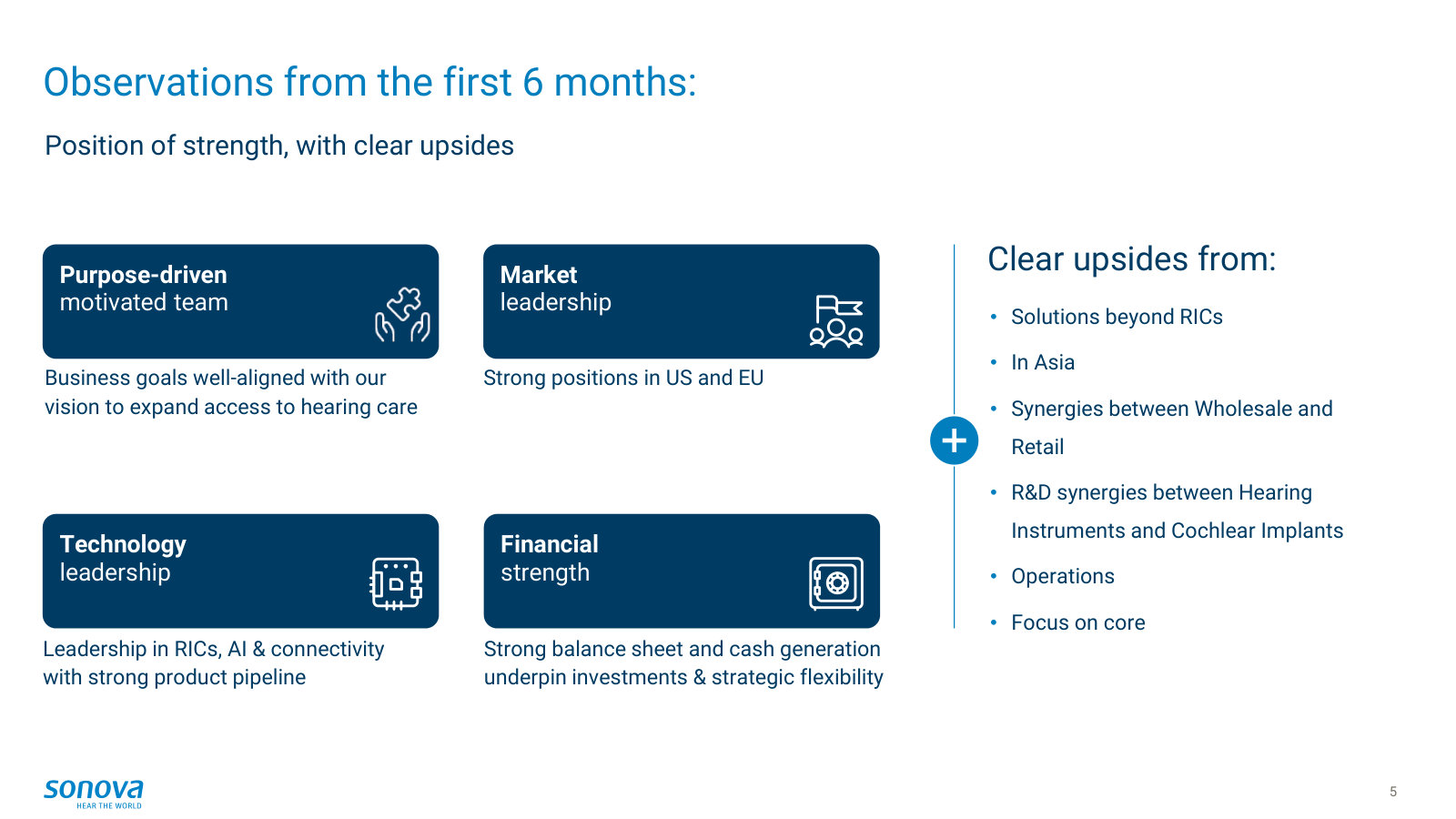
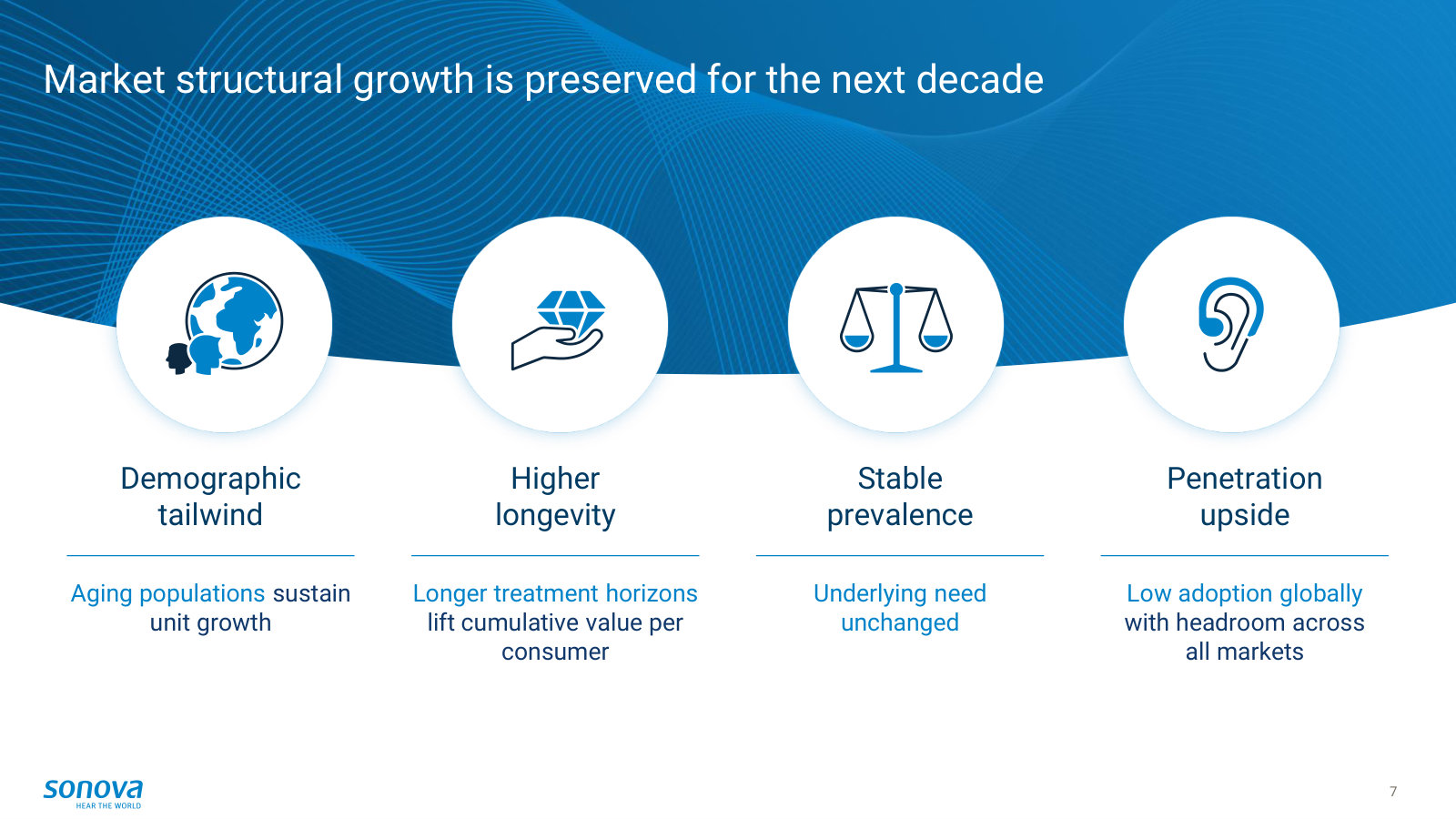
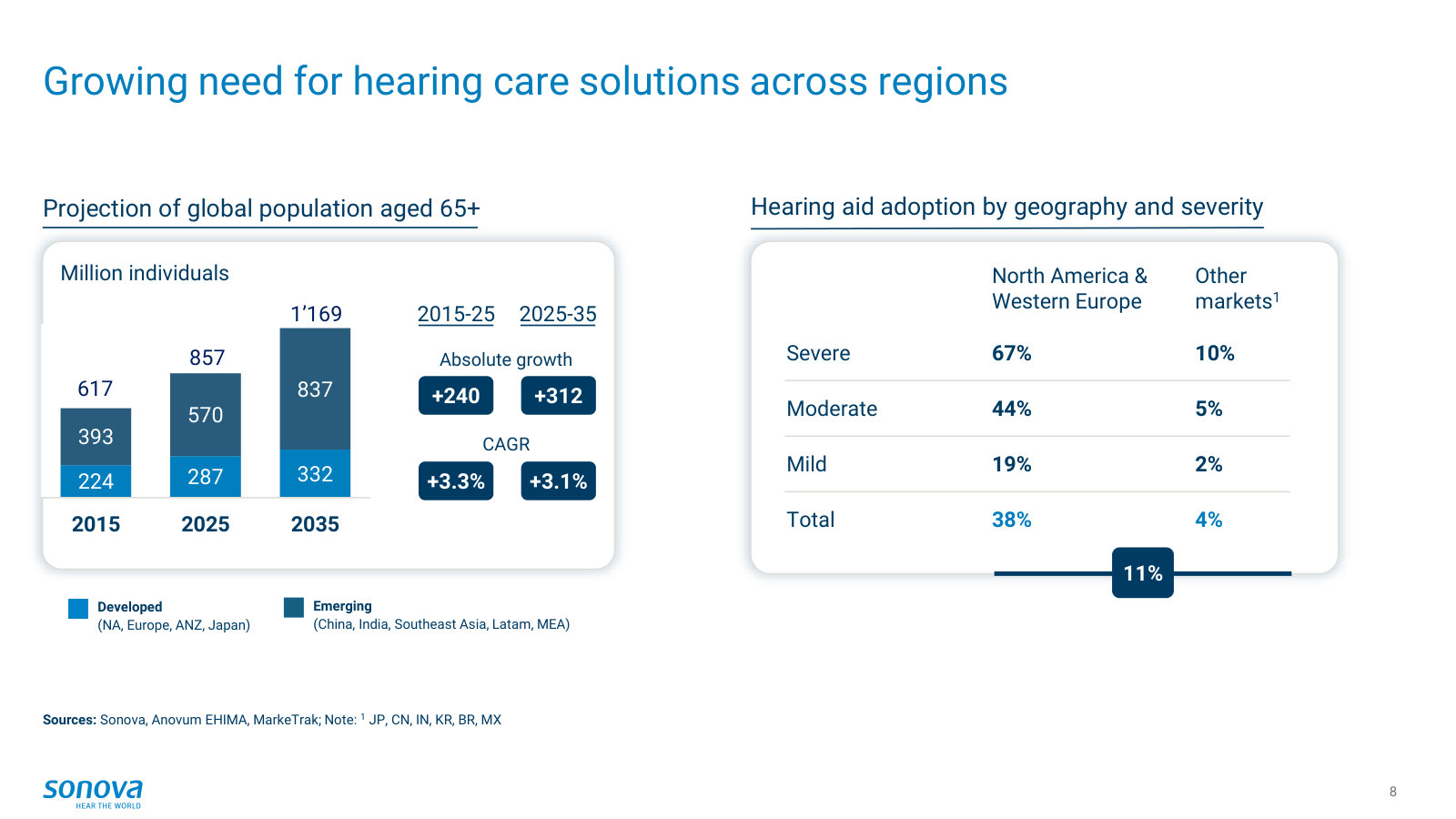
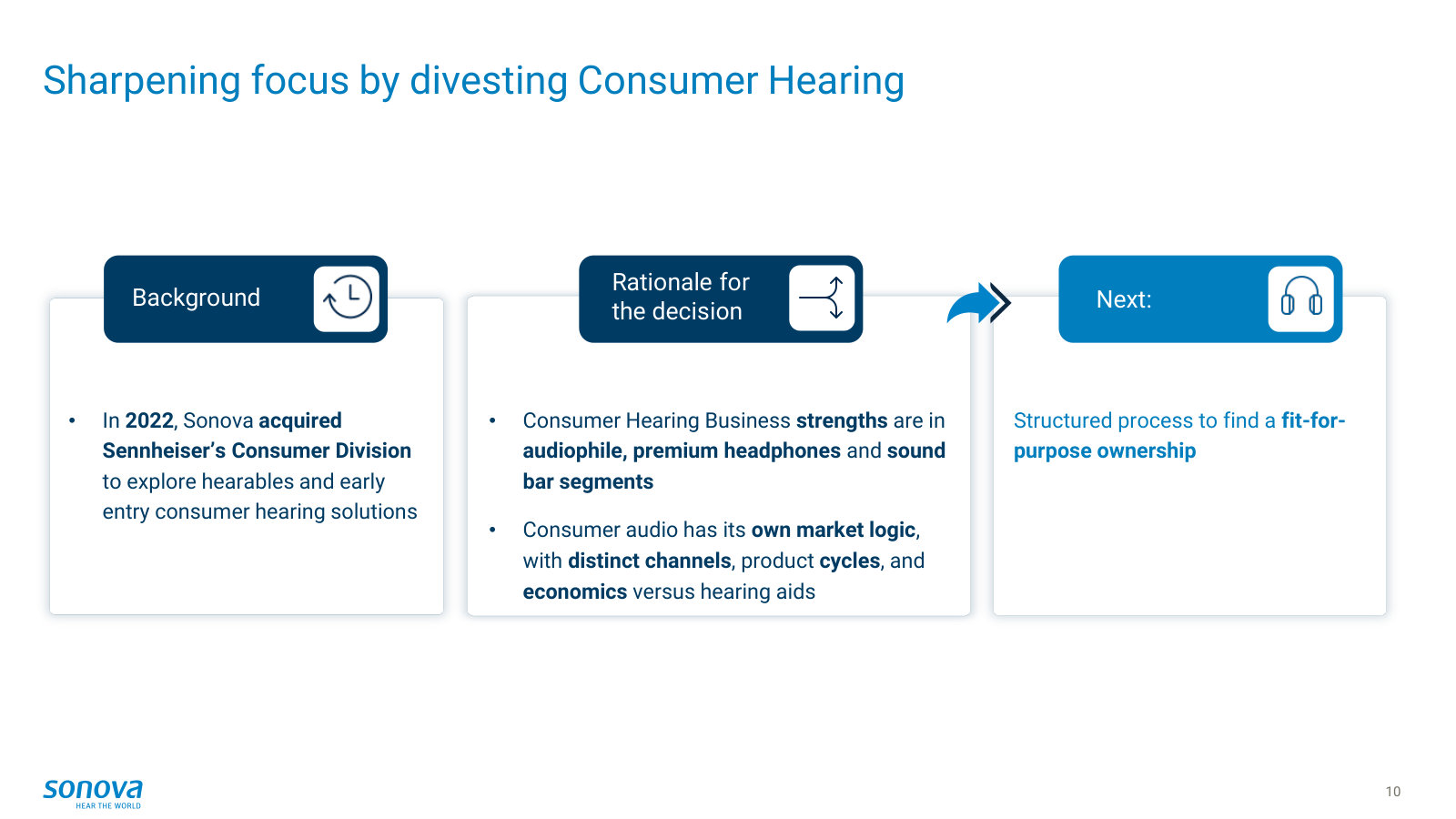
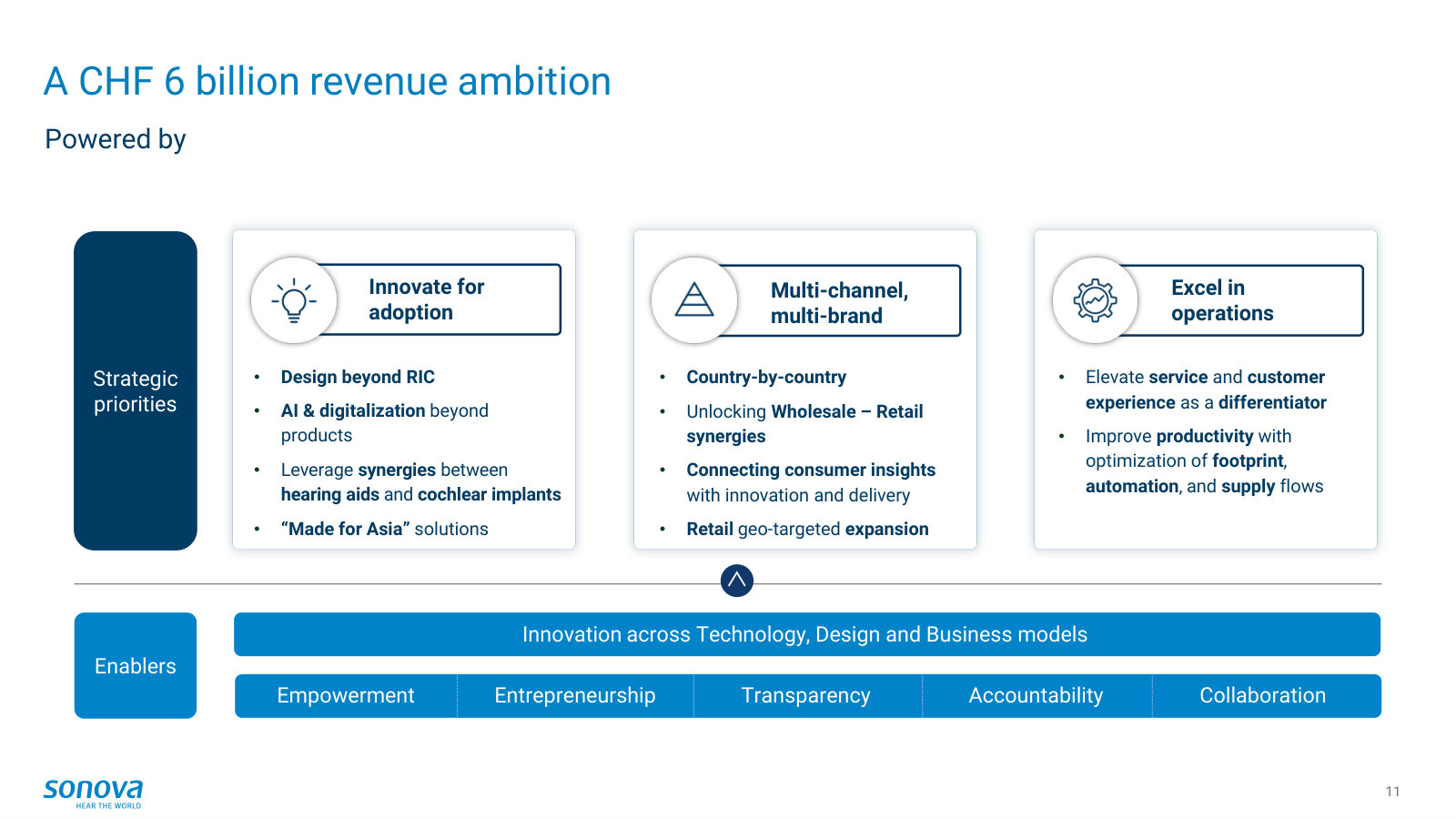
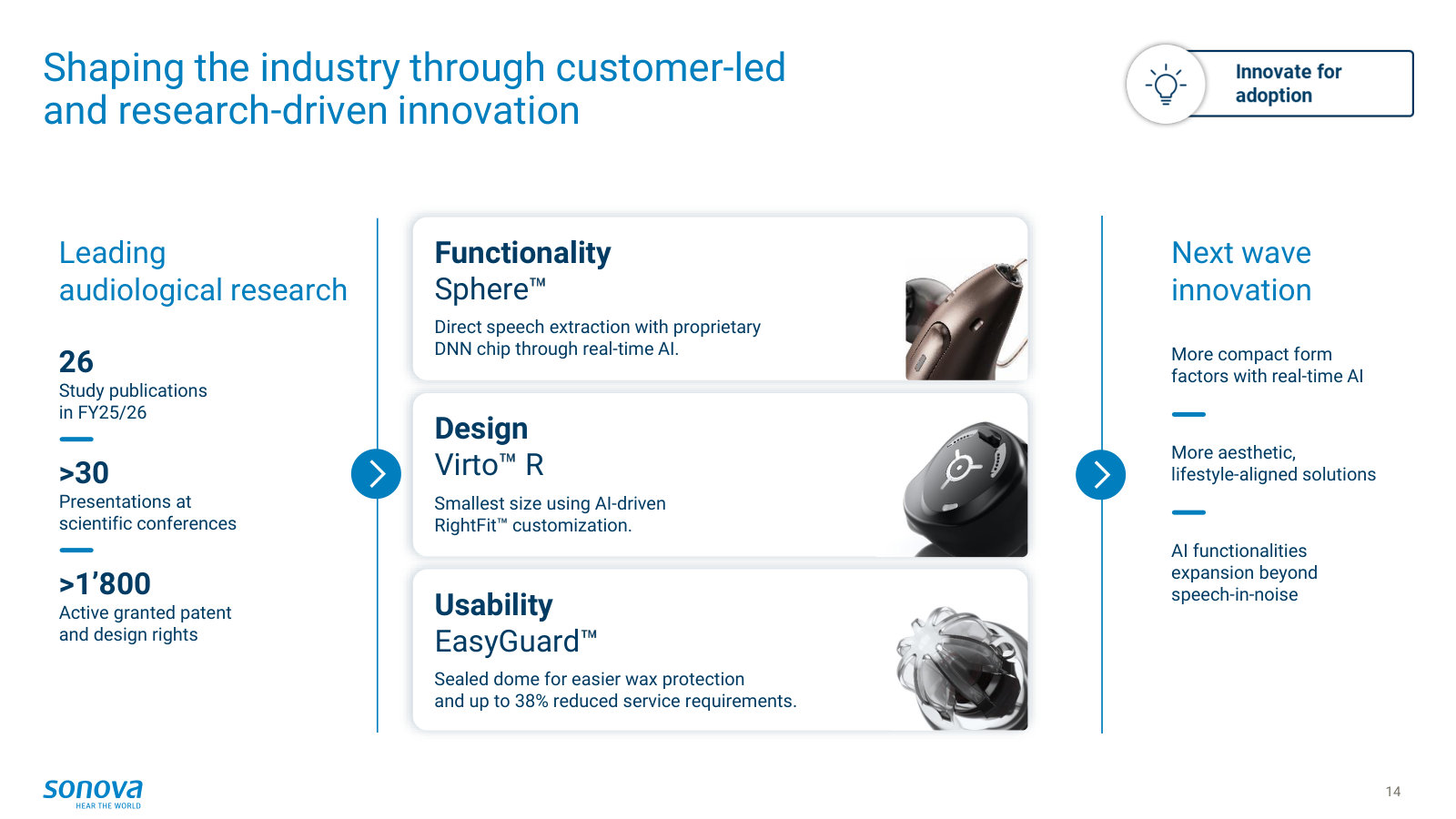
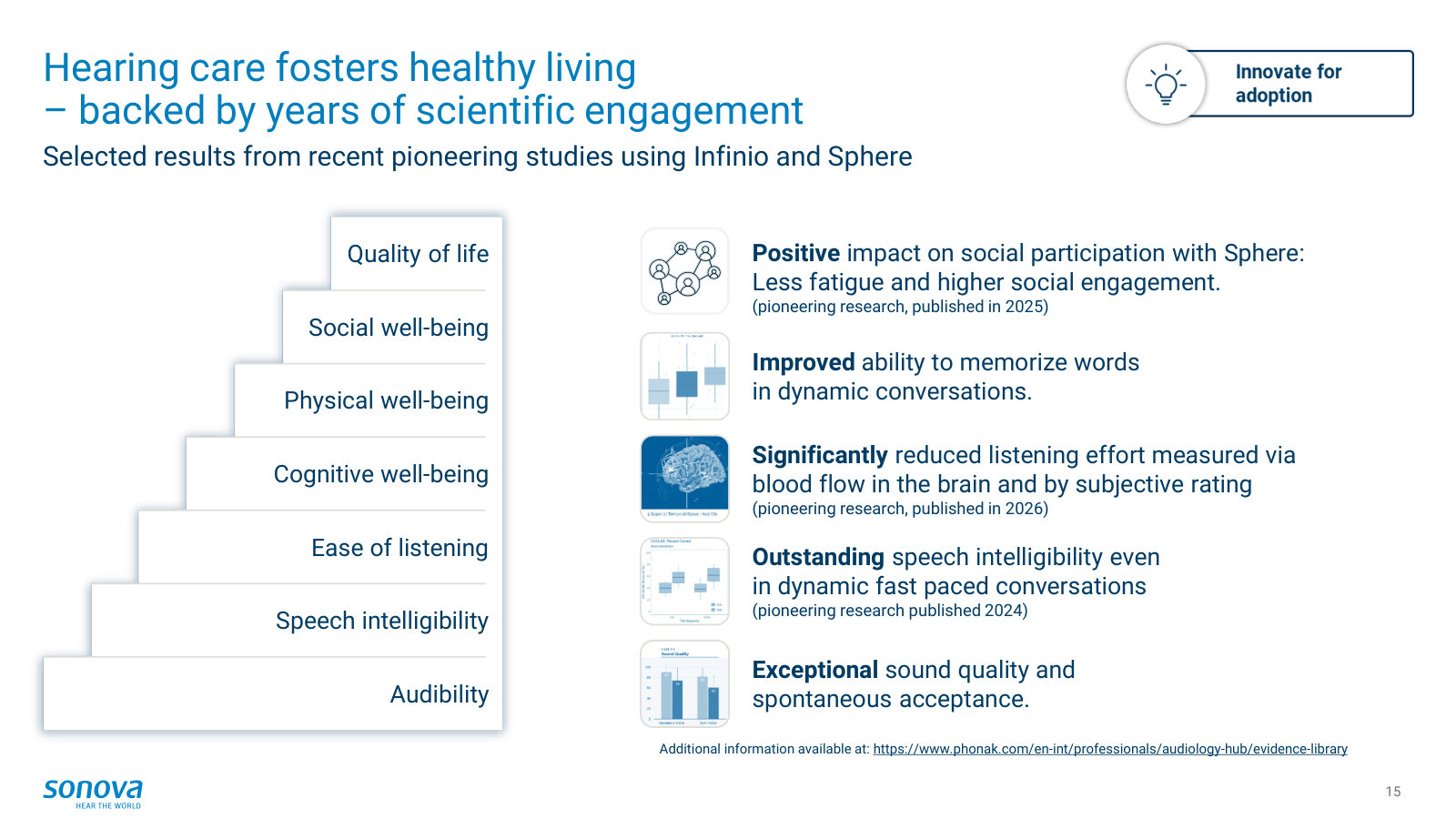
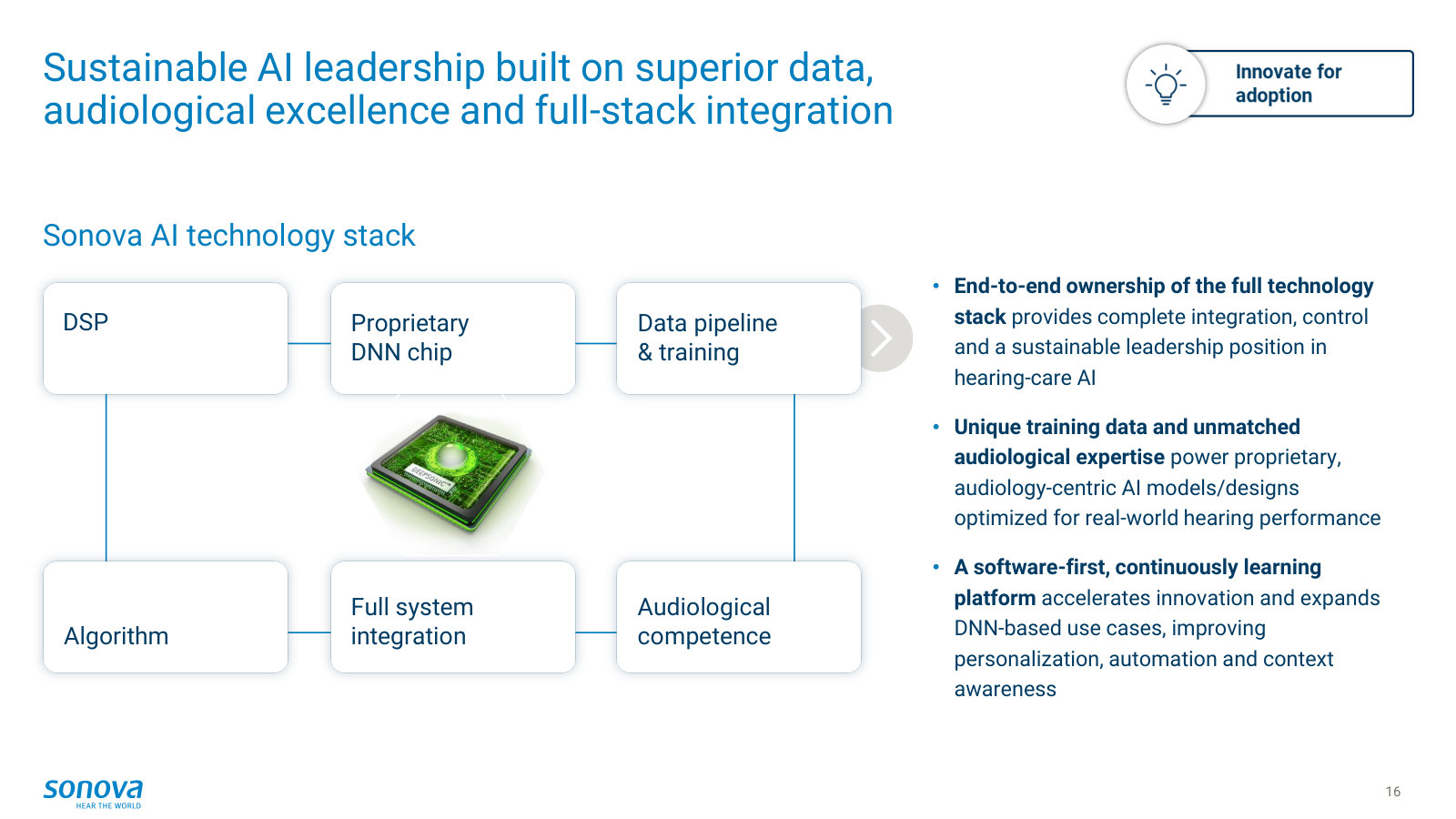
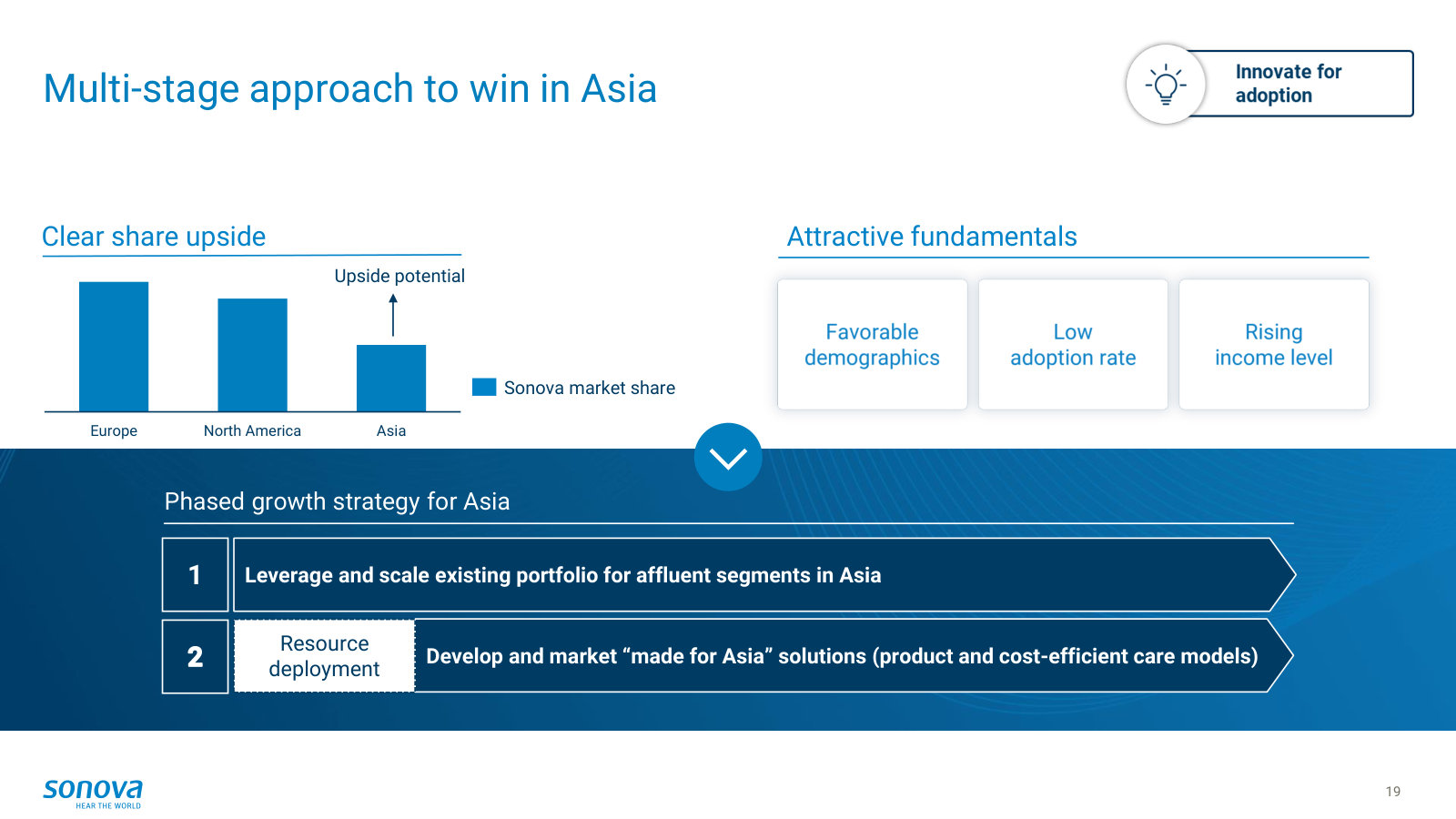
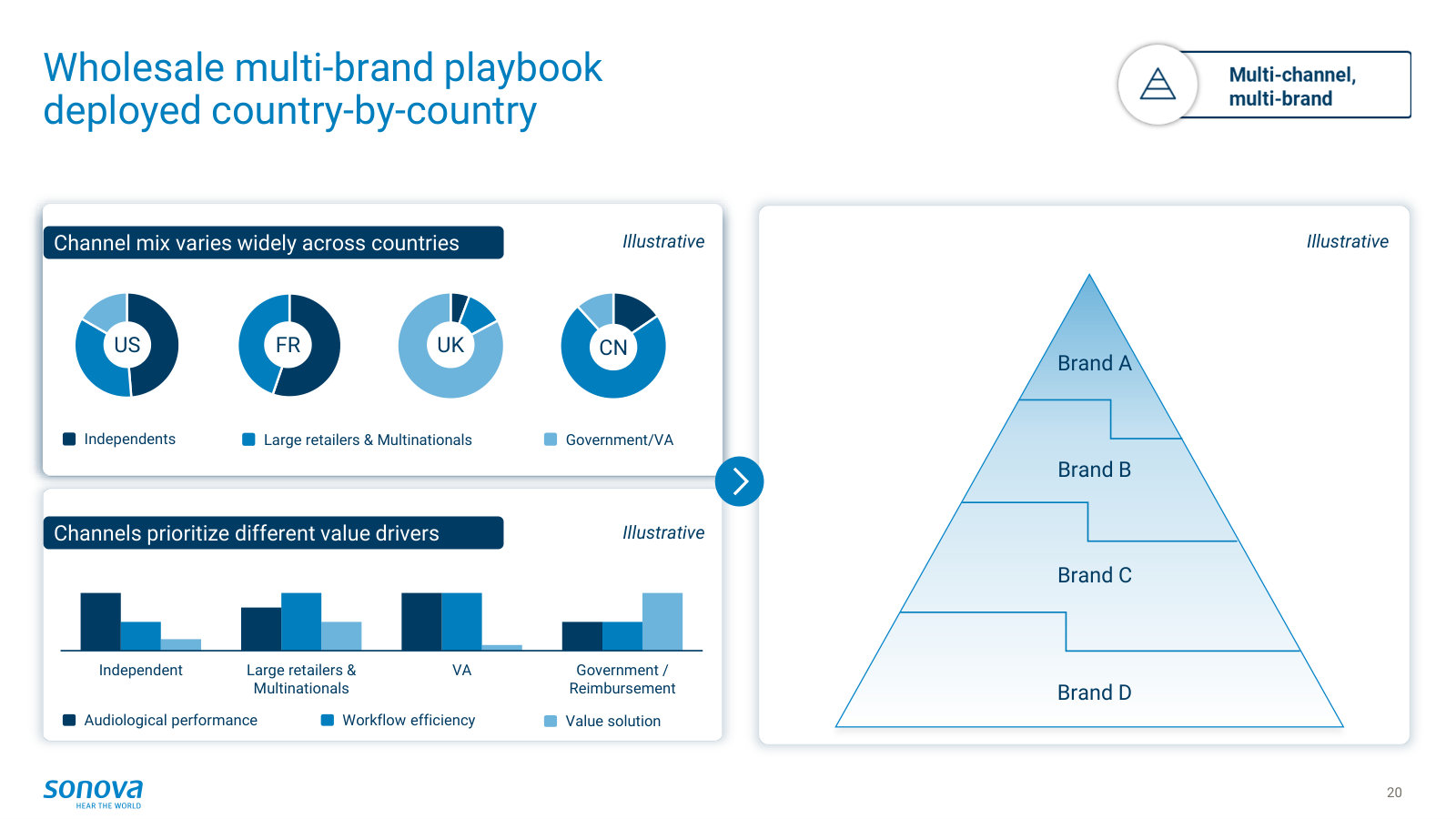
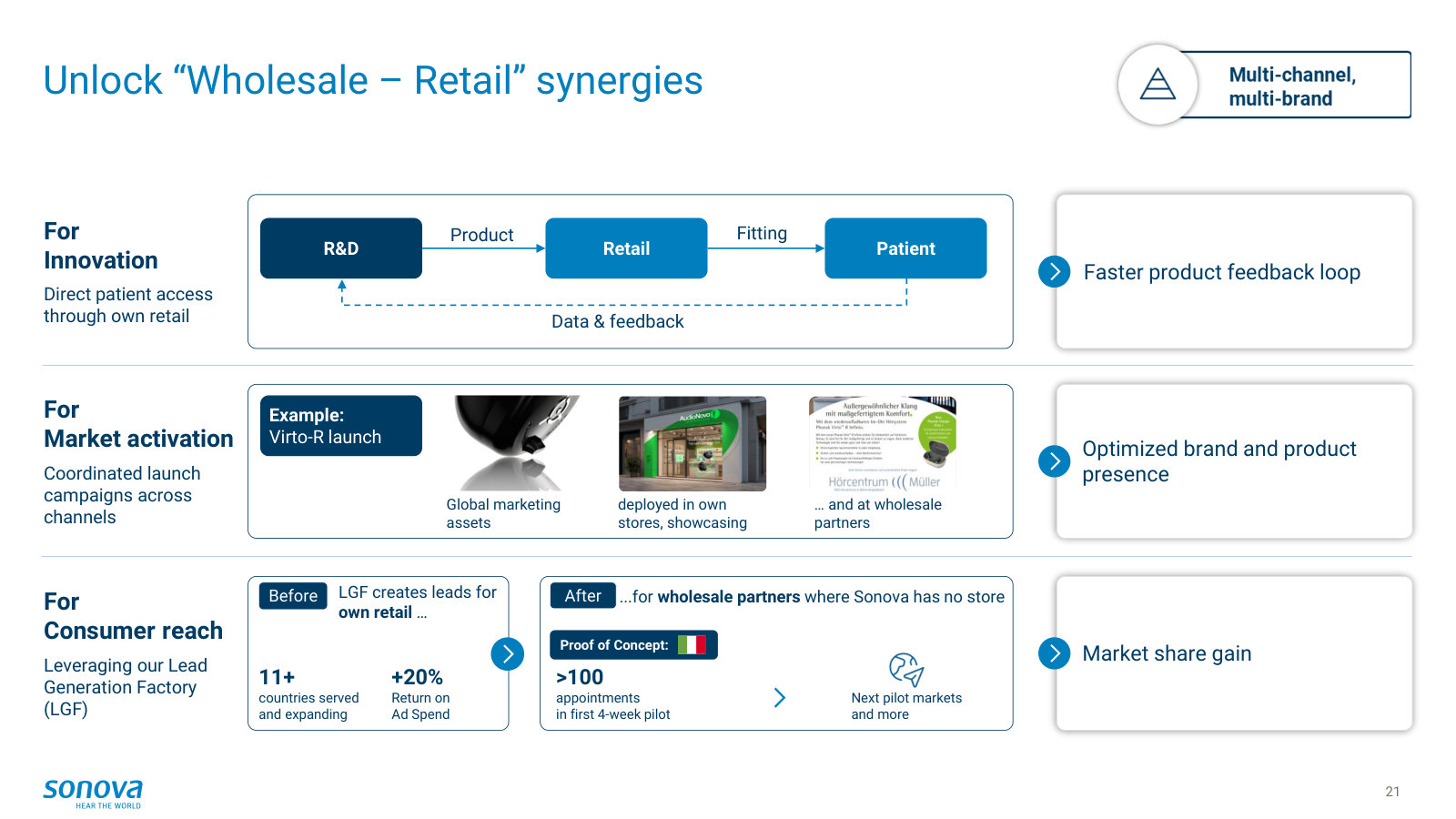
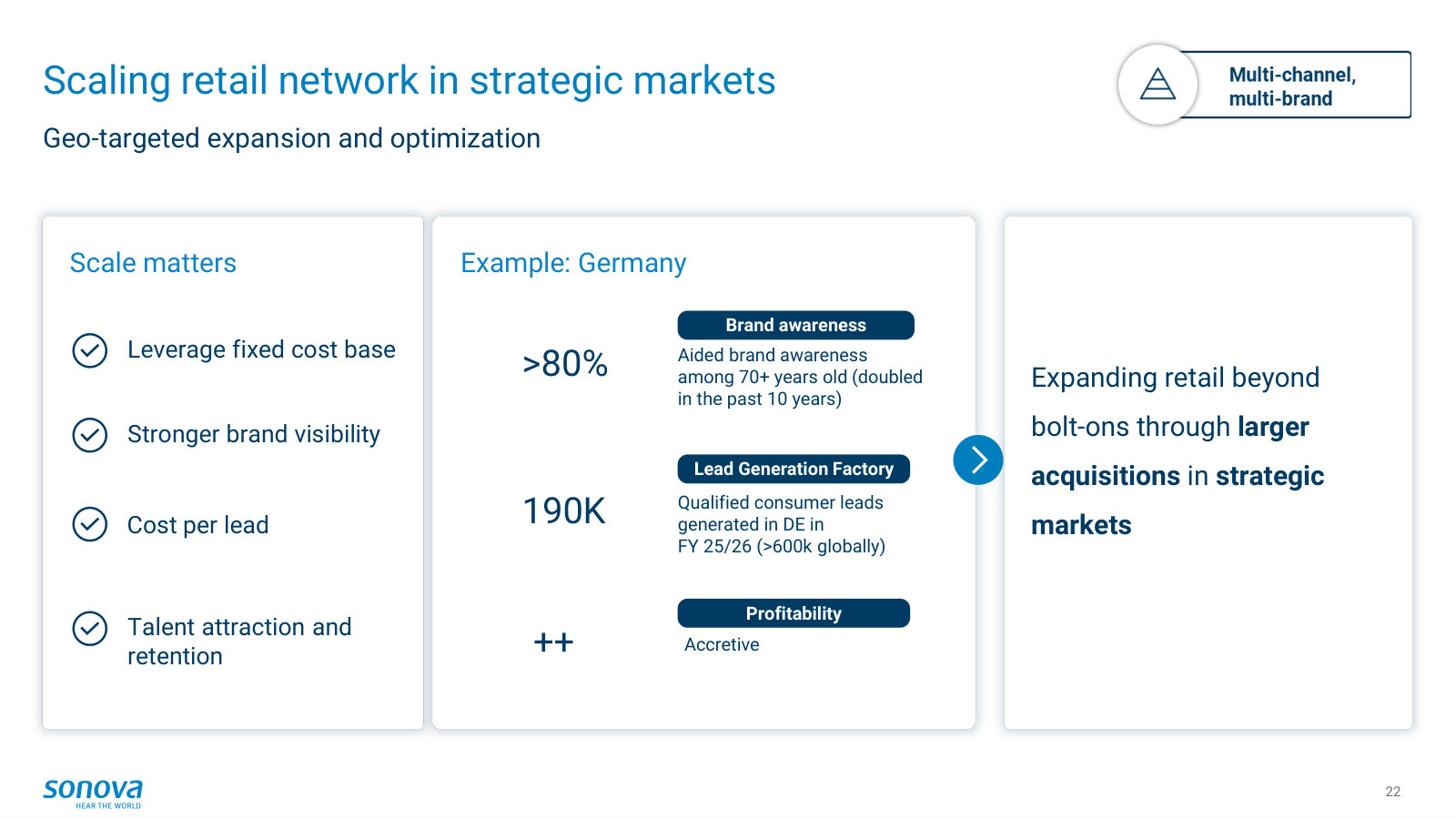
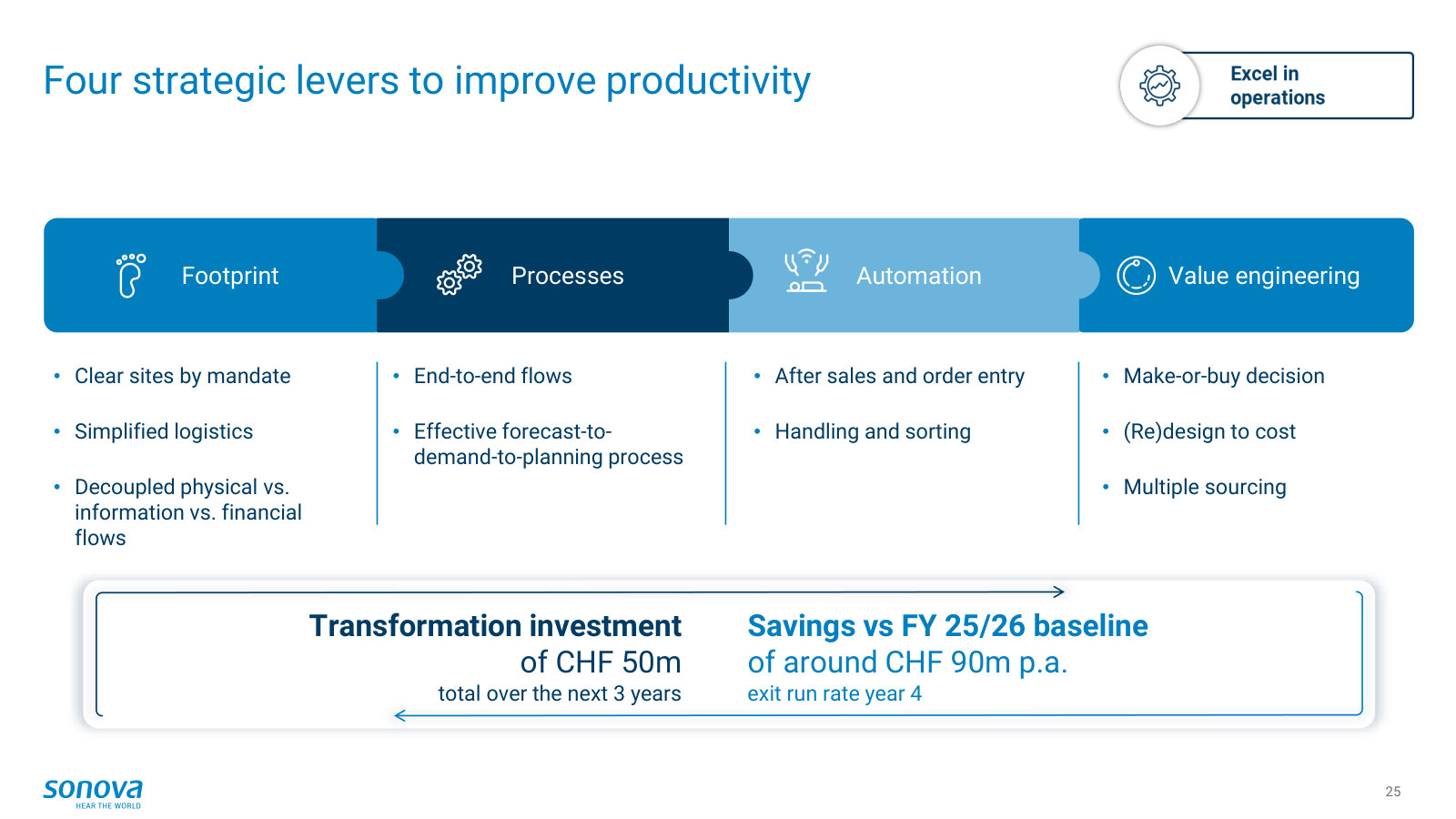
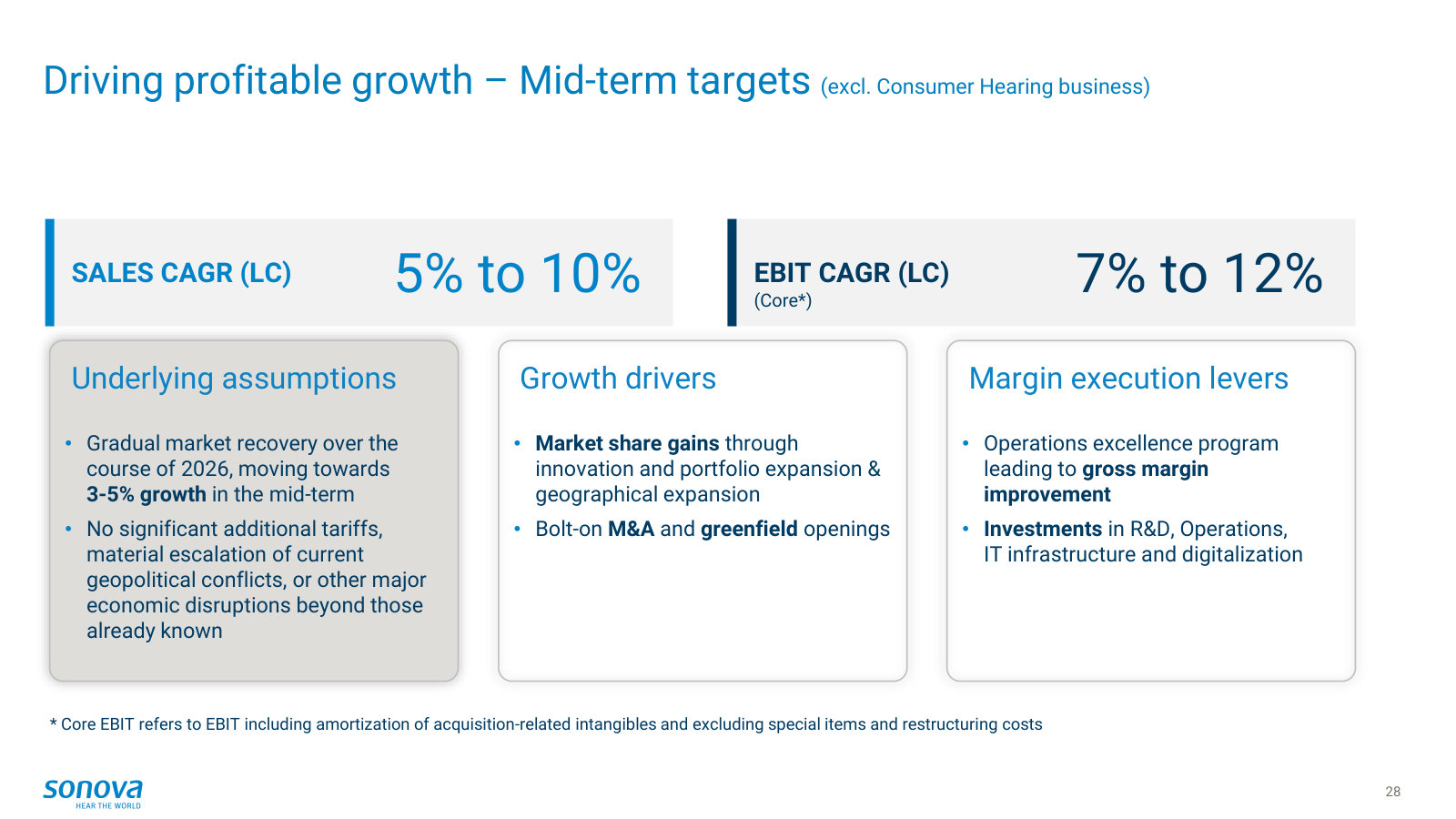
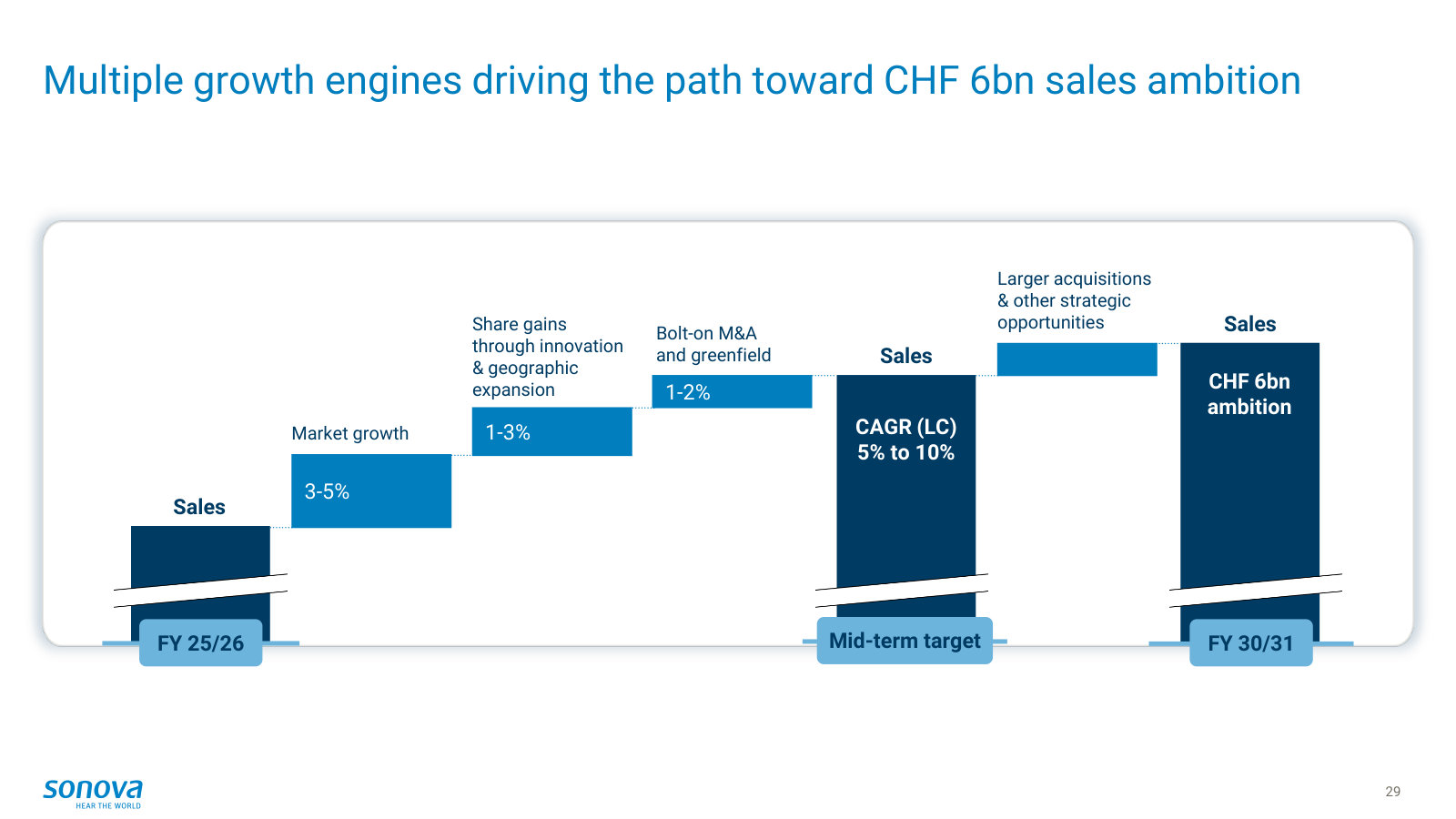
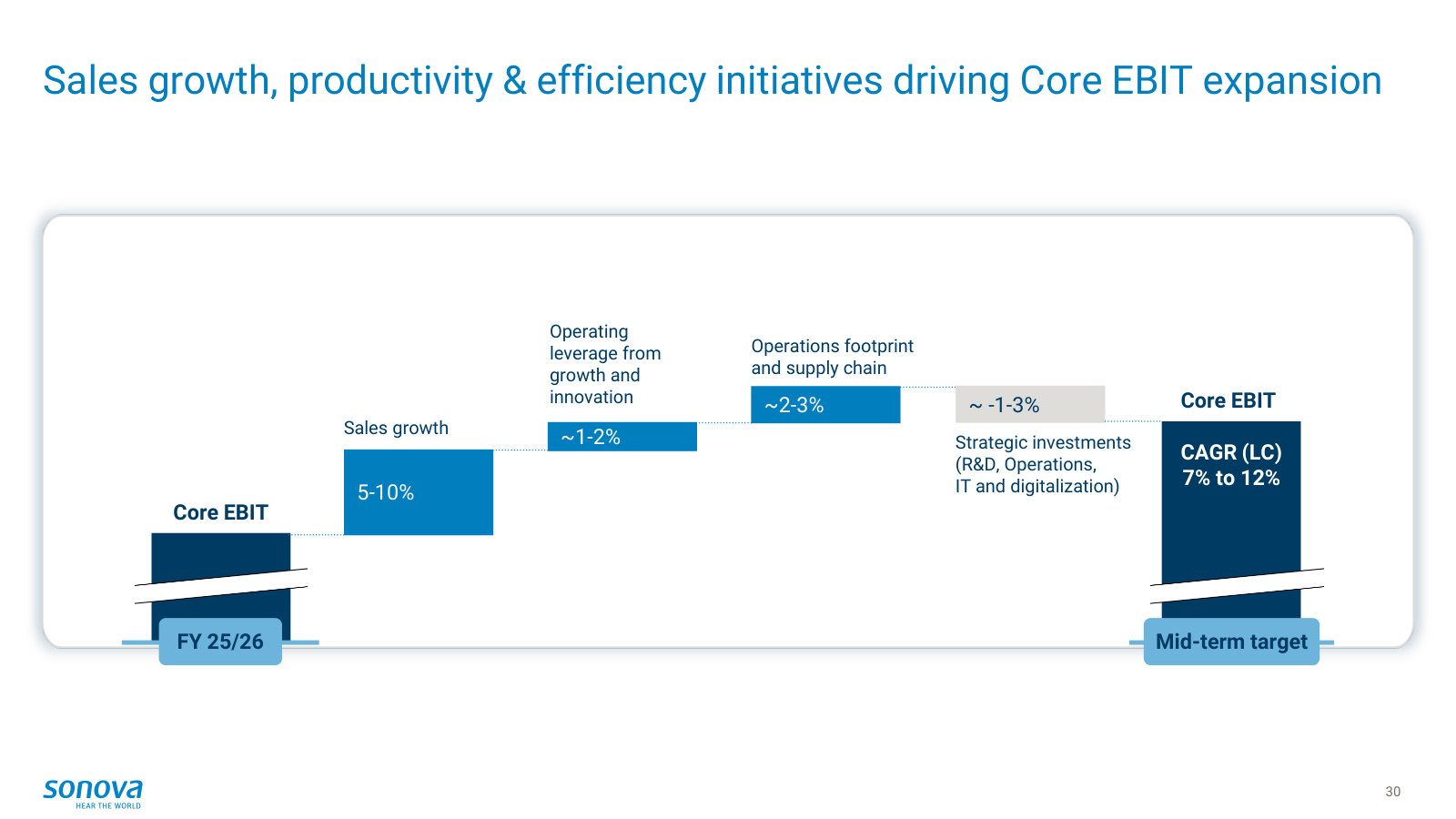
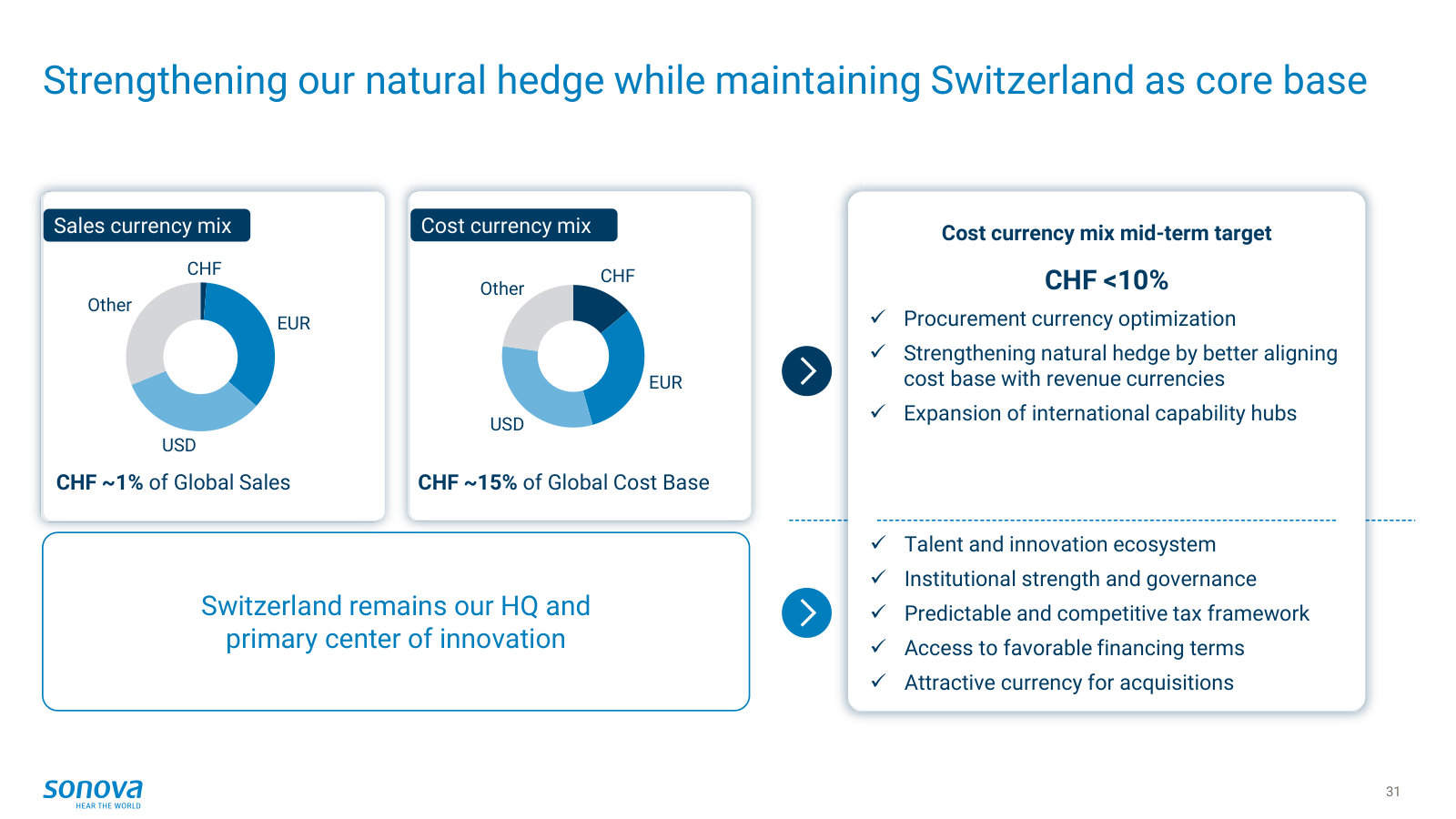
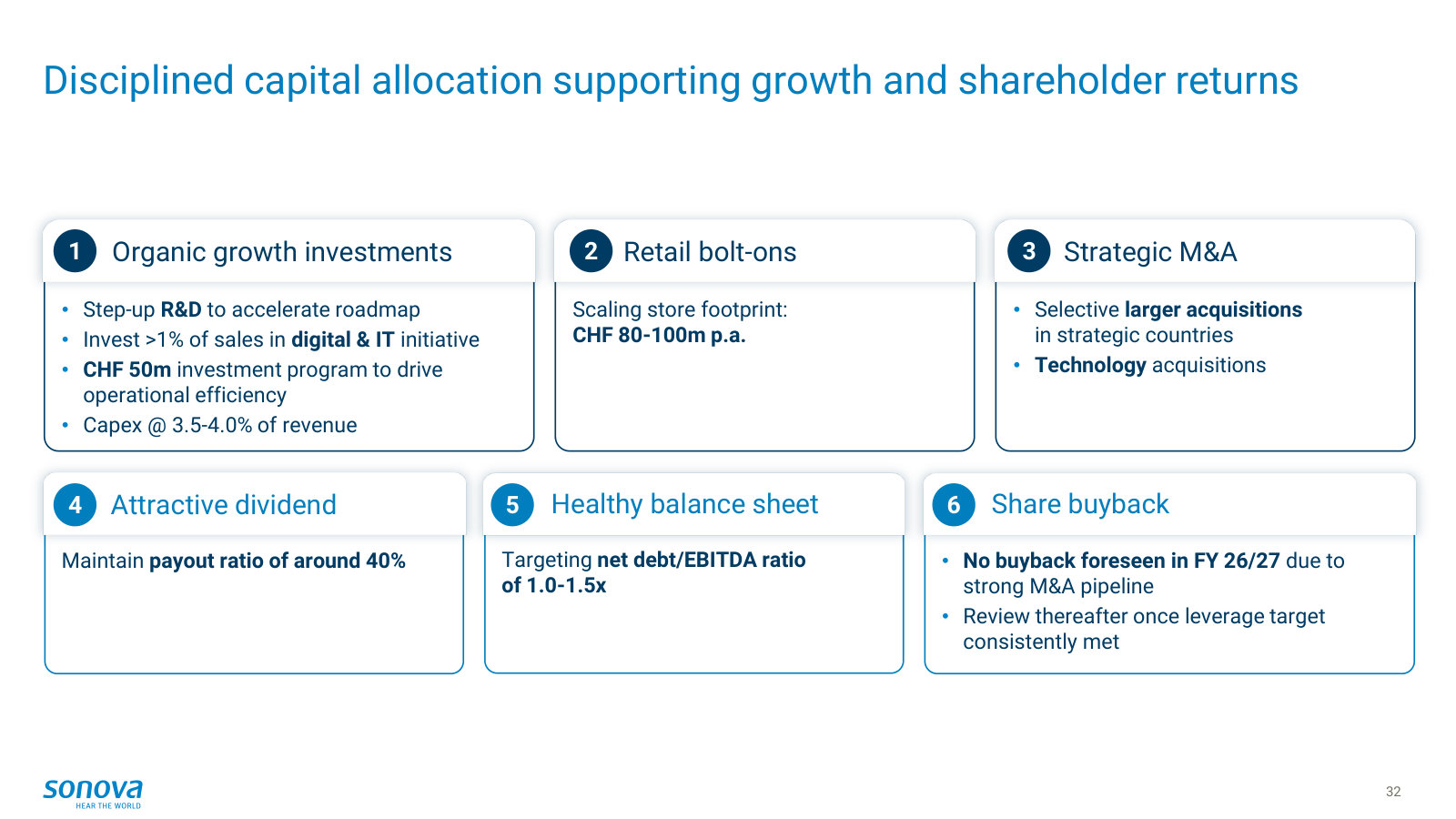
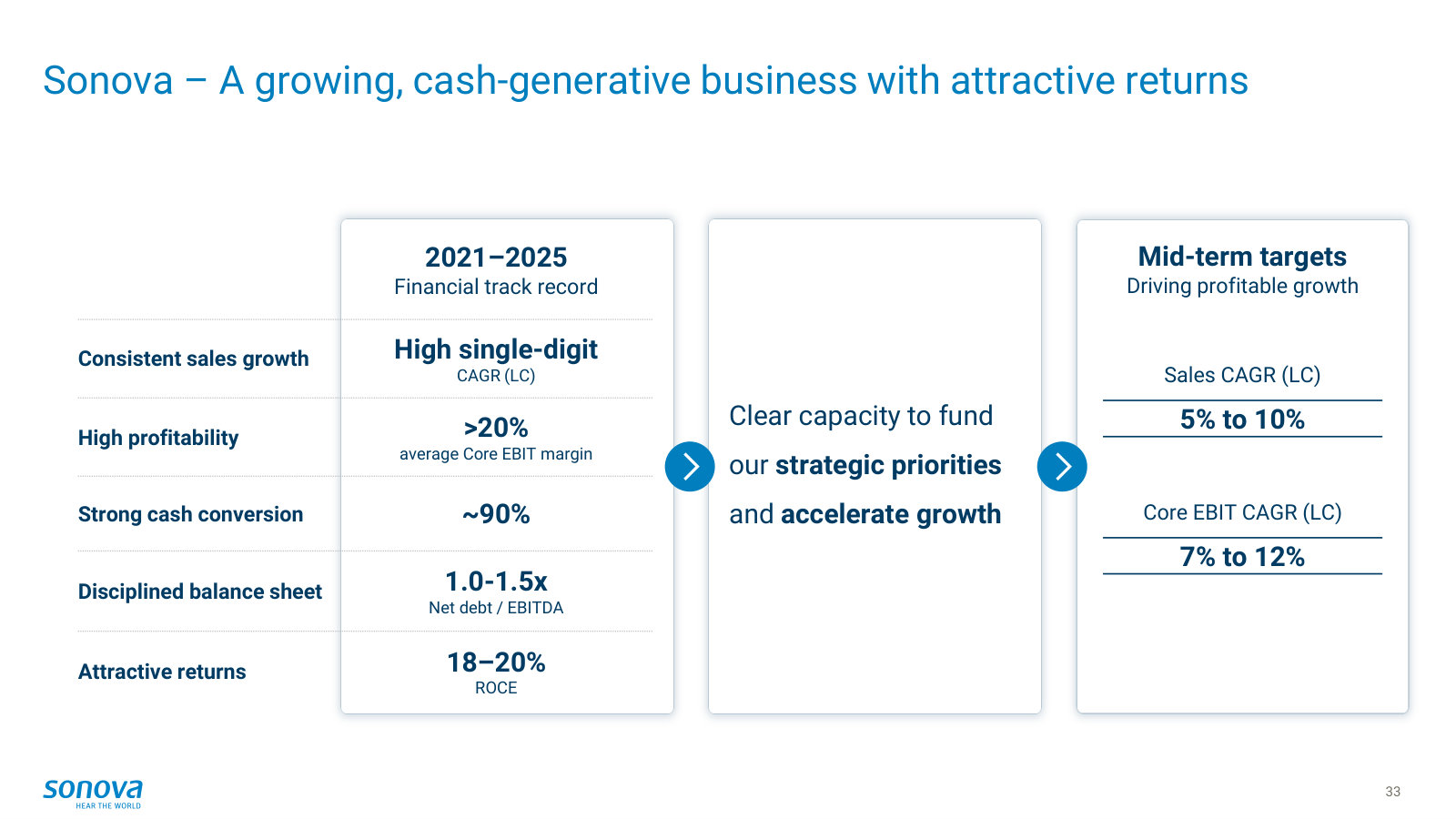
Full Year Results 2025/26 — FY2025/26
The most recent results — a current snapshot of the two segments, the wholesale/retail split, regional growth, margins and guidance. · Open the full document →
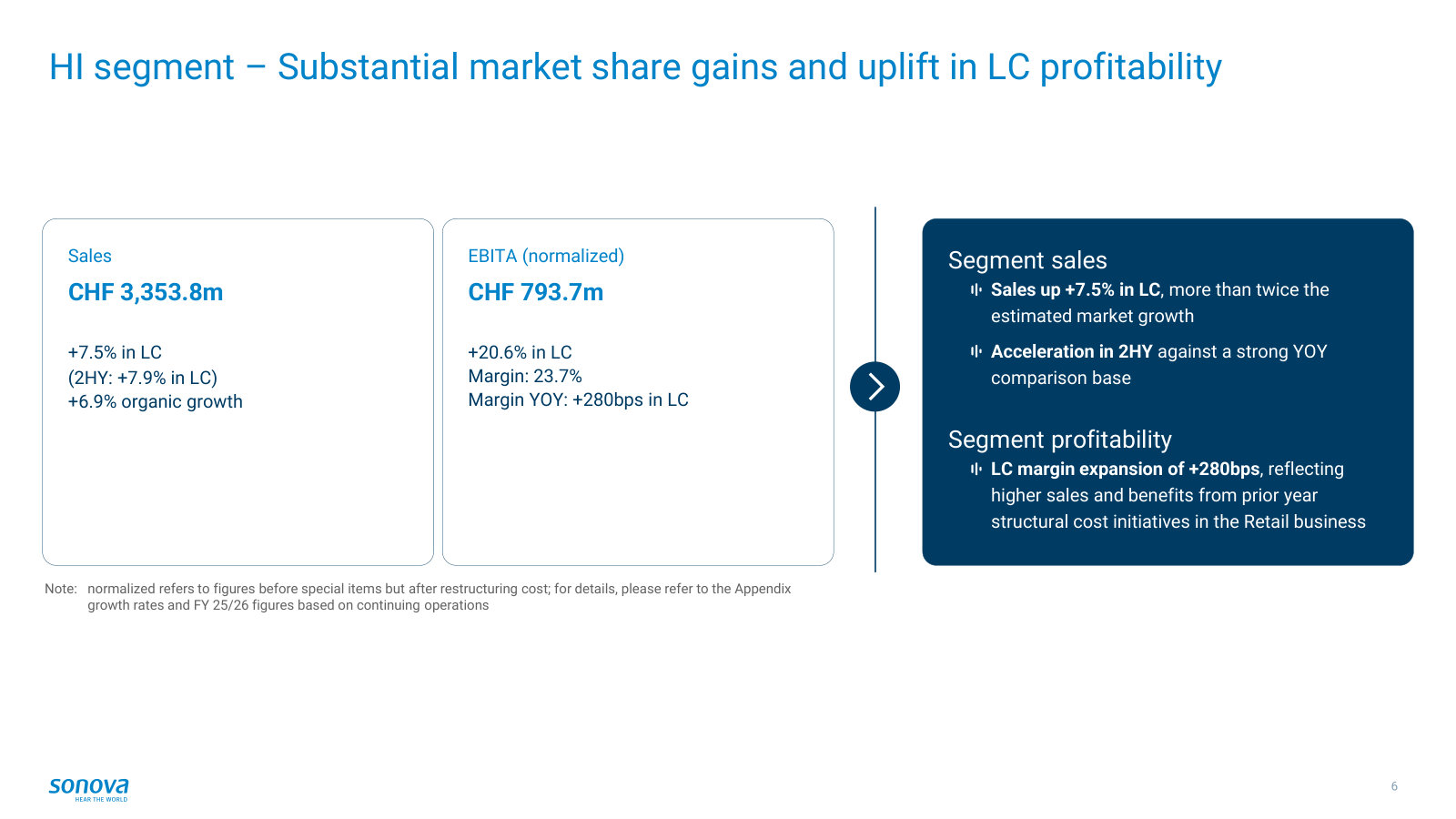
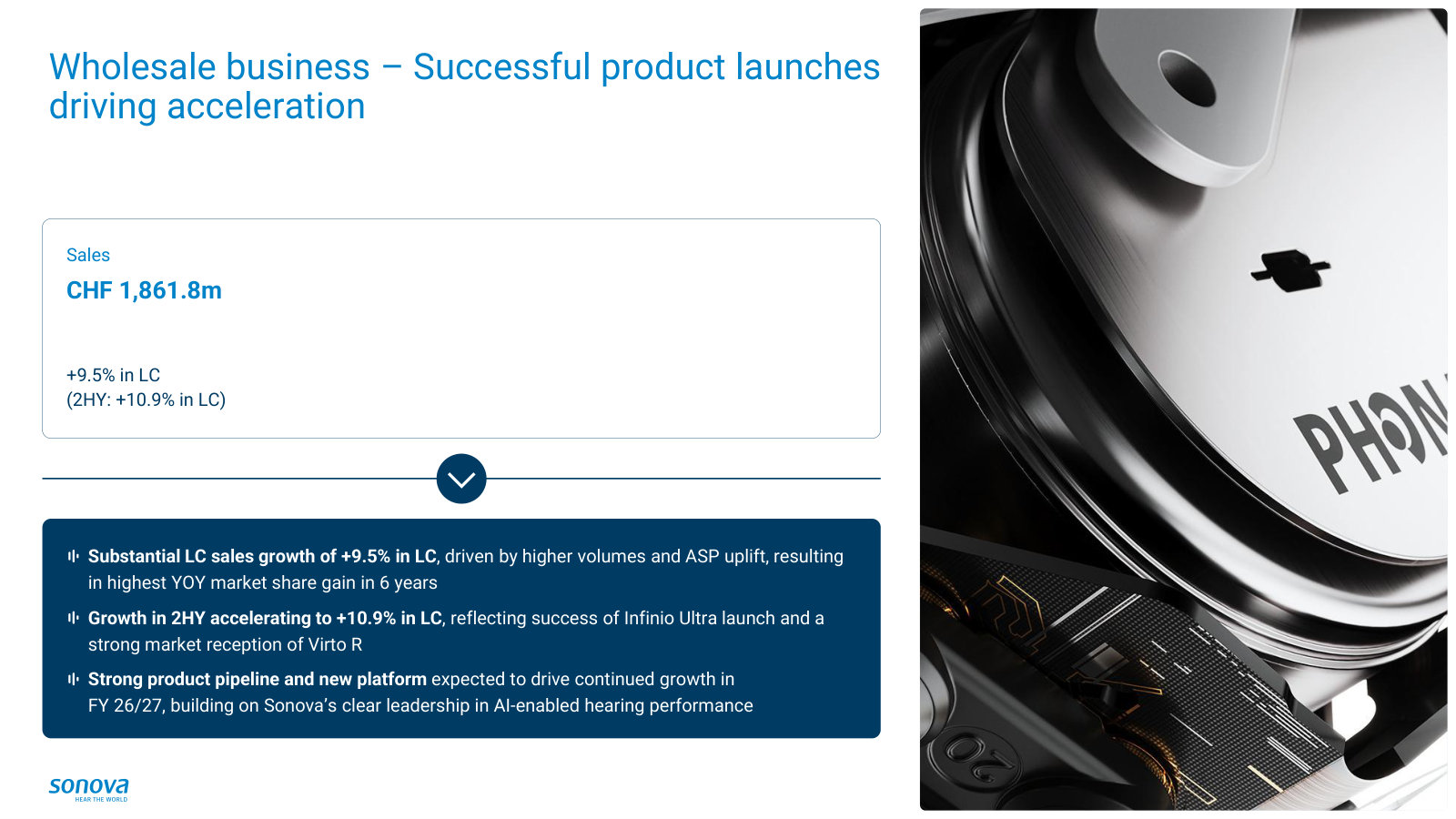
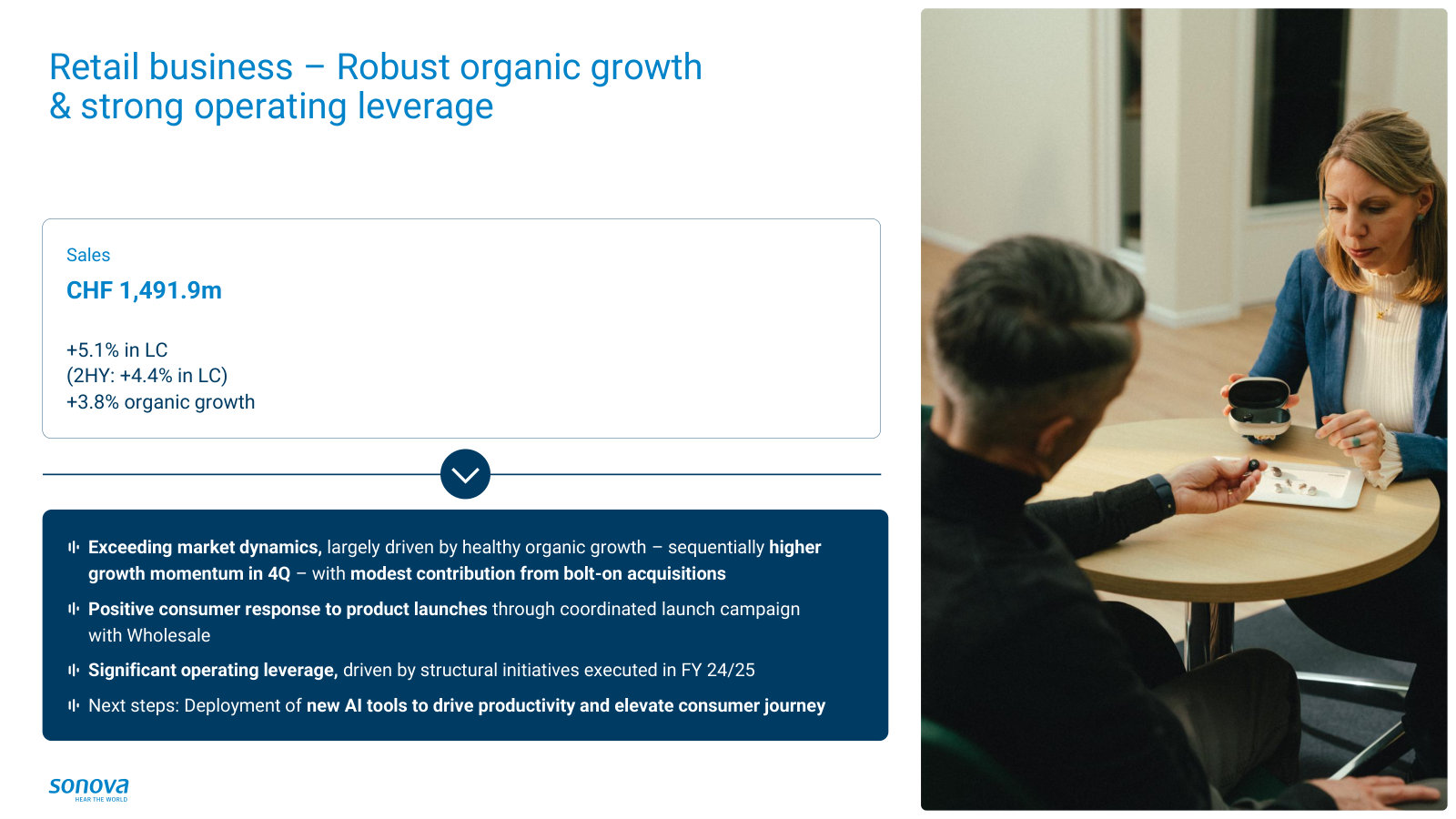
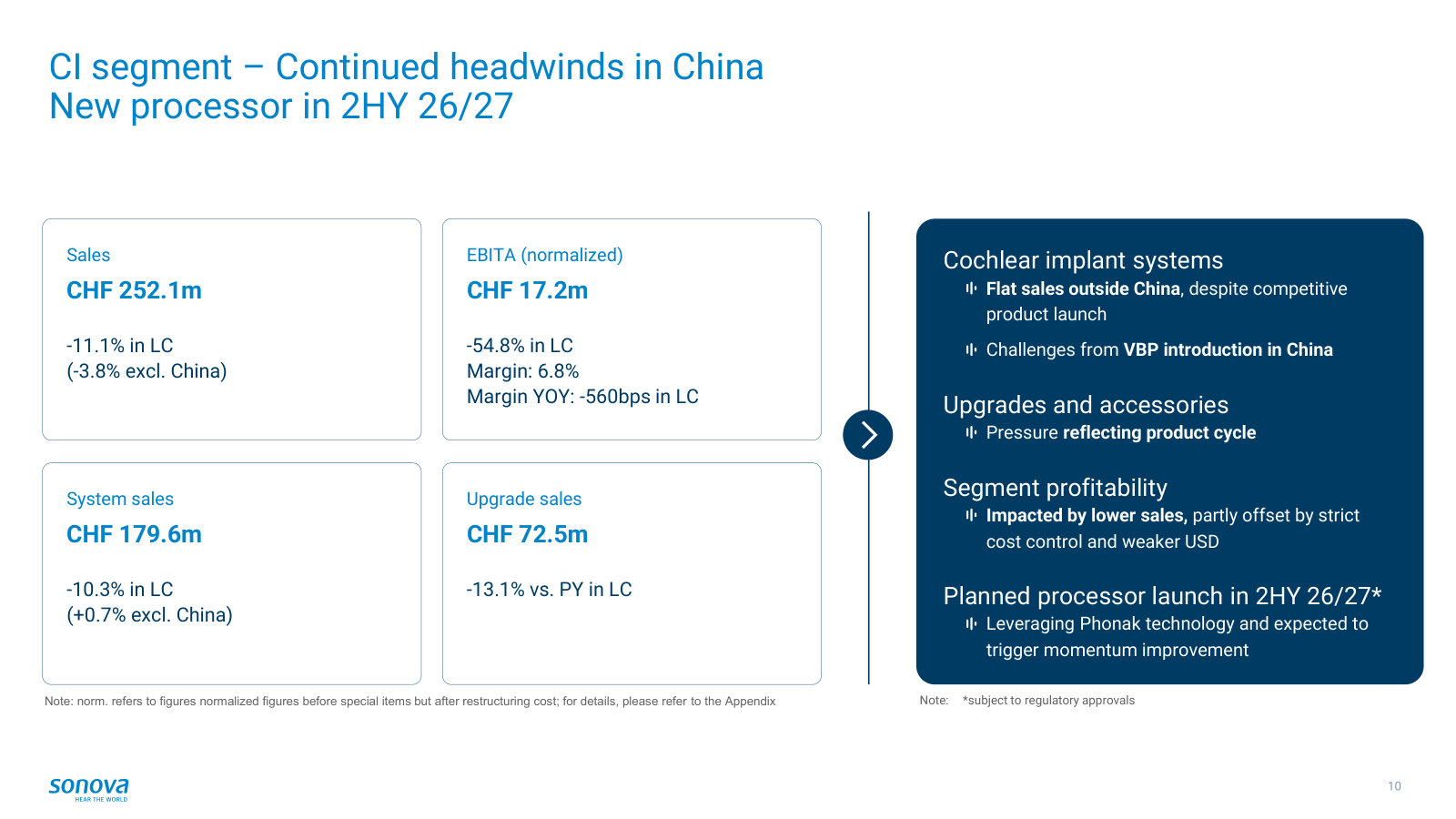
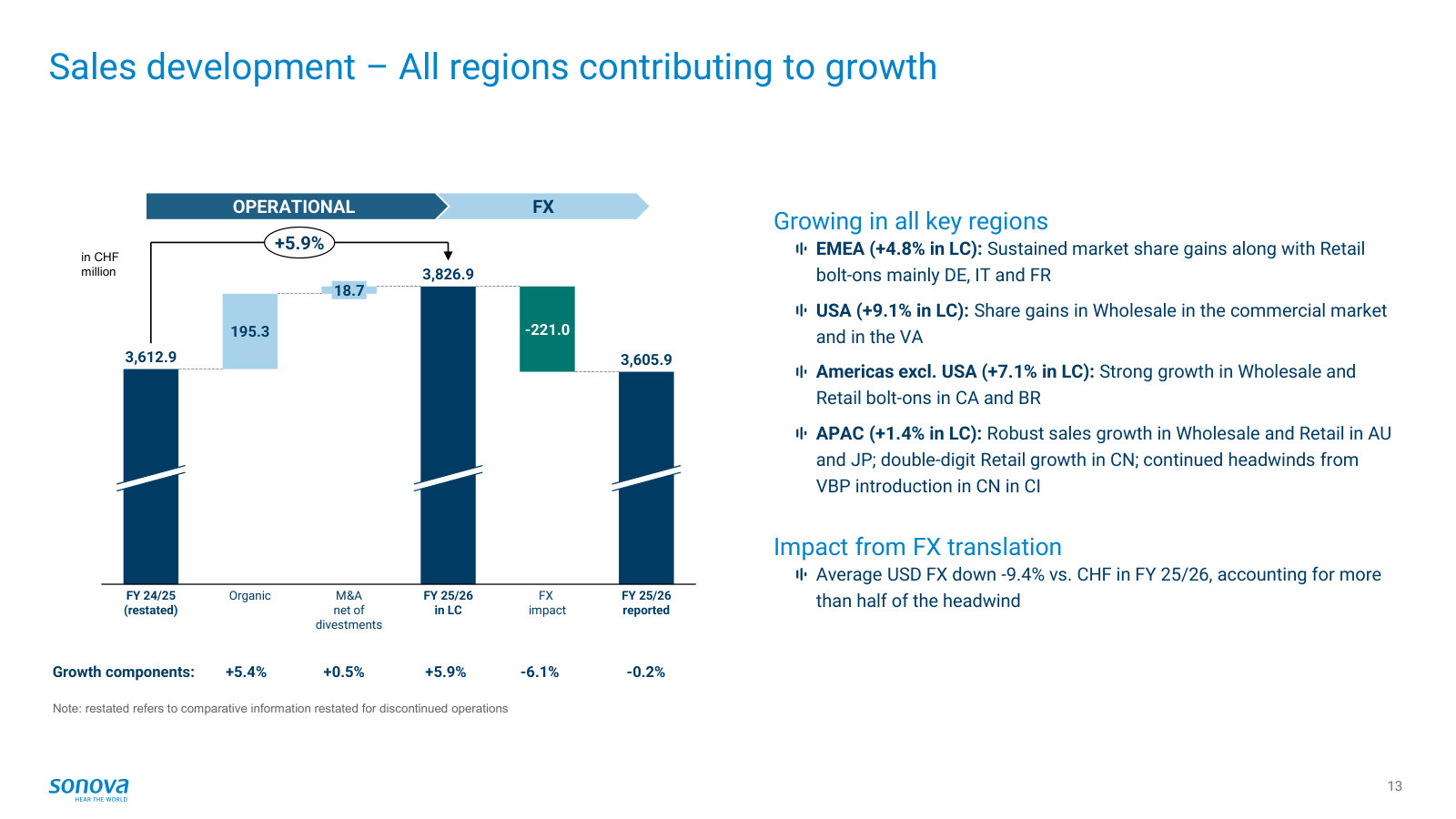
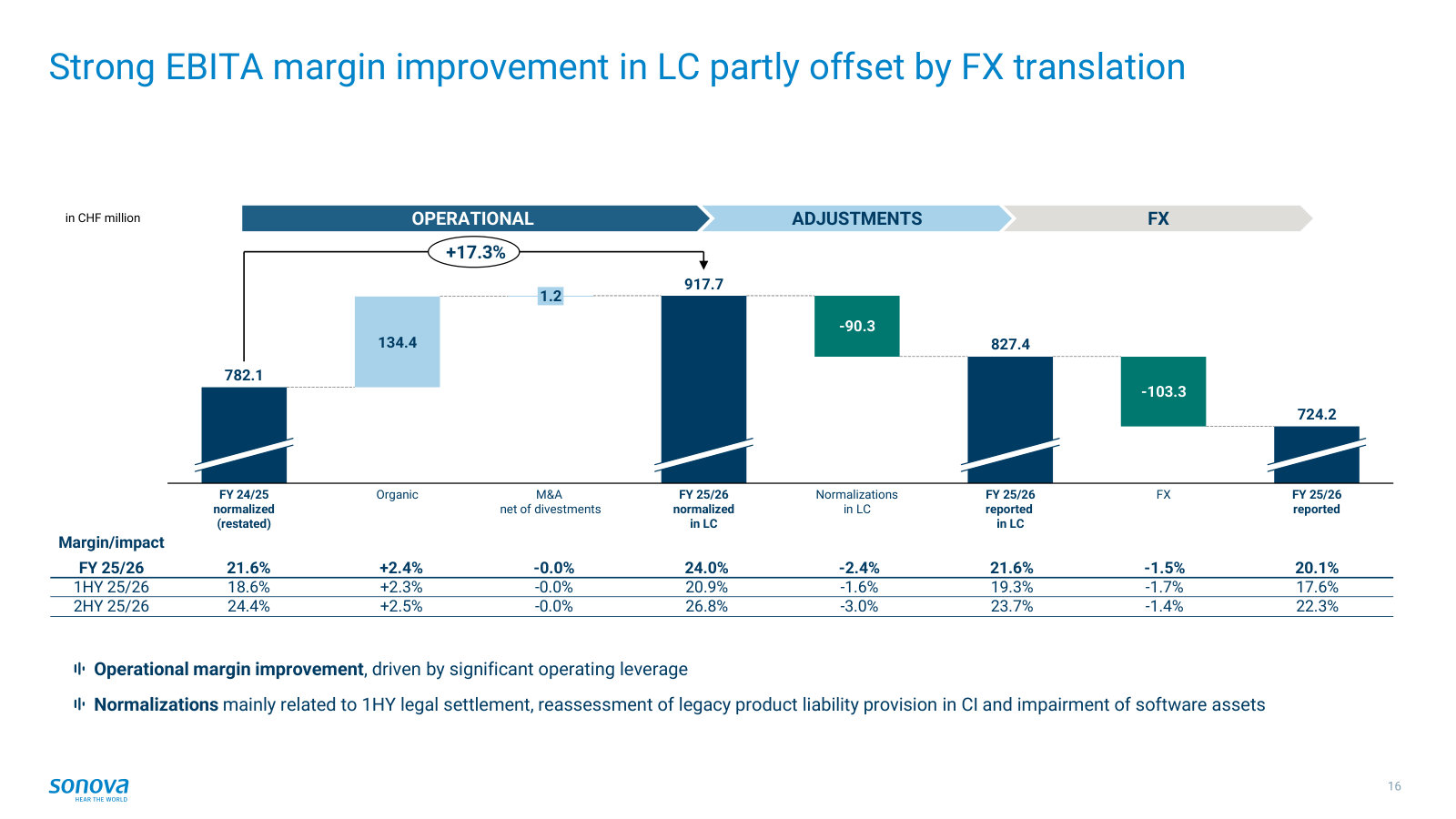
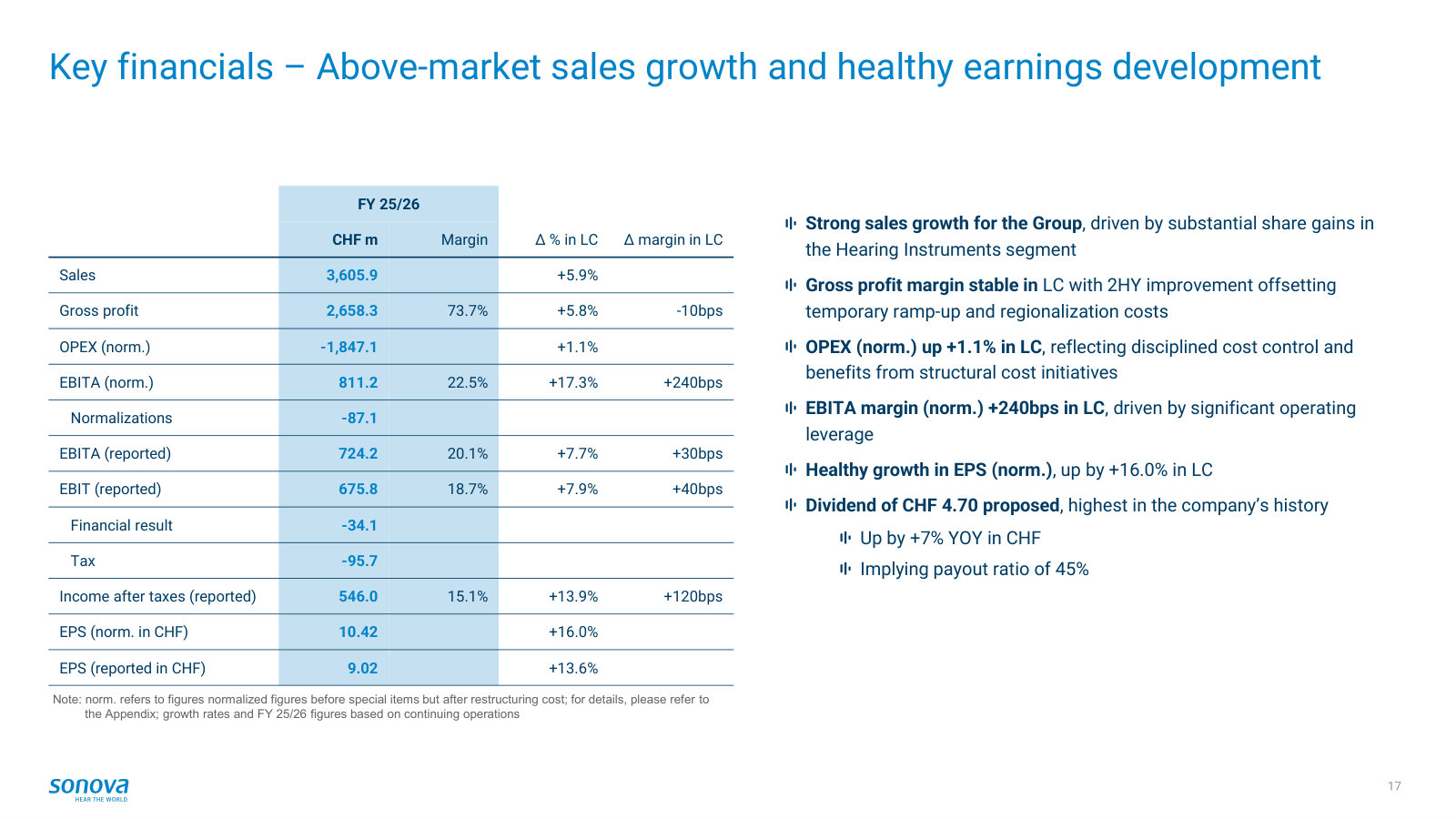
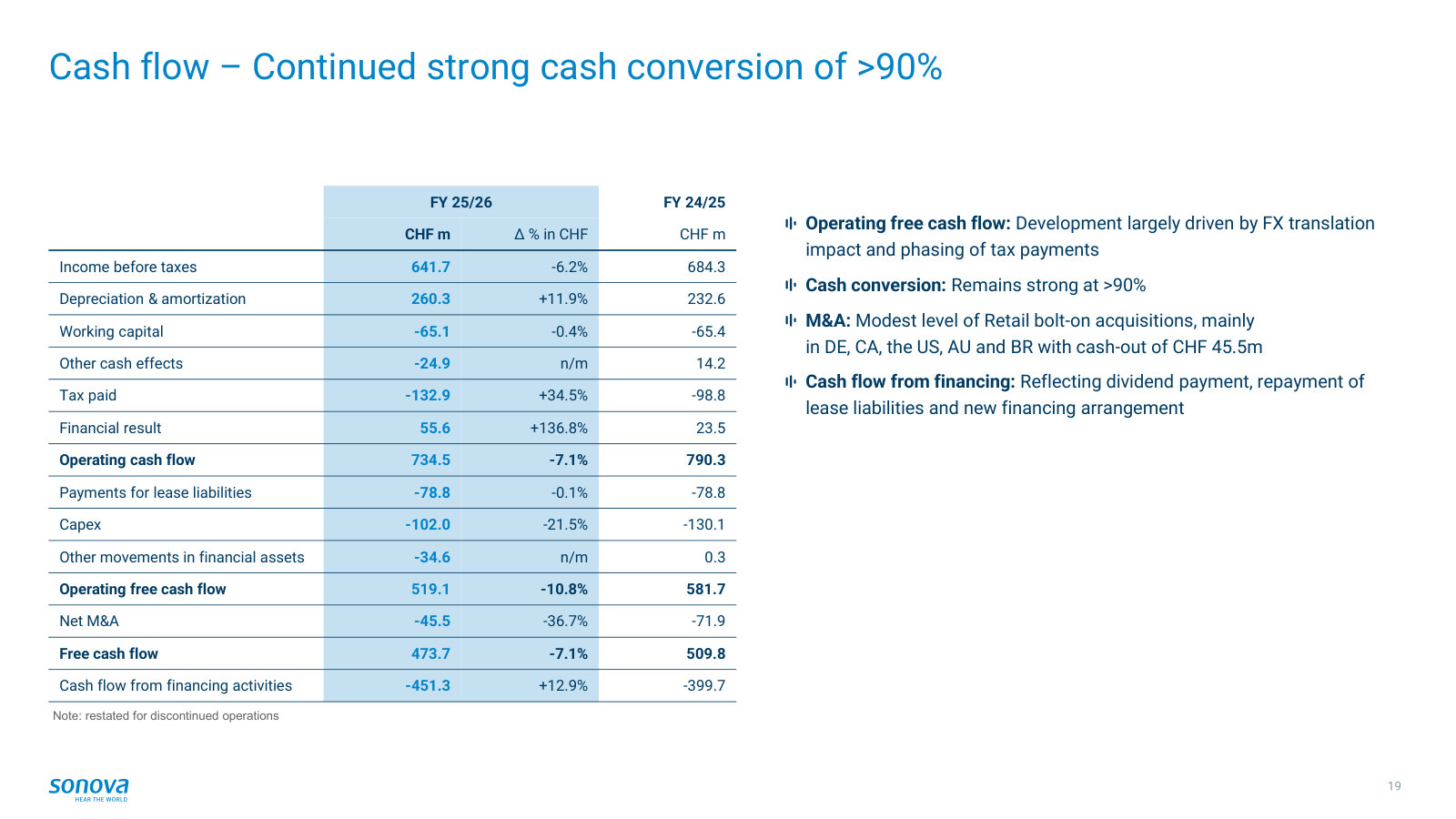
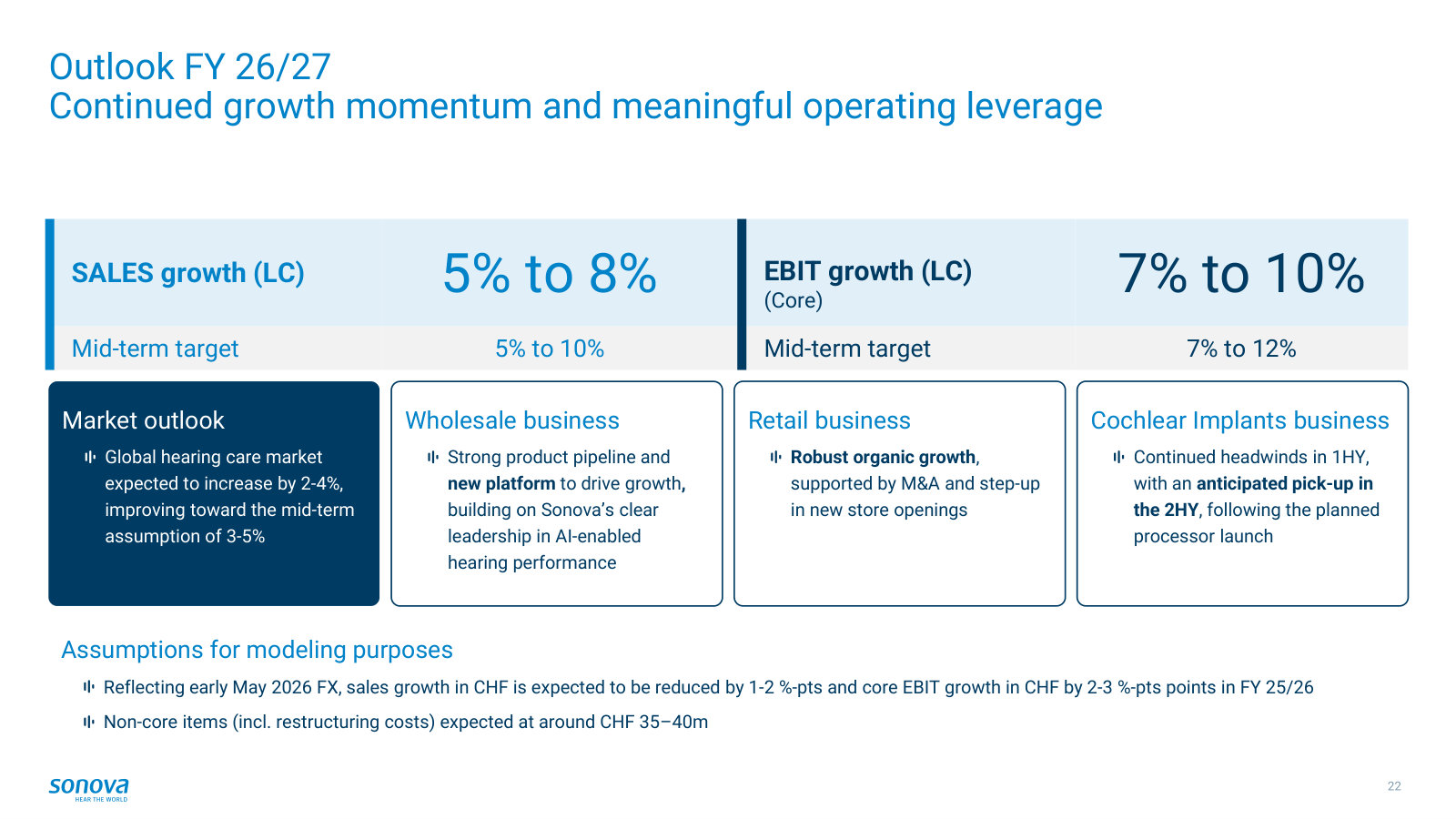
Investor & Analyst Day 2024 — 2024
The deepest single explainer of the business — market structure, the AI speech-in-noise technology moat, the retail (audiological care) segment and the operational-excellence system. · Open the full document →
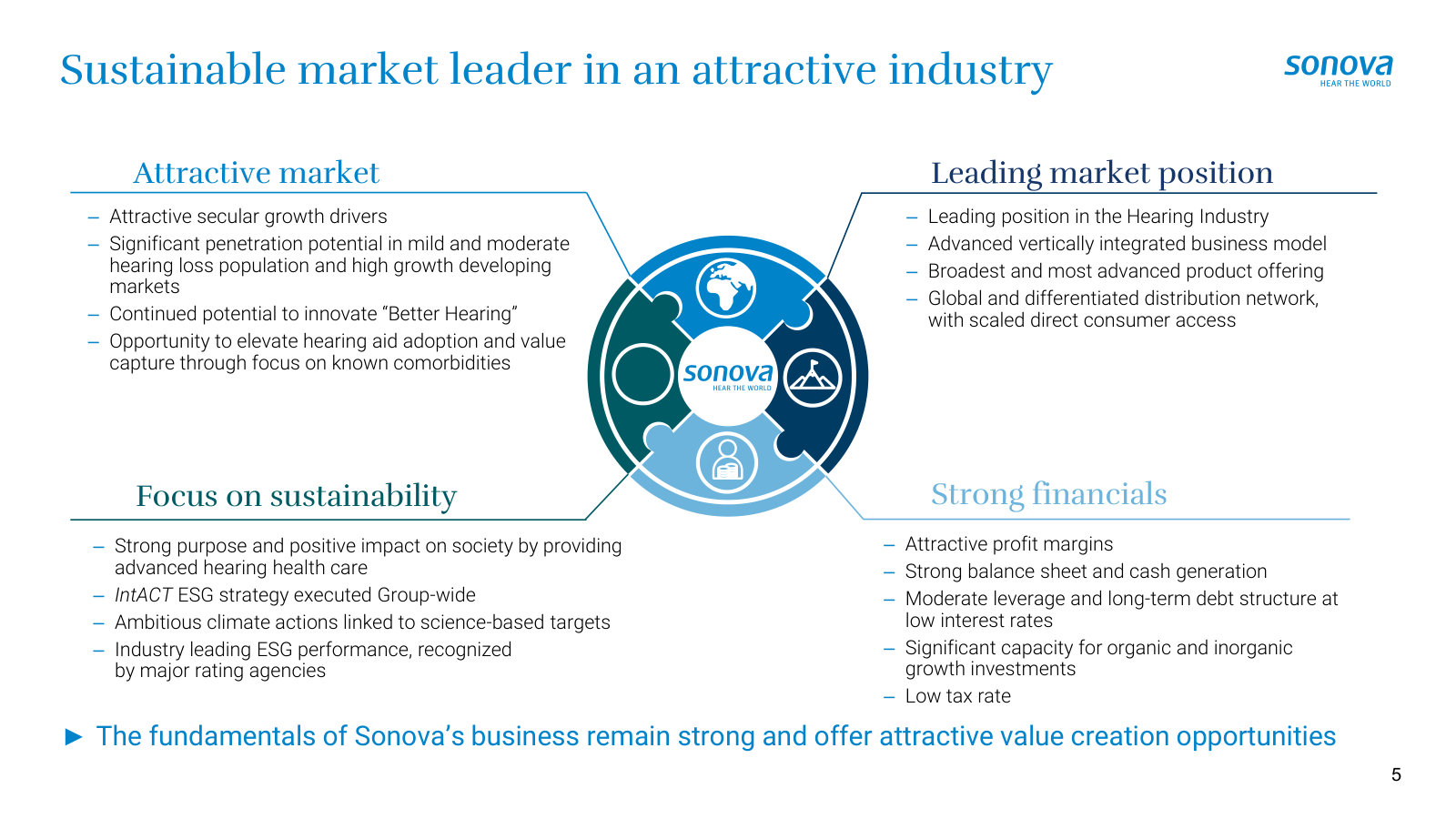
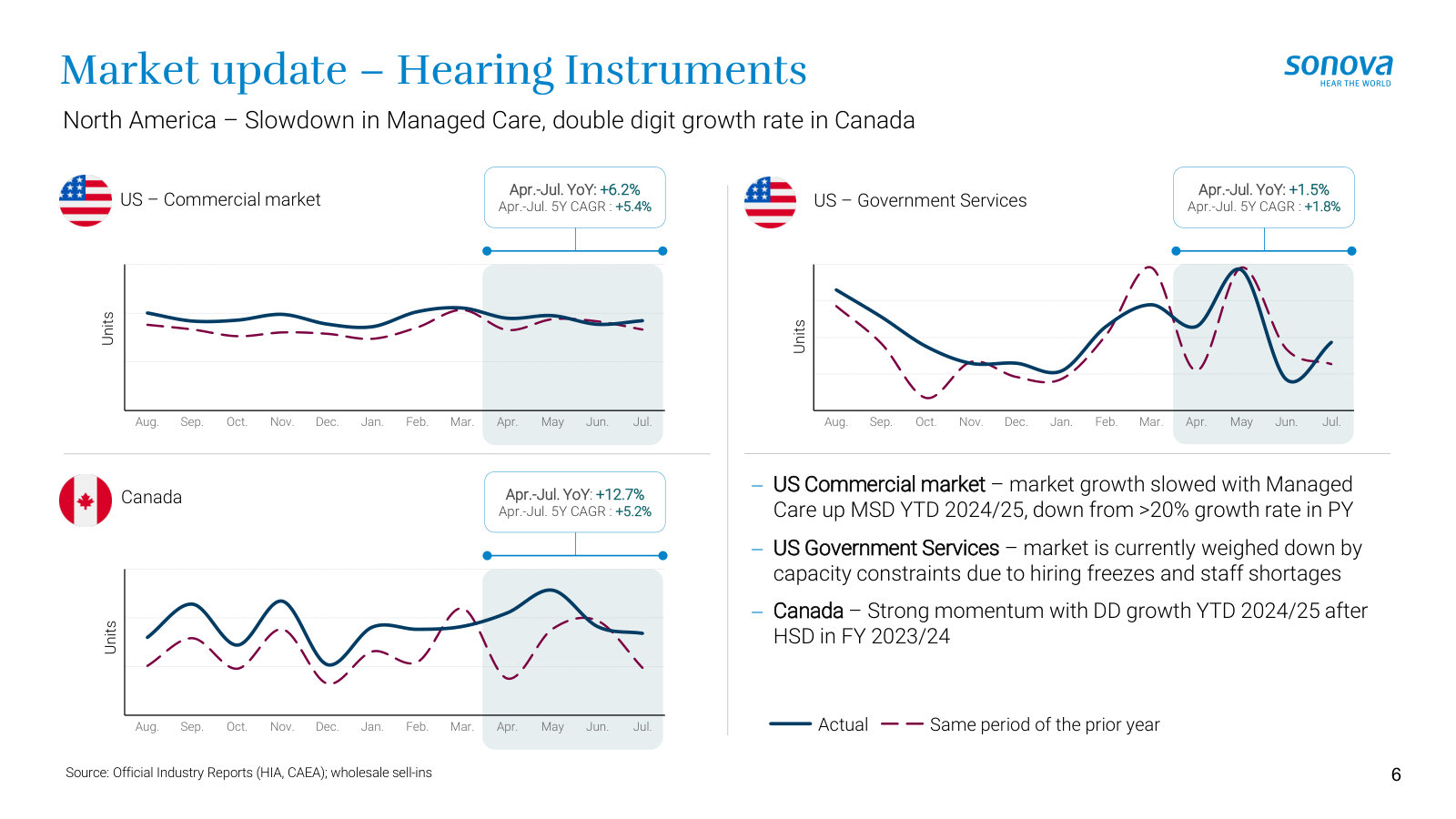
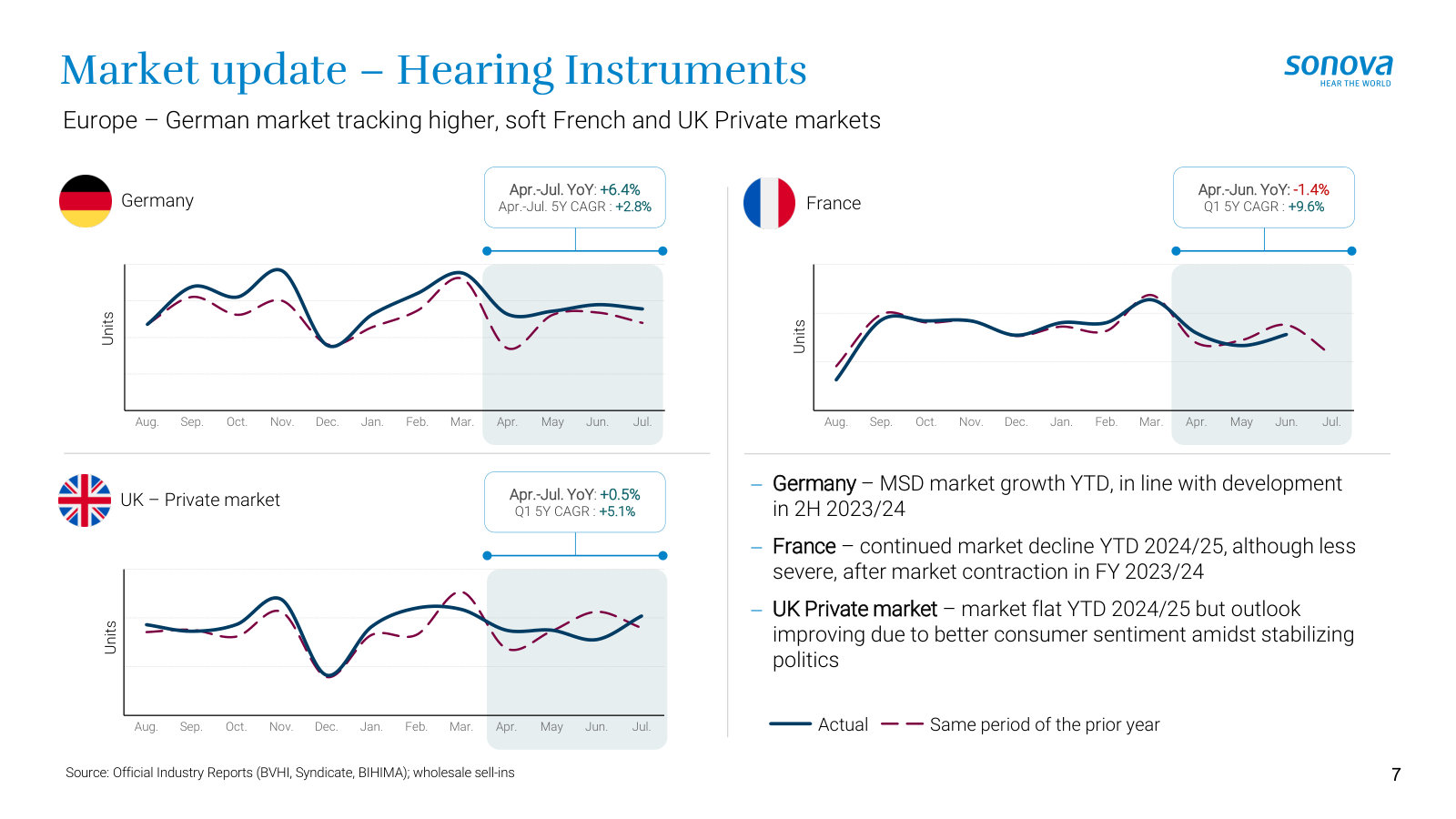
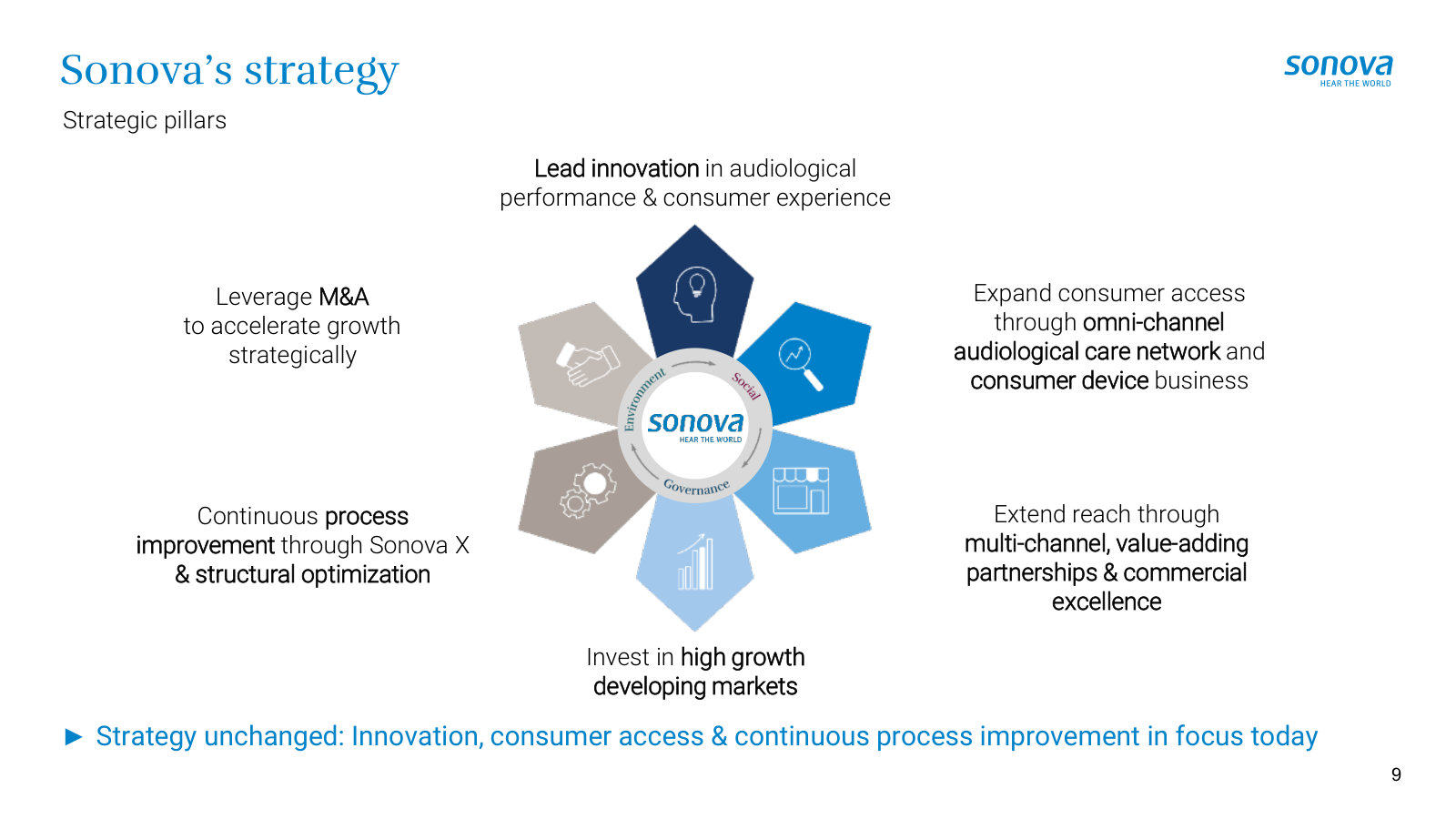
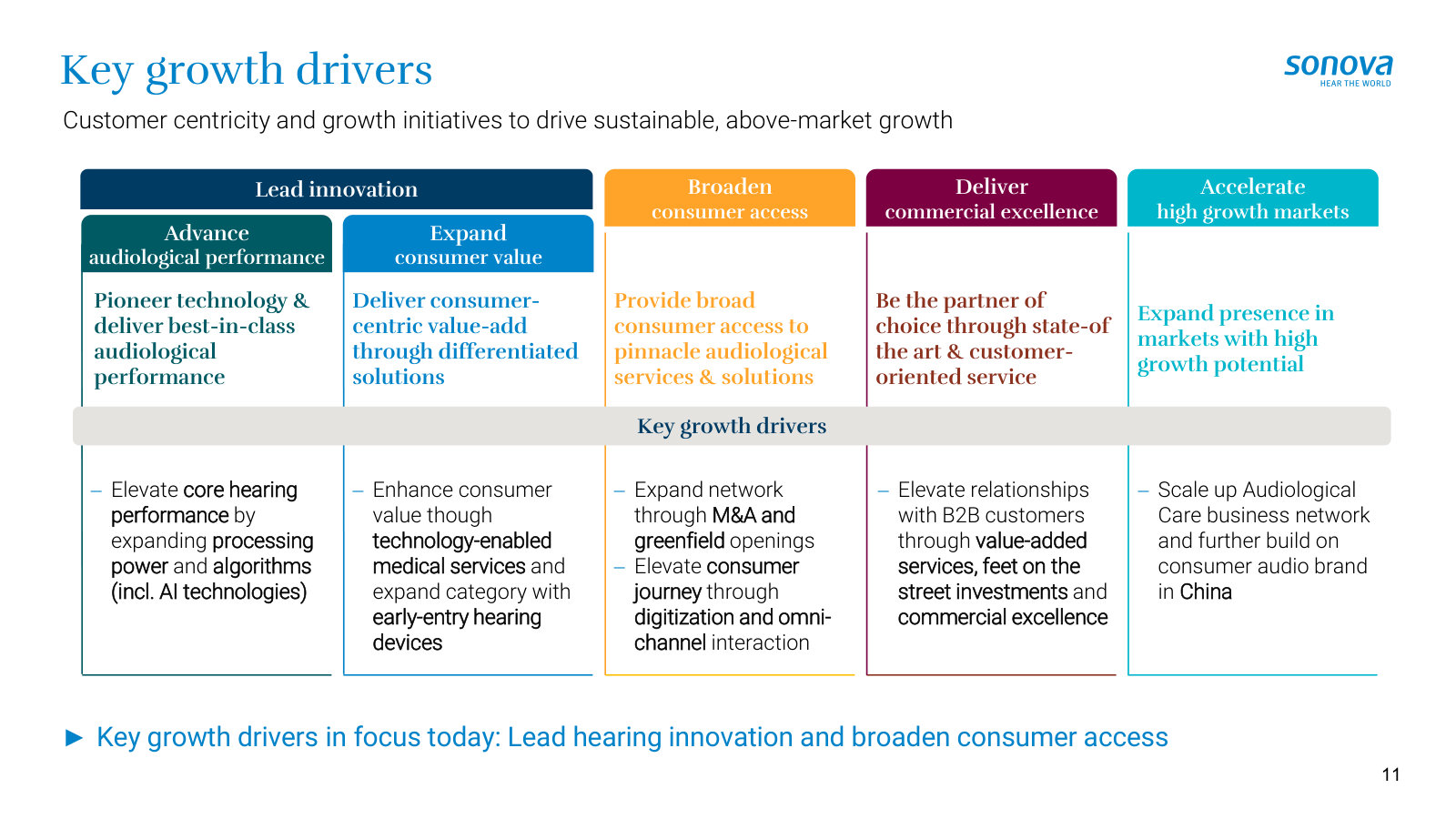
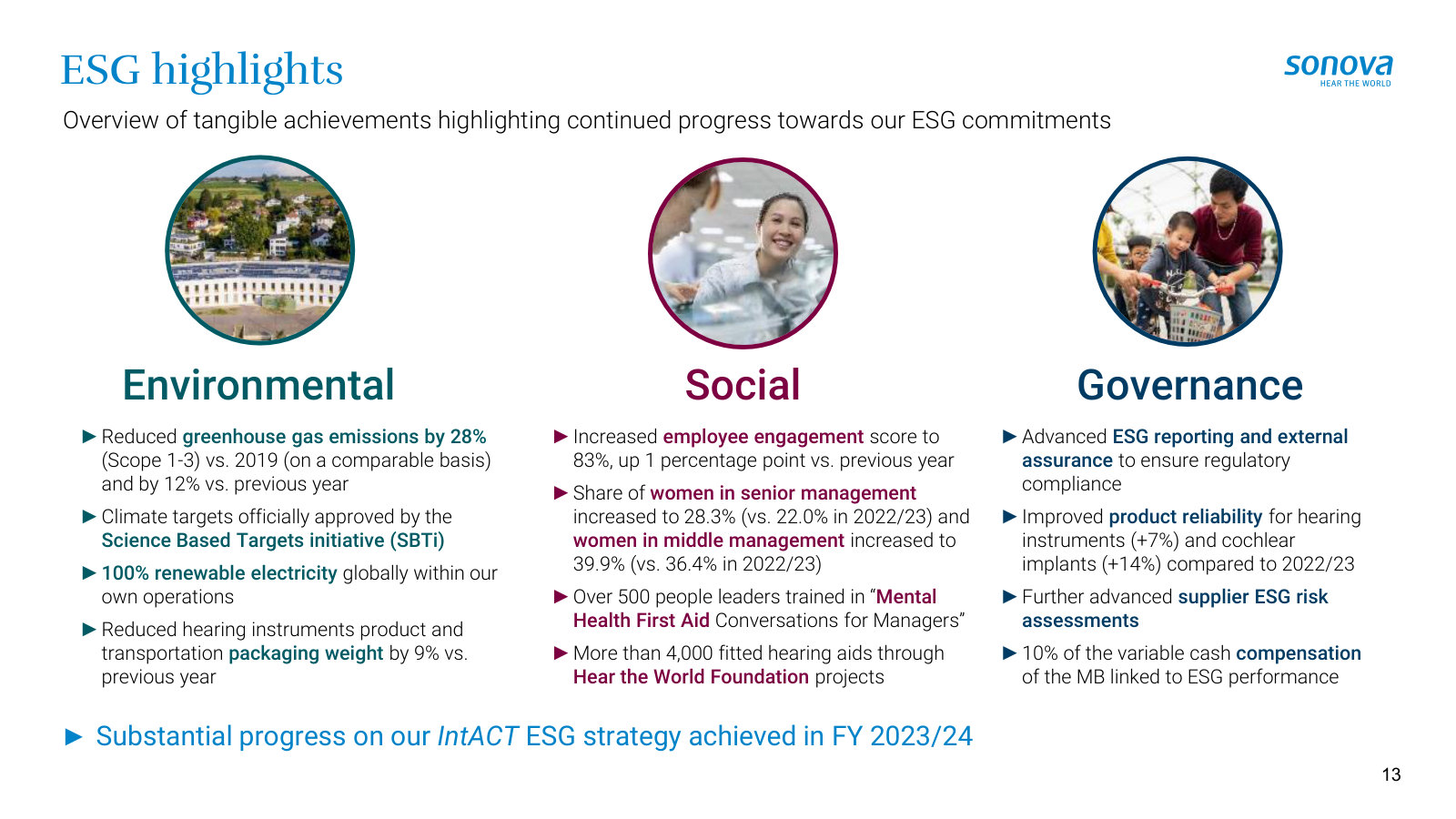
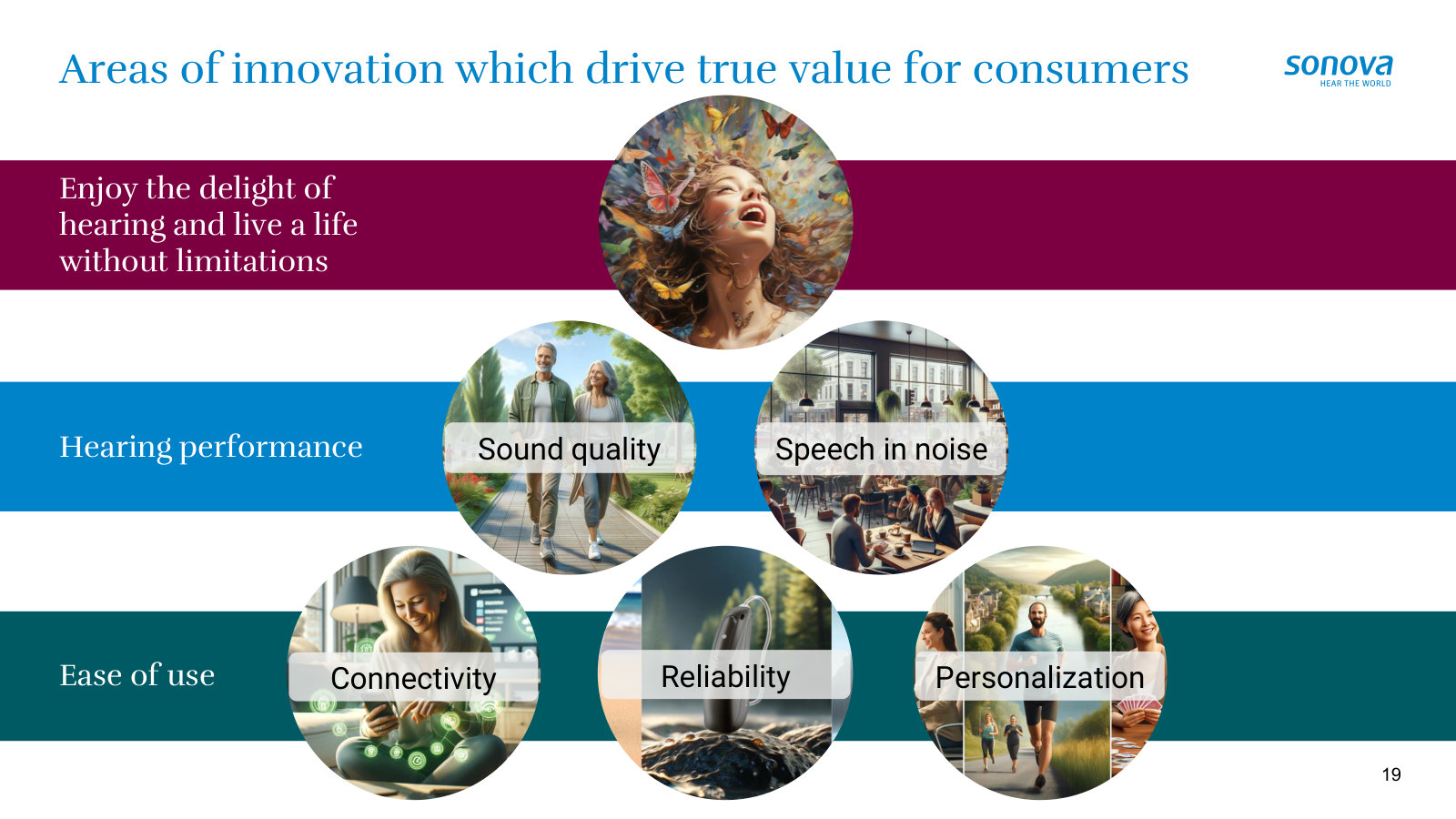
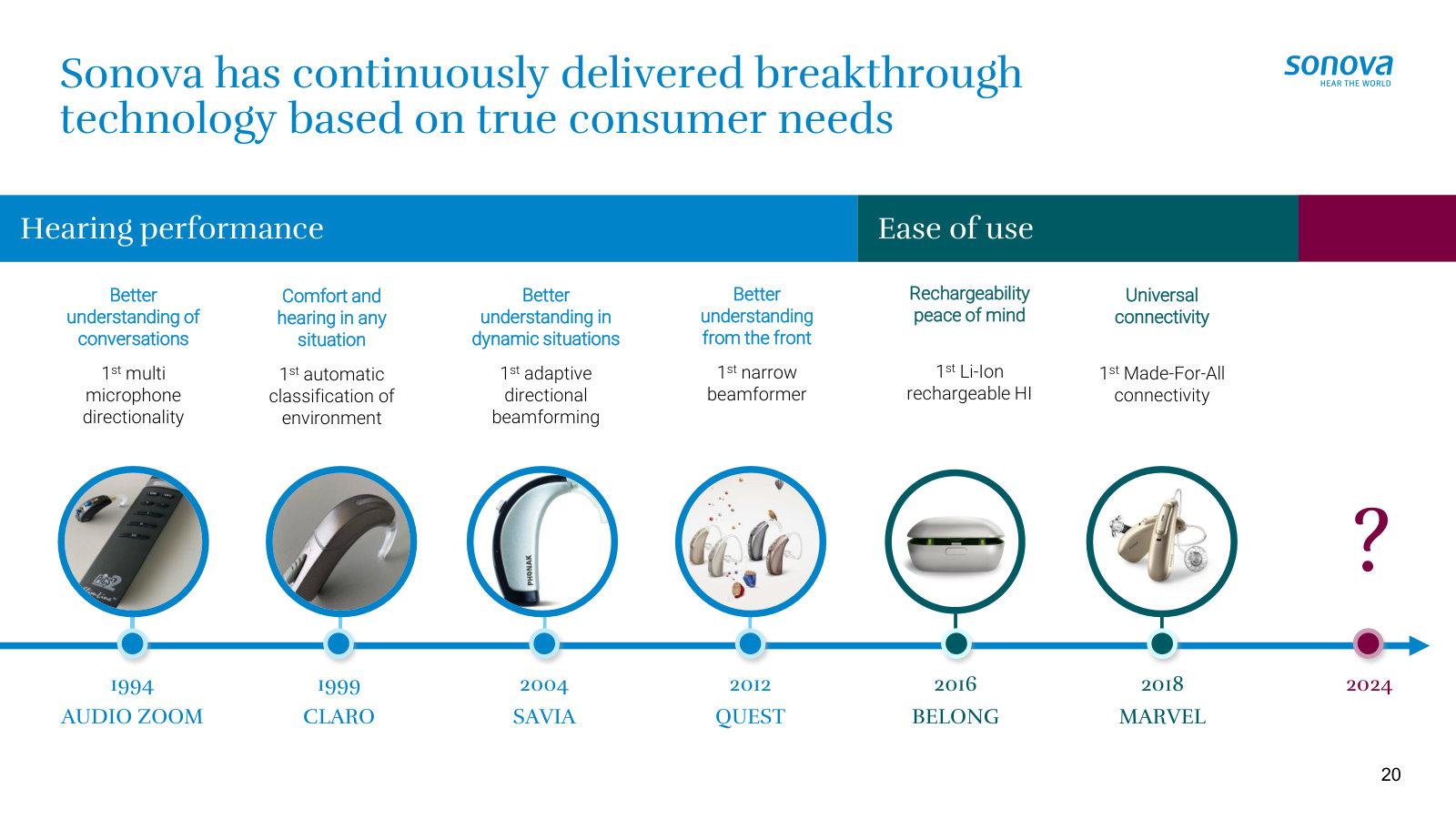
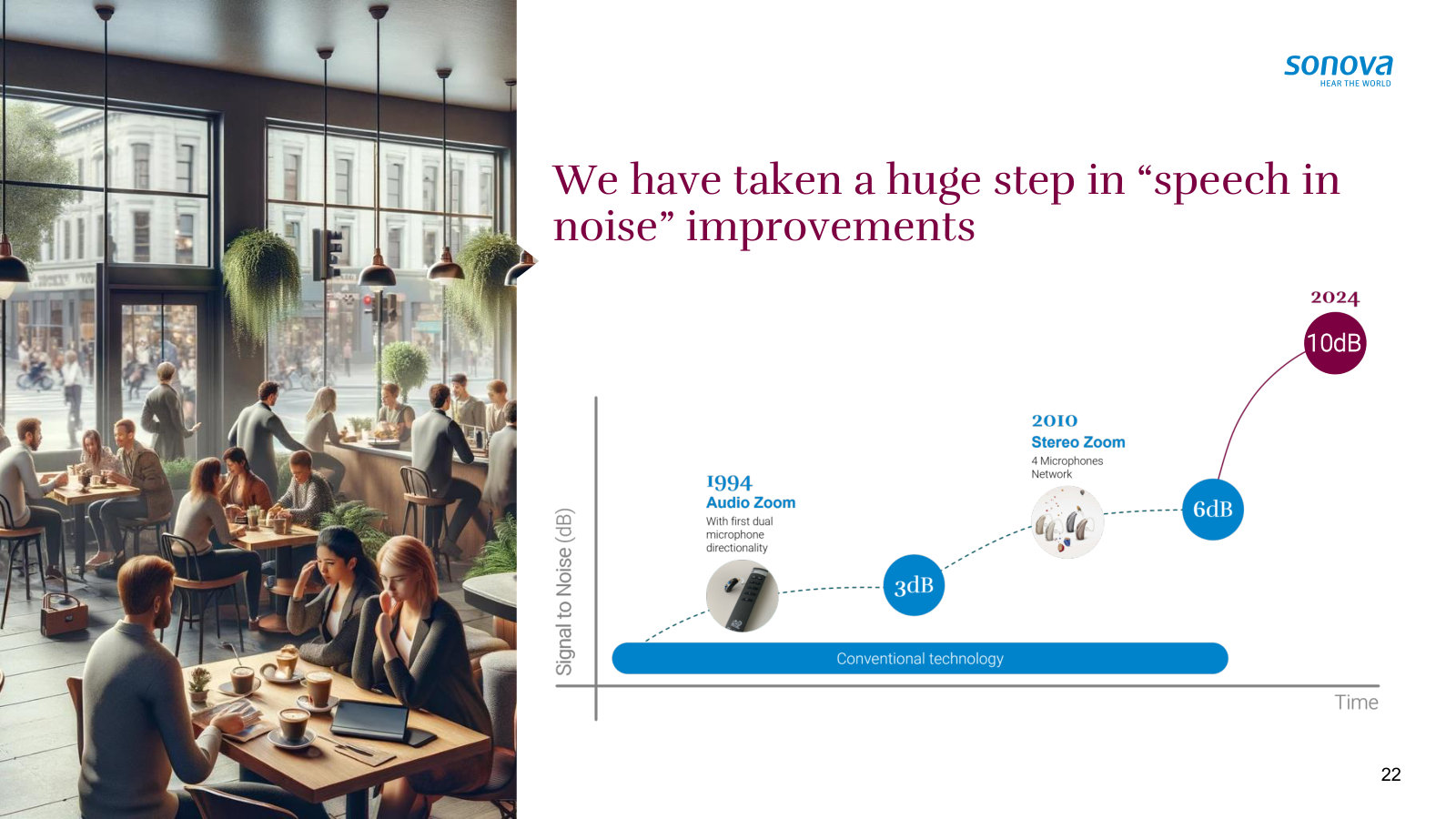
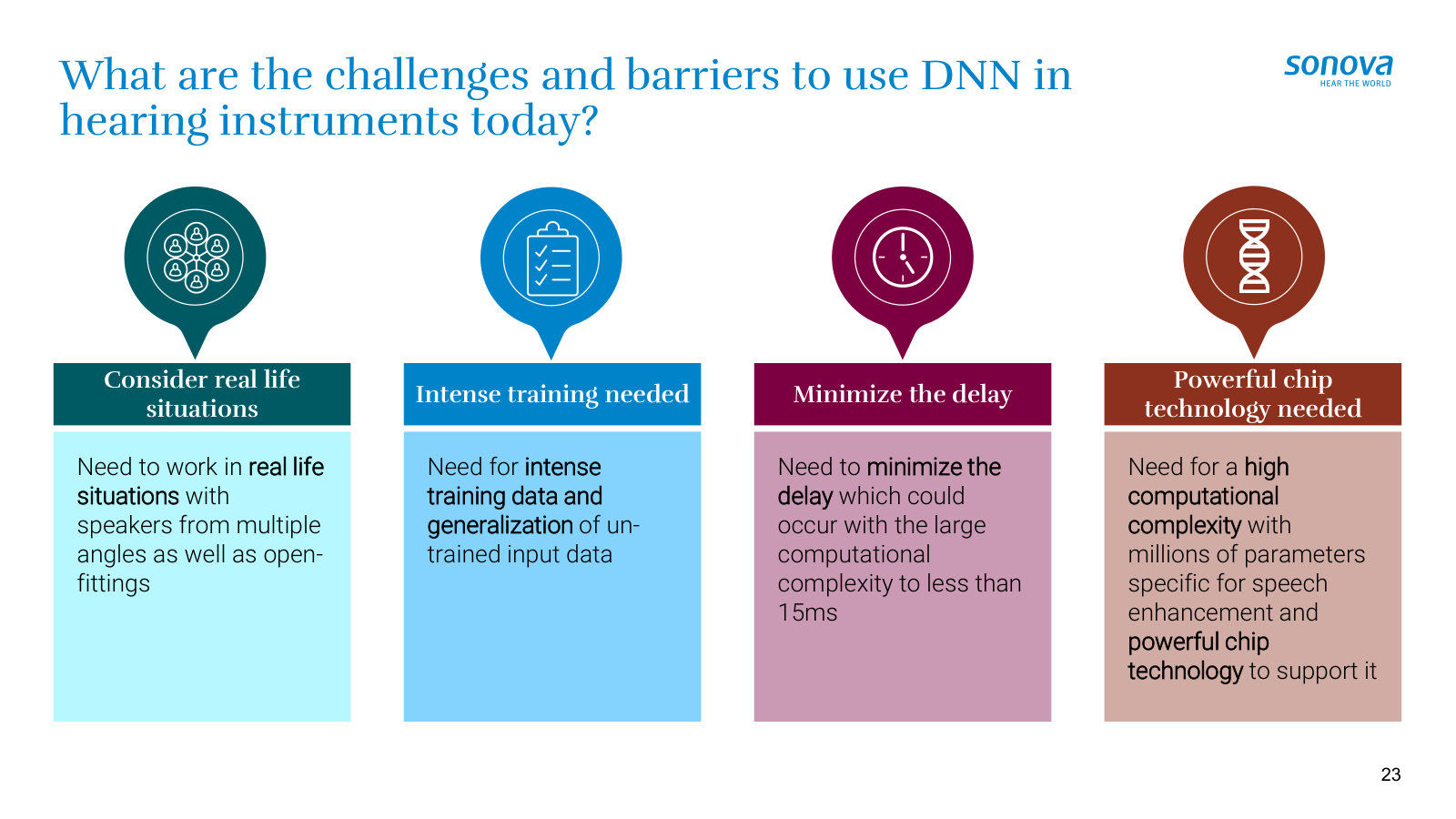
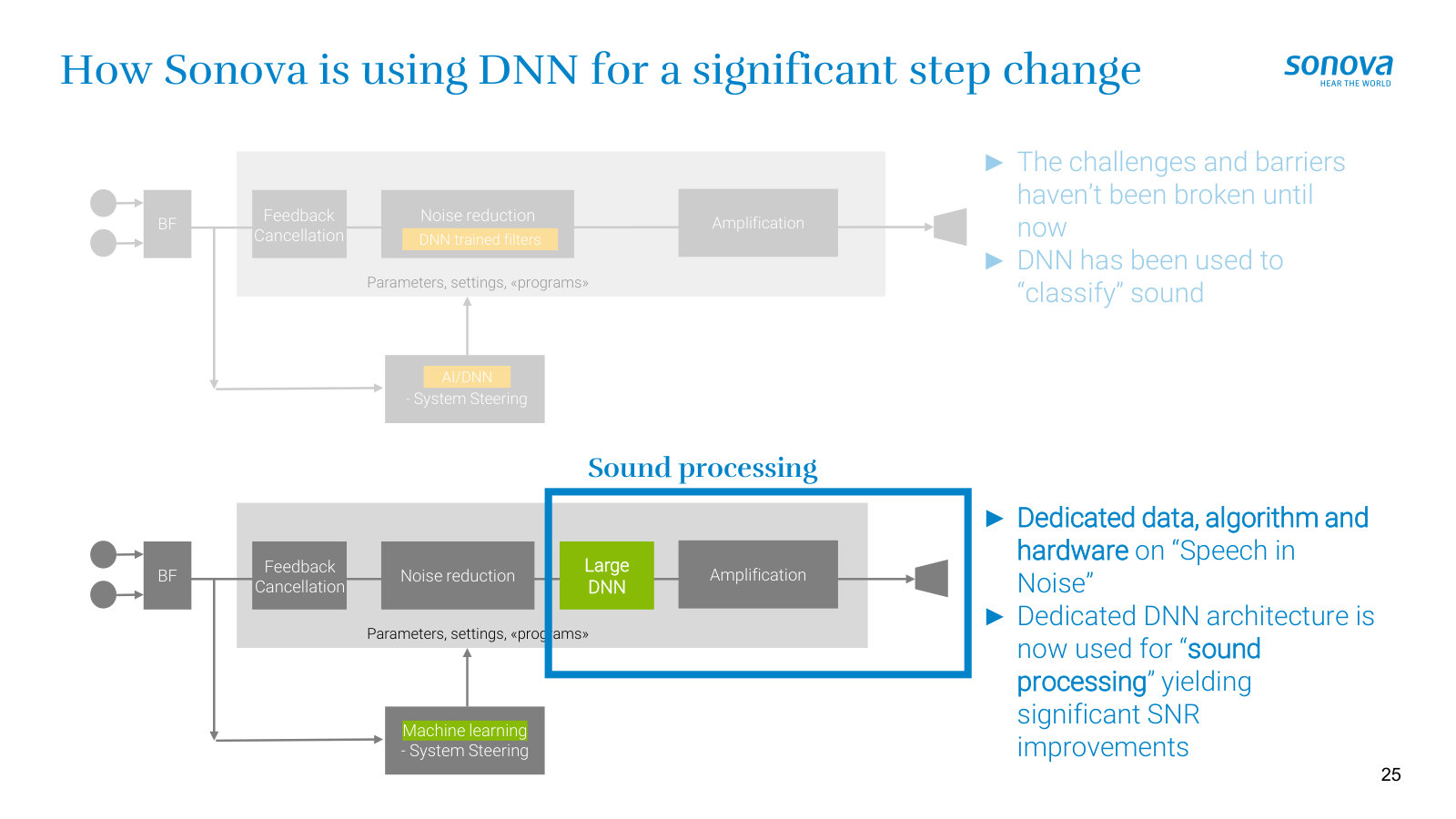
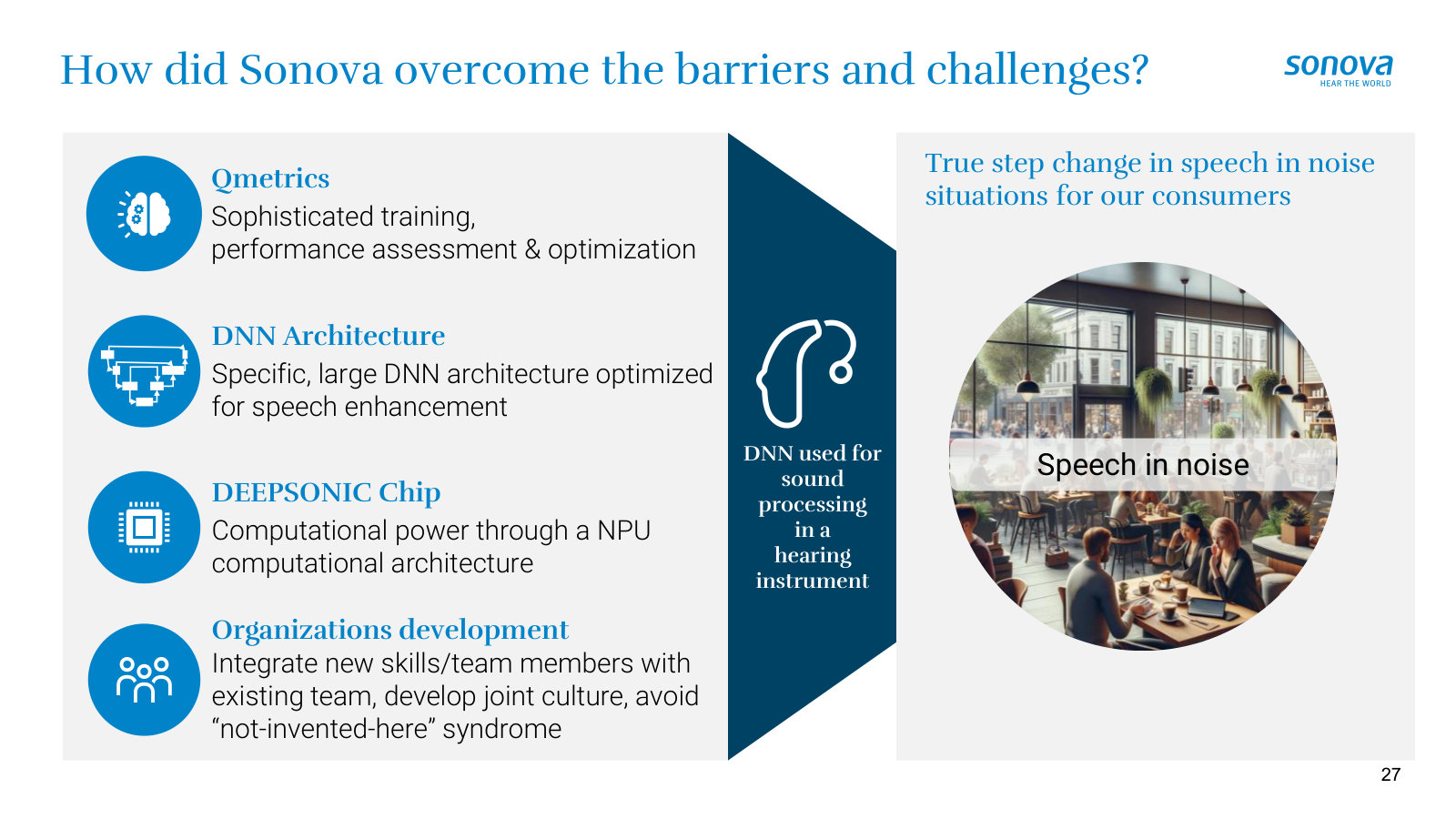
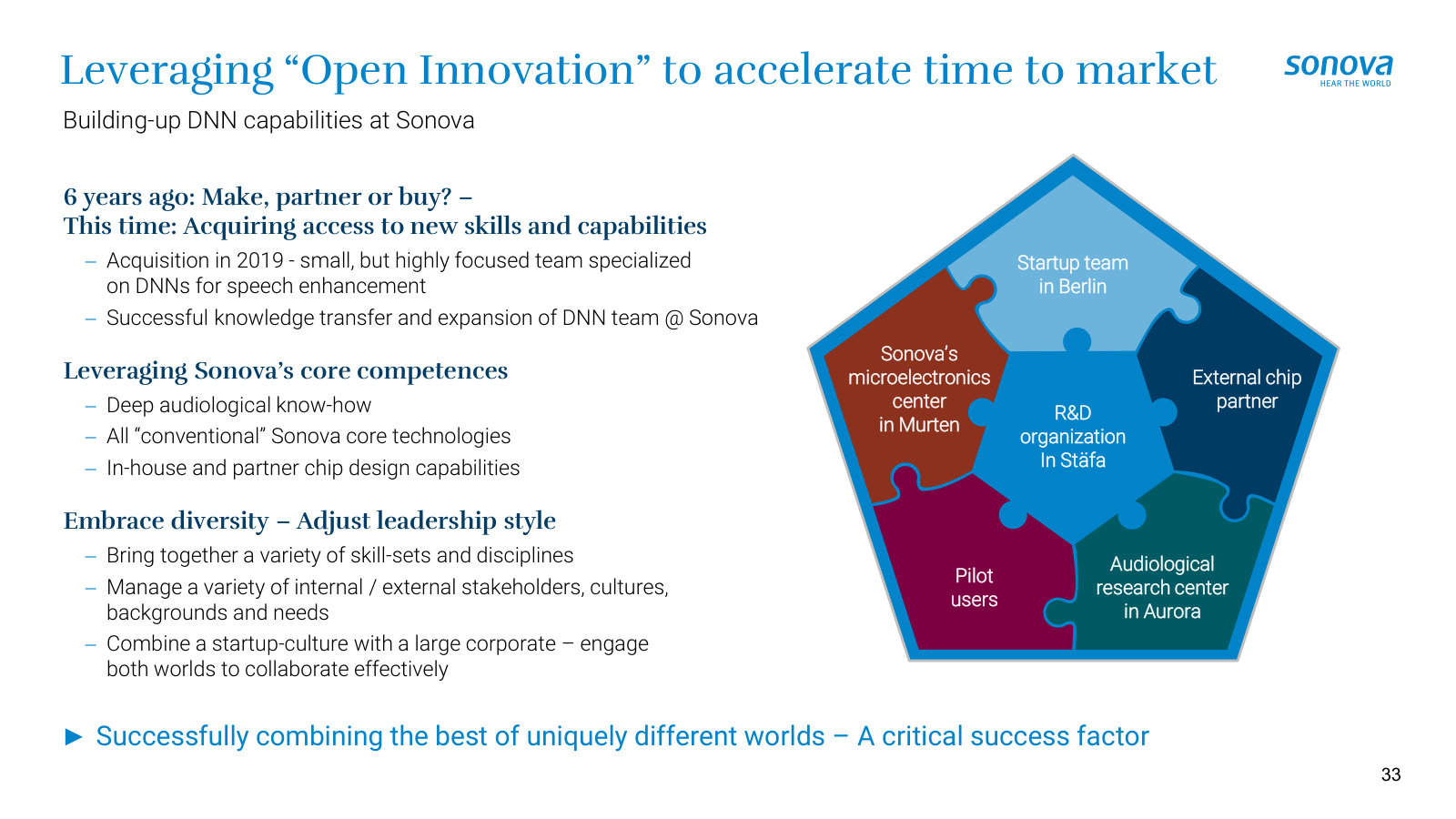
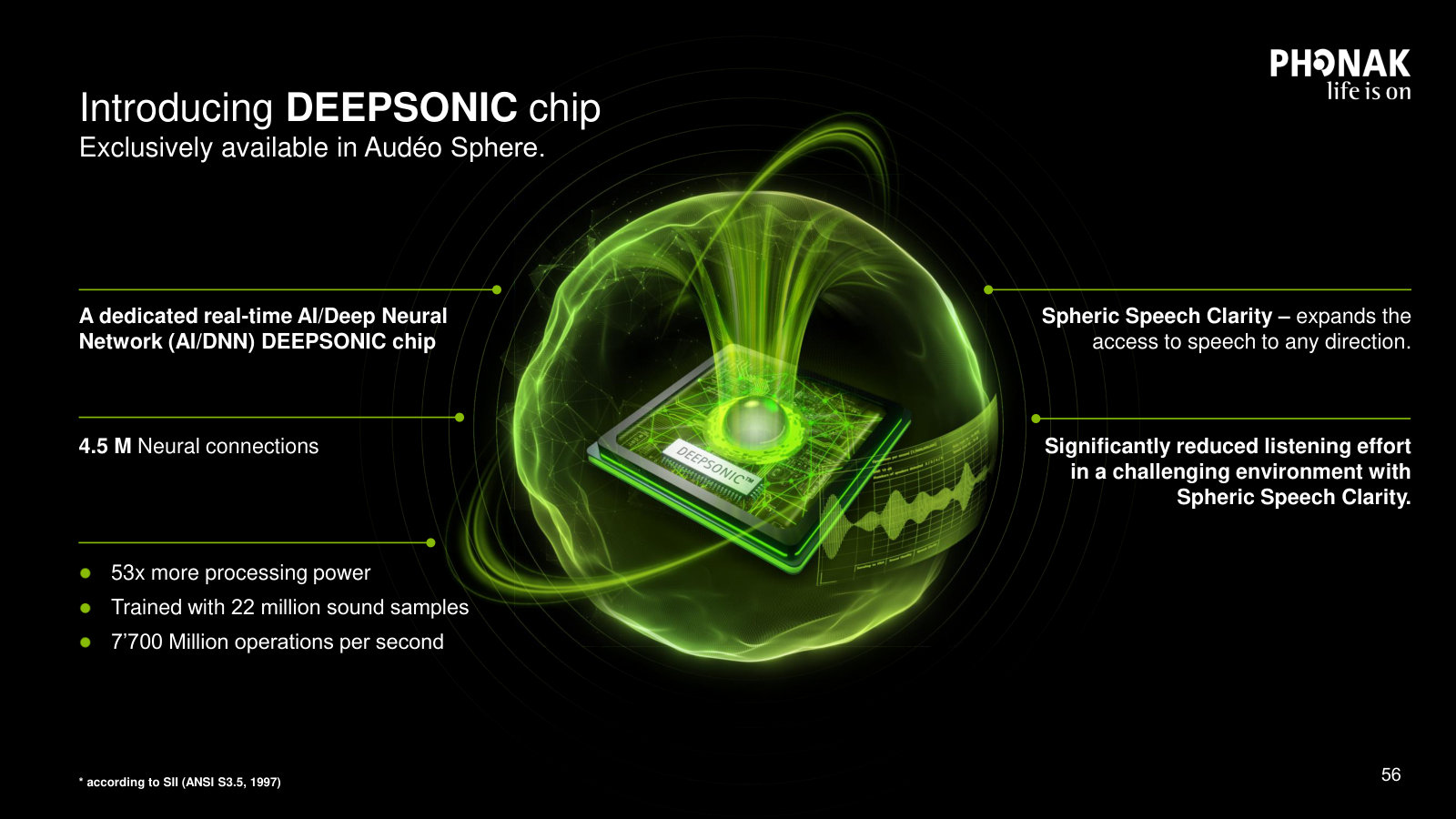
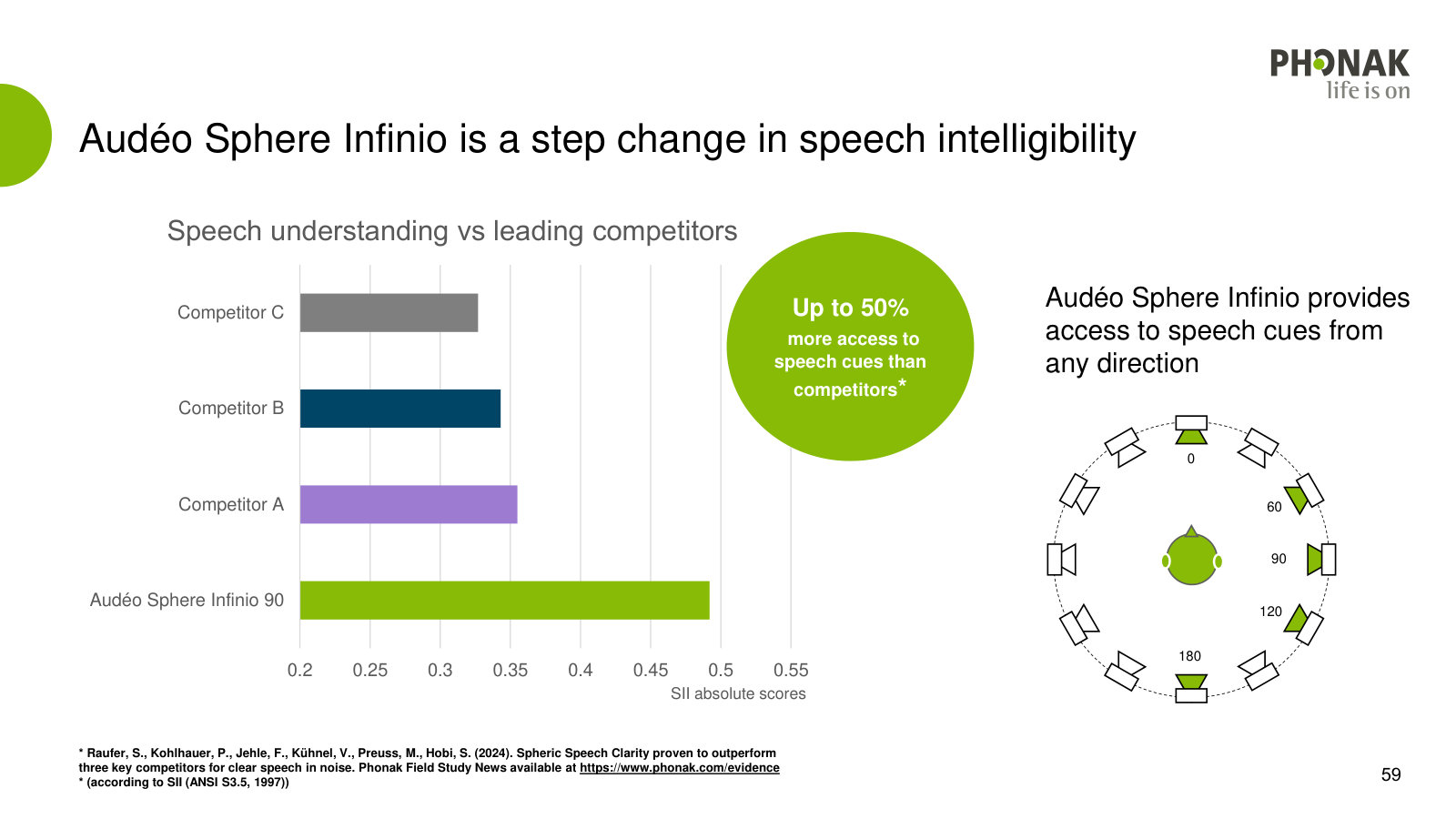
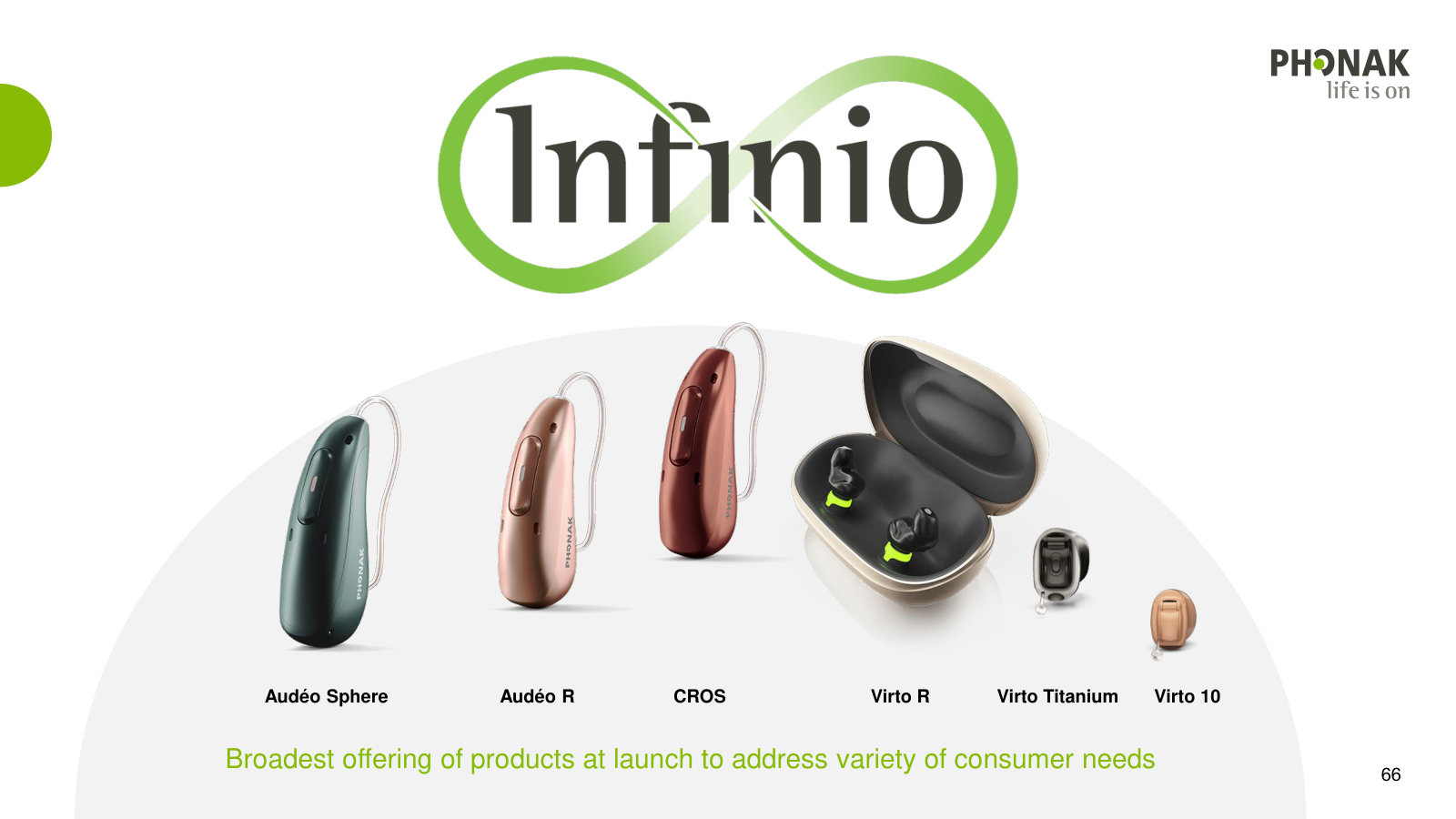
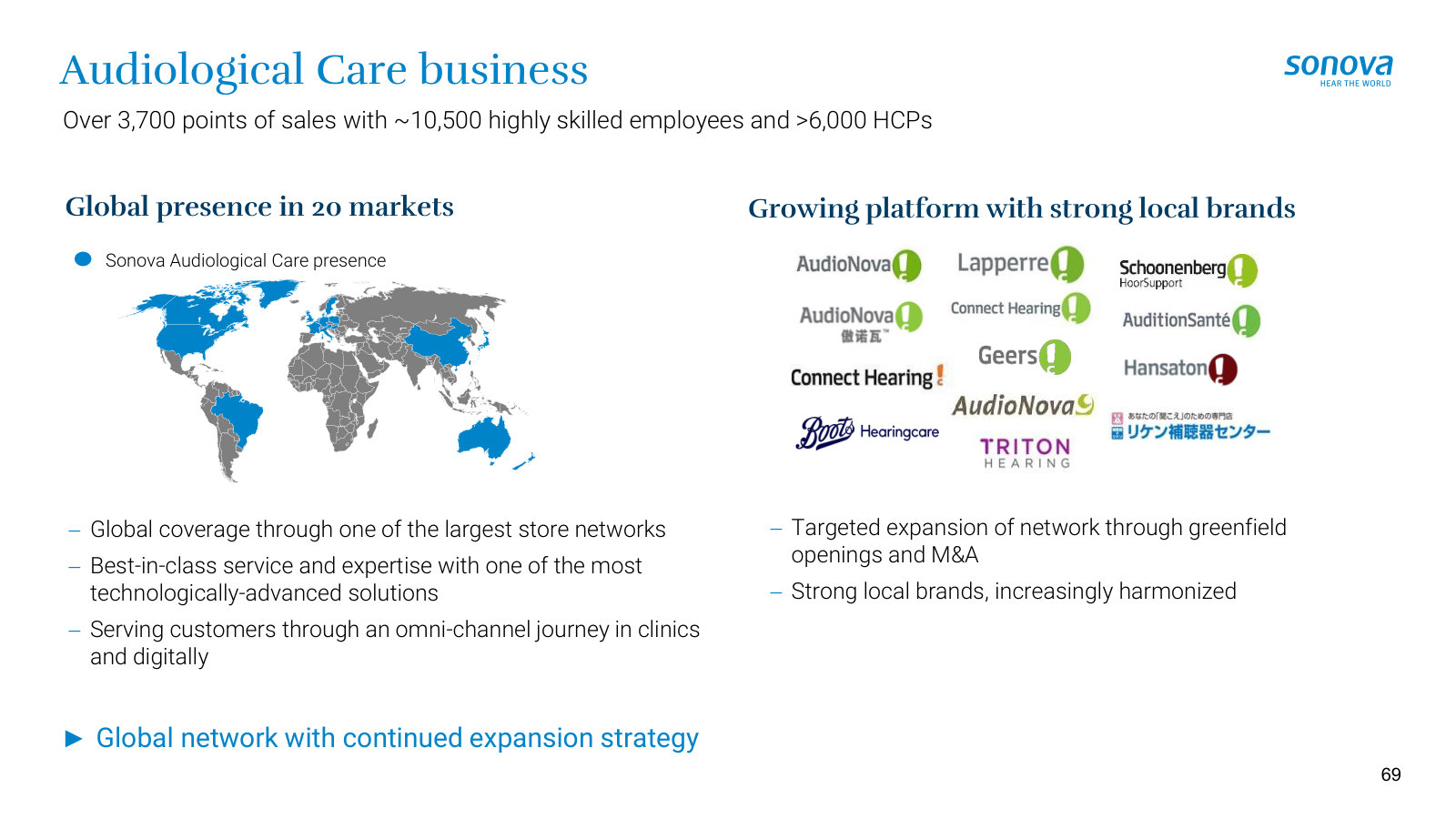
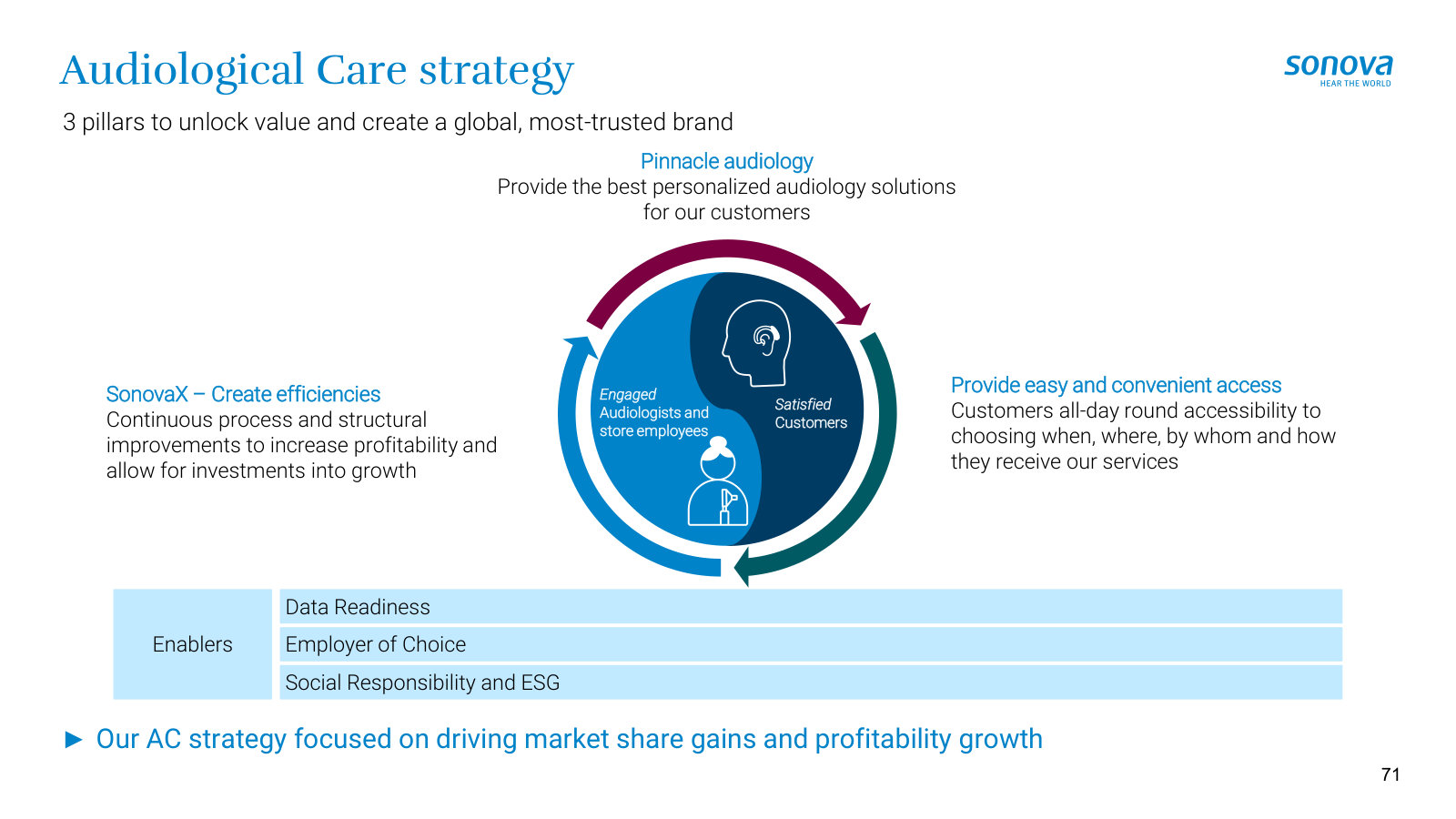
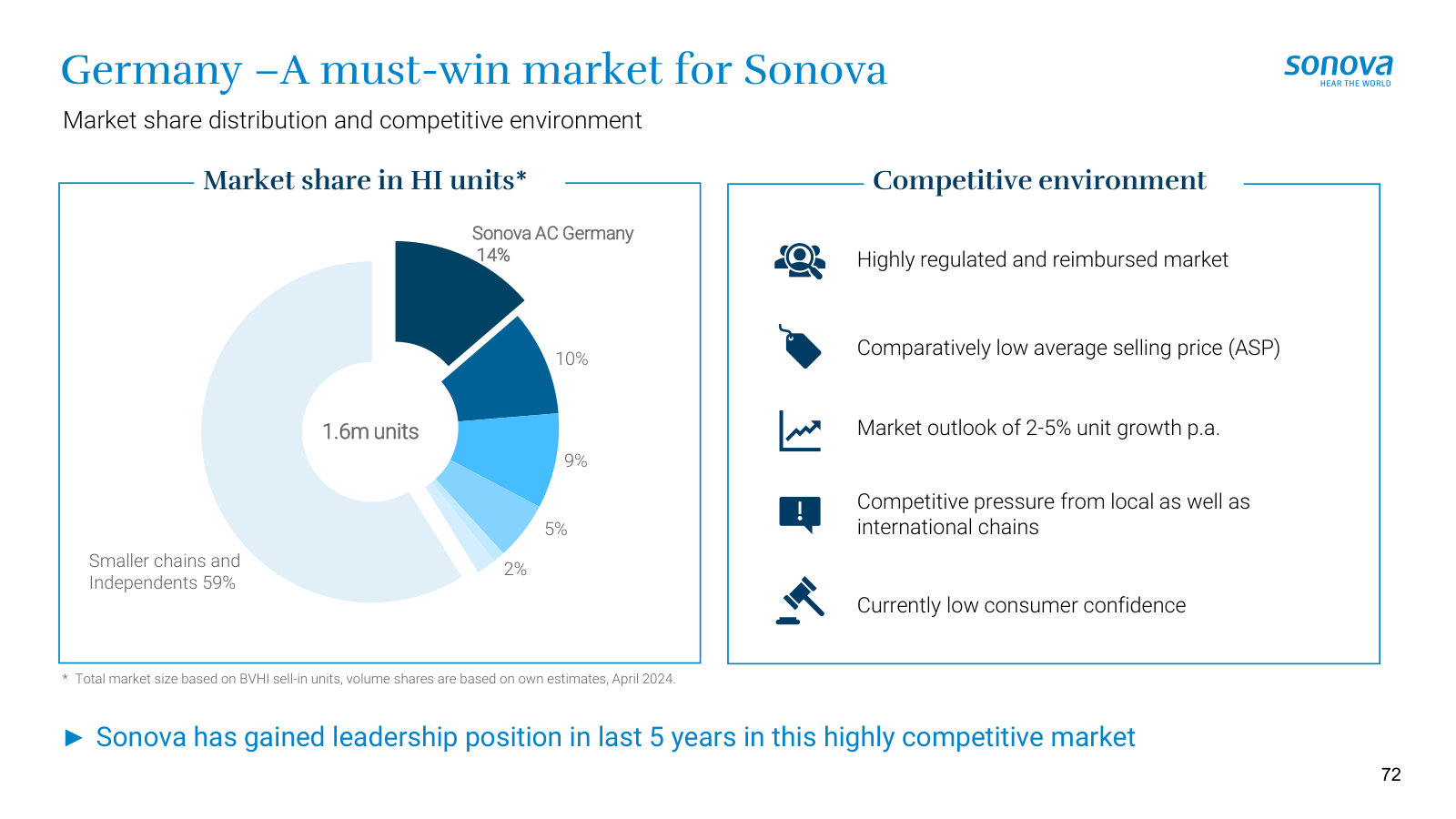
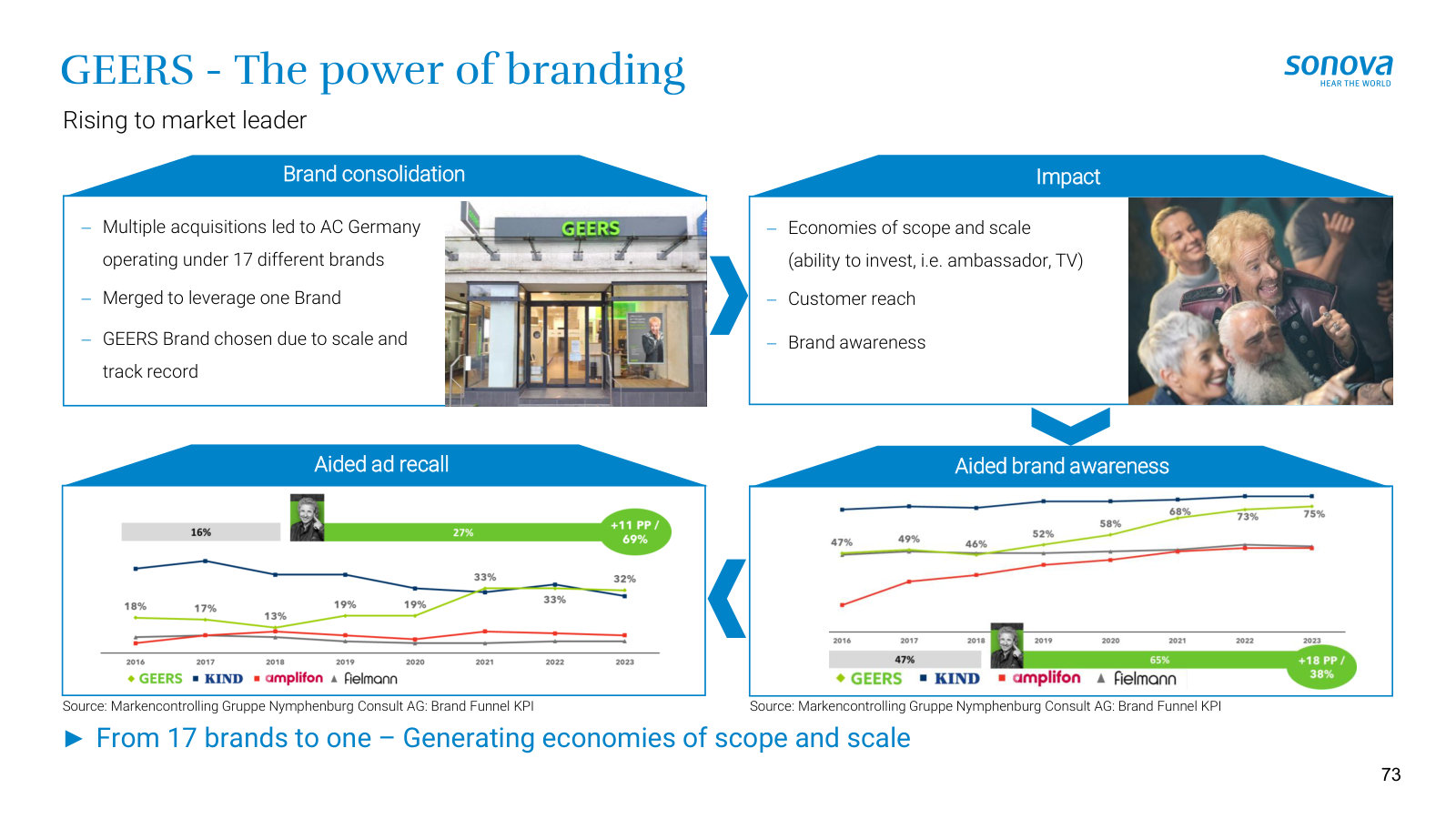
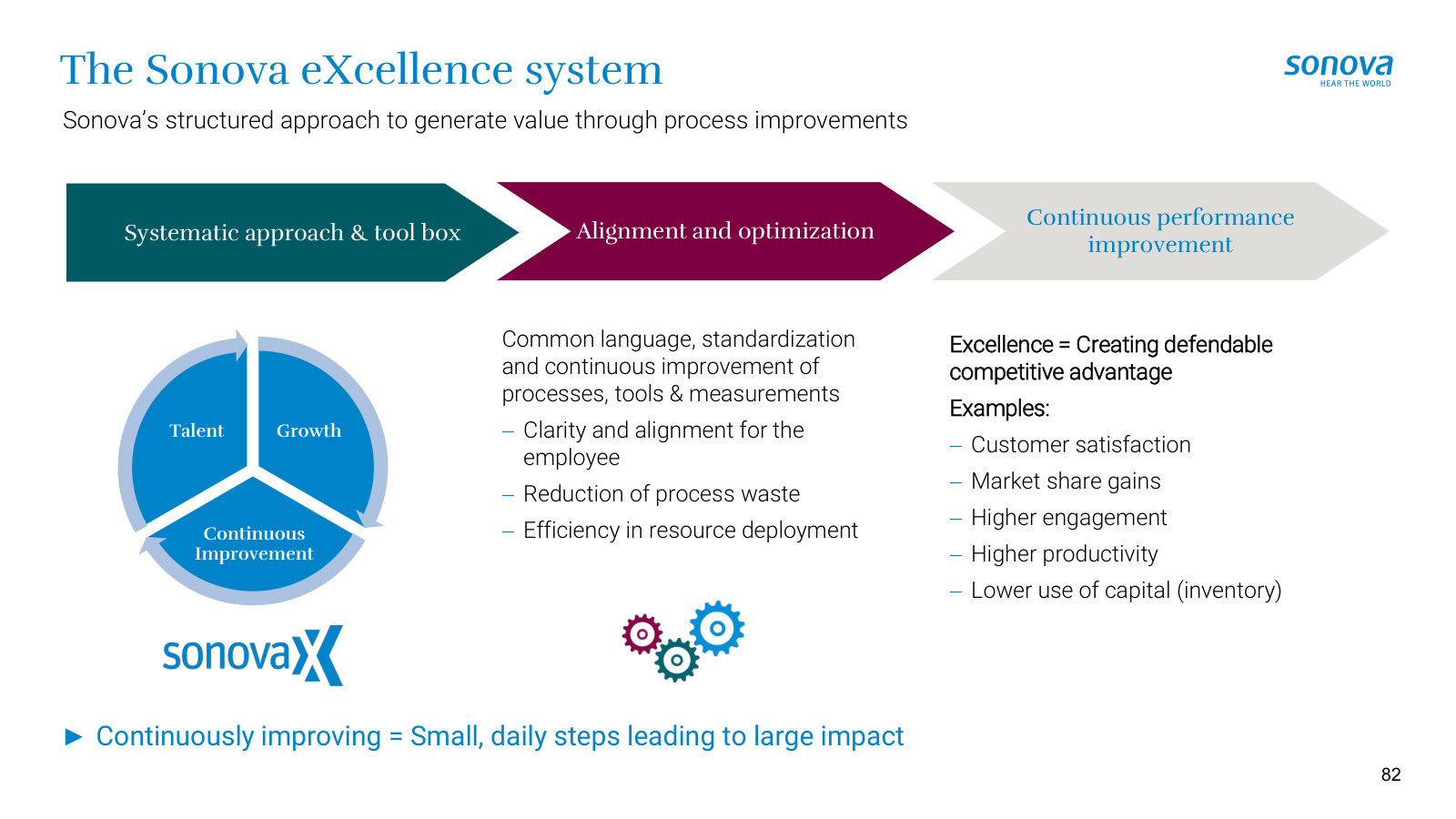
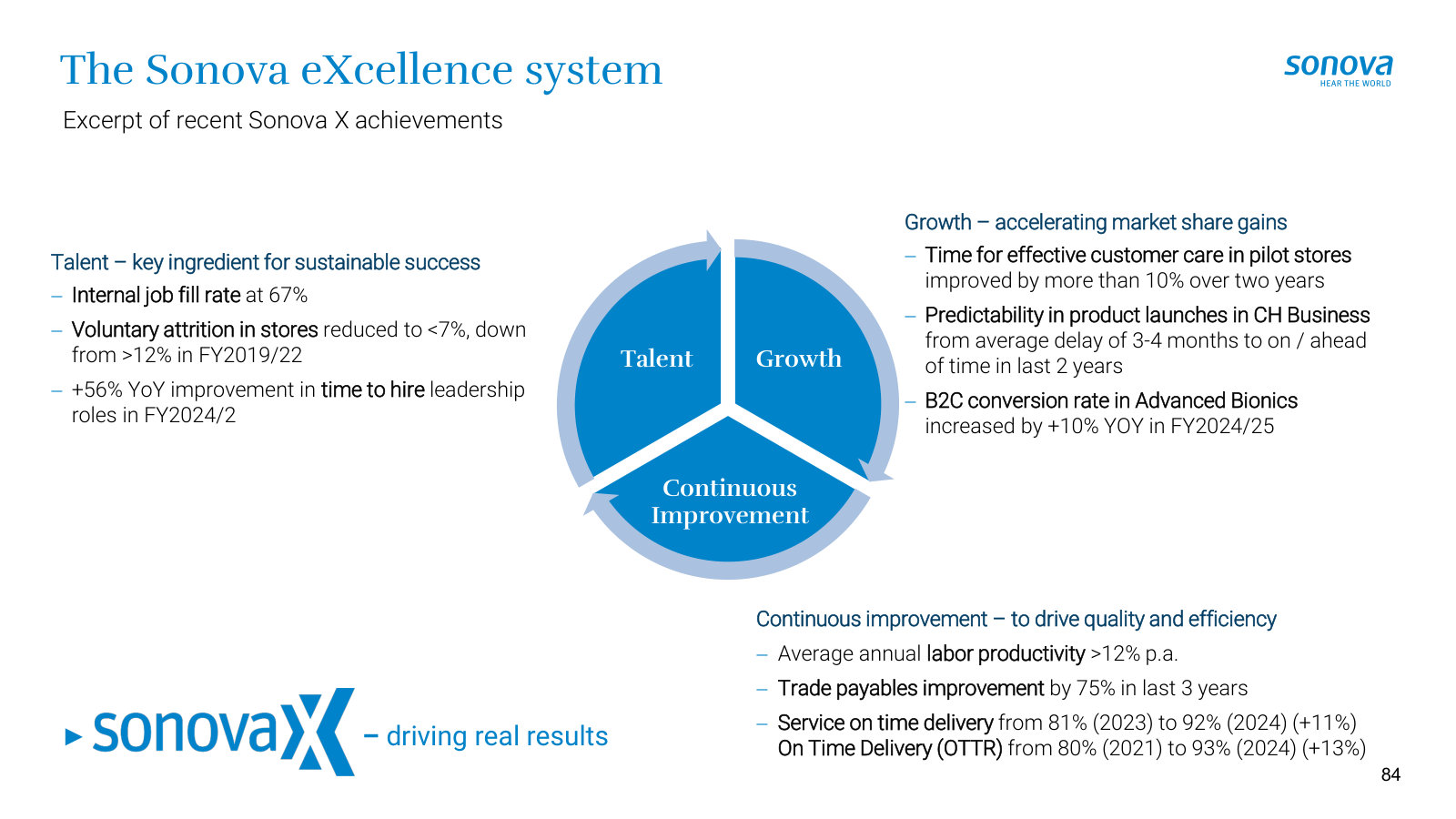
More from management
Half-Year Results 2025/26 — 1H FY2025/26 · 31 pages · The latest interim results and trading momentum in the window between the strategy update and the full-year print. · Open →
EUHA 2025 — Phonak Infinio Product Presentation — 2025 · 28 pages · A product-level deep dive on the Infinio / Sphere hearing-aid family and the Sphere AI technology, for readers who want the device detail. · Open →
Full Year Results 2024/25 — FY2024/25 · 47 pages · The prior-year results — the year-on-year base behind the FY2025/26 numbers. · Open →
J.P. Morgan Healthcare Conference 2025 — 2025 · 14 pages · A concise 14-slide company overview pitched at a generalist healthcare audience. · Open →
Sonova Holding AG's annual reports contain management's most considered account of the business. These are the sections, passages and visual pages worth opening in the originals preserved in Sources.
Sonova Holding AG — 2025/26 Annual Report (FY ended 31 March 2026) — FY2025/26
The latest report, written into a strategy reset: new leadership relaunches the strategy, sets a CHF 6bn-by-2030/31 goal, and divests Consumer Hearing. · Open the full document →
Letter to Shareholders — p. 4 · Read the full section →
Management's considered framing of the new chapter — the ambition, the transformation, and how the year's numbers support it.
New leadership's ambition: 5.9% local-currency growth, +17.3% normalized EBITA, and a CHF 6bn revenue target by 2030/31.
In the 2025/26 financial year, Sonova delivered sustained market share gains and meaningful operating leverage, reaffirming the strength of our business and illustrating that value-creating transformation and execution can go hand in hand. We achieved robust sales growth of 5.9% and a 17.3% increase in normalized EBITA, in local currencies and from continued operations. […] Our ambition is clear: to reach CHF 6 billion in revenue by 2030/2031, improve the lives of 30 million people, and strengthen our position at the intersection of medtech, technology, and lifestyle.
p. 5 · Read in context →
Our renewed strategy and ambition — p. 10 · Read the full section →
The March-2026 strategy reset and the market thesis behind it — the three priorities the rest of the report is organized around.
Low hearing-aid adoption is the structural tailwind; the reset rests on three priorities: innovate, succeed locally, excel in operations.
The world hearing care market shows clear signs of structural growth and Sonova is very well positioned to capture this opportunity. Demand is expected to continue expanding, driven by aging populations and longer treatment horizons. While the prevalence of hearing loss remains stable, persistently low adoption rates create significant headroom for growth across all regions – particularly in Asia. […] It is built around three strategic priorities: innovate for adoption, succeed locally with a multi-channel, multi-brand approach, and excel in operations for growth.
p. 10 · Read in context →
Financial Review — p. 88 · Read the full section →
The MD&A, and where management discloses the year's biggest structural change: divesting Consumer Hearing and renaming the segments.
23 March 2026: Consumer Hearing to be divested (now discontinued ops); Hearing Instruments recast as Wholesale plus Retail.
On 23 March 2026, Sonova announced that, following a strategic portfolio review, Sonova intends to divest its Consumer Hearing business. As a result, the business is classified as discontinued operations, and the relevant comparative figures for the 2024/25 financial year have been restated accordingly. Figures and growth rates refer to continuing operations and exclude the Consumer Hearing business, unless otherwise stated. In addition, the Hearing Instruments business will be referred to as the Wholesale business, and the Audiological Care business as the Retail business, from this point forward.
p. 89 · Read in context →
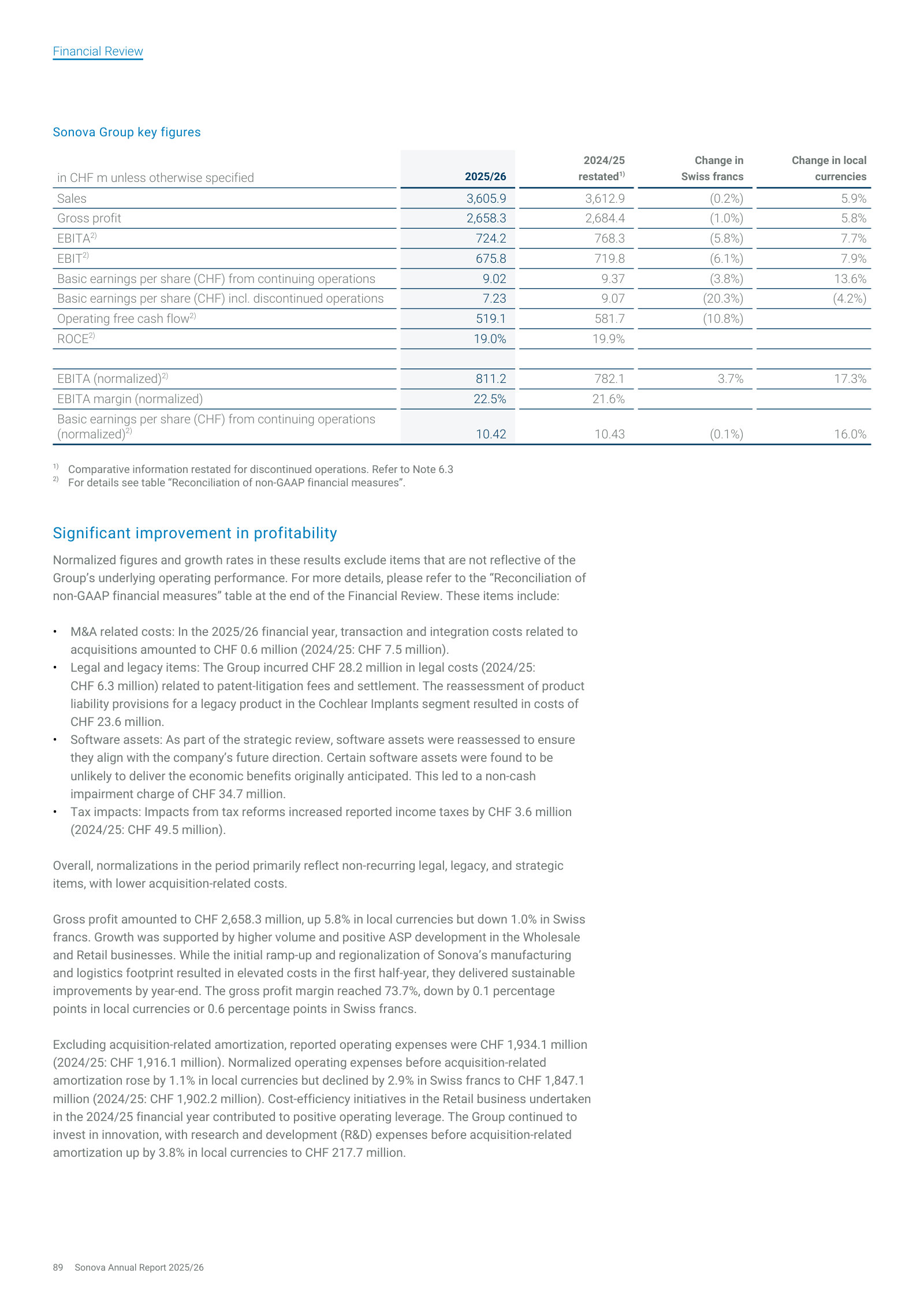
Hearing Instruments segment – Strong sales growth — p. 91 · Read the full section →
The core engine (93% of sales): Wholesale accelerated on new product launches while Retail grew on reinvested cost savings.
Wholesale +9.5% on Infinio Ultra and Virto R Infinio; Retail +5.1% as cost savings fund lead generation.
Sales in the Hearing Instruments segment totaled CHF 3,353.8 million, reflecting an increase of 7.5% in local currencies and 1.4% in Swiss francs. Organic sales growth was 6.9%, while acquisitions contributed an additional 0.6% equating to CHF 18.7 million.
Sales in the Wholesale business reached CHF 1,861.8 million, up 9.5% in local currencies. Growth was driven by strong market reception of Infinio Ultra, which built on the success of the Infinio and Infinio Sphere™ platforms, and of Virto R Infinio. As a result, the business significantly expanded its market share globally and achieved double-digit growth in the second half-year, on a much higher comparison base from the prior-year period, reflecting the strong momentum.
The Retail business reported sales of CHF 1,491.9 million, representing an increase of 5.1% in local currencies. Organic growth reached 3.8%. Reinvesting a portion of cost savings from measures implemented in the 2024/25 financial year into targeted lead-generation initiatives contributed to above-market growth. Acquisitions lifted sales by 1.3% (including the full-year effect of prior year acquisitions), mainly in Germany, Australia, and Canada.
p. 91 · Read in context →
Cochlear Implants segment – Continued headwinds — p. 92 · Read the full section →
The company-specific soft spot: China volume-based procurement and a competitor's launch drove a double-digit decline.
Cochlear Implants −11.1% in local currency on China VBP and a top competitor's launch; ex-China systems roughly flat.
Sales in the Cochlear Implants segment totaled CHF 252.1 million, a decline of 11.1% in local currencies and 17.1% in Swiss francs. System sales were down 10.3% in local currencies. The business in China was substantially hampered by challenges following the introduction of volumebased procurement (VBP). Developed markets saw increased competitive pressure following a product launch by the largest competitor in the second half-year. Excluding China, system sales were up 0.7% in local currencies. Sales of upgrades and accessories were down by 13.1% in local currencies, as many recipients have already adopted the Marvel sound processor technology introduced in 2021.
p. 92 · Read in context →
Five Year Key Figures — p. 96 · Read the full section →
One page of five-year trend for sanity-checking the story: sales, margins, EPS, dividend, net debt and returns.
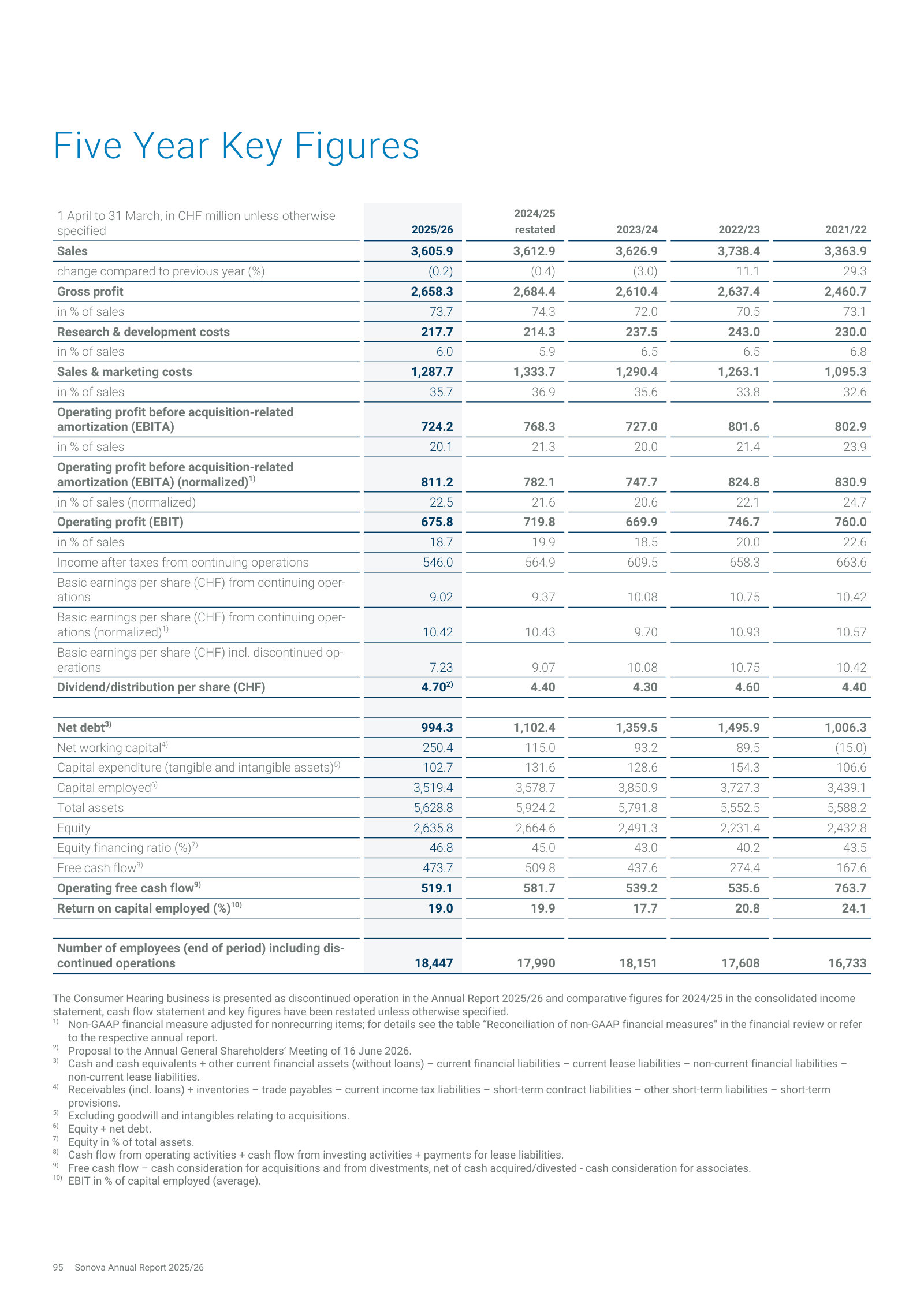
Key audit matters — p. 167 · Read the full section →
What the auditor singled out as the real estimation risks — goodwill and the Advanced Bionics product-liability provision.
Goodwill of CHF 2,284.2m is 41% of assets and 87% of equity — its carrying value rides on management's growth and margin assumptions.
As of 31 March 2026, the Group has goodwill of CHF 2,284.2 million representing 41% of the Group’s total assets and 87% of the Group’s total equity. Per note 3.5, goodwill is tested for impairment at least annually. In performing the impairment analysis, management applies considerable judgment in respect of future market and economic conditions, such as economic growth, expected inflation rates, demographic developments, expected market share, revenue and margin development of the cash generating units (CGUs) to which goodwill has been allocated. Changes in these assumptions might lead to a change in the carrying value of goodwill.
p. 167 · Read in context →
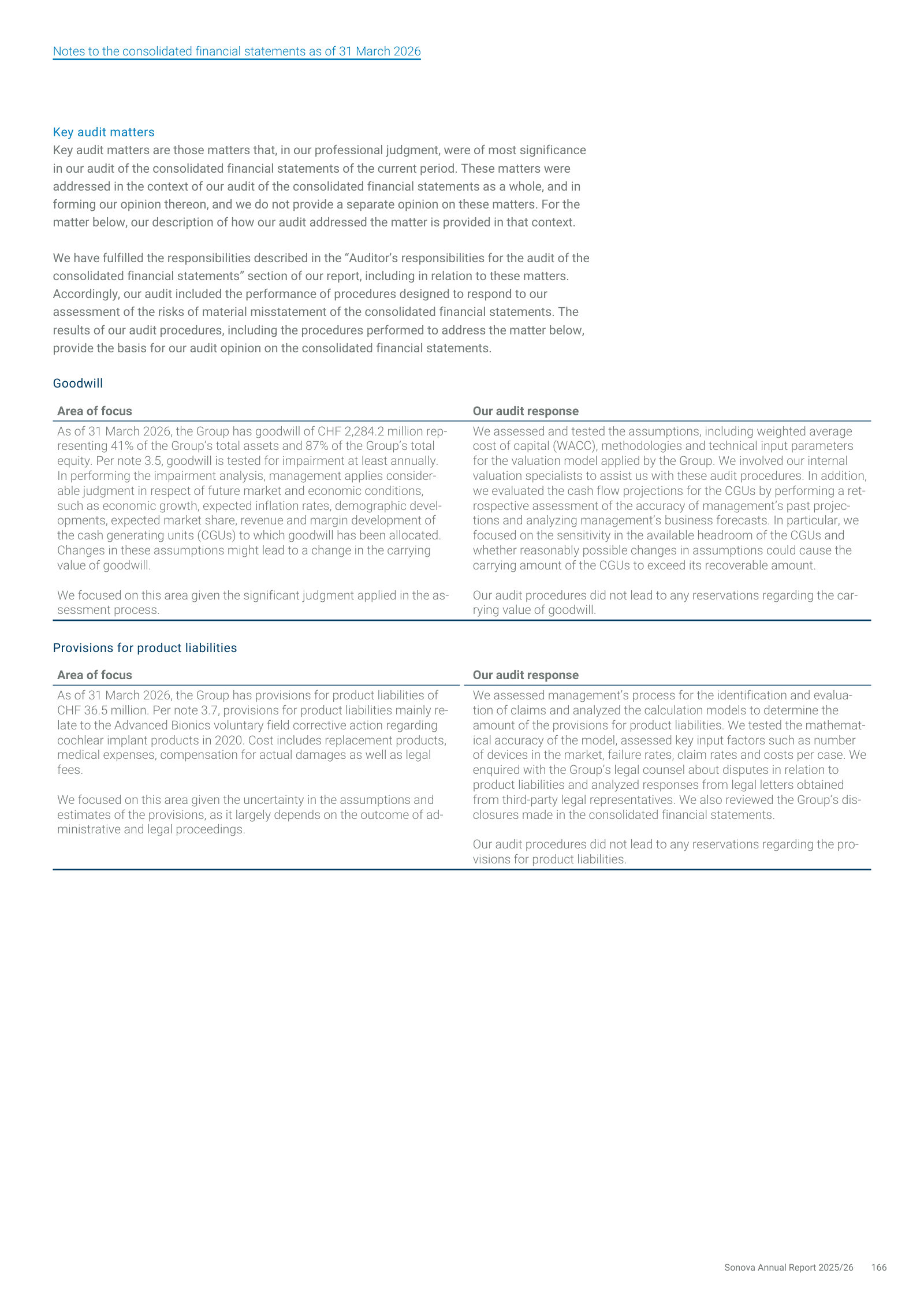
Double materiality assessment — p. 189 · Read the full section →
Sonova's own mapped risk landscape — the closest thing a Swiss report has to risk factors.
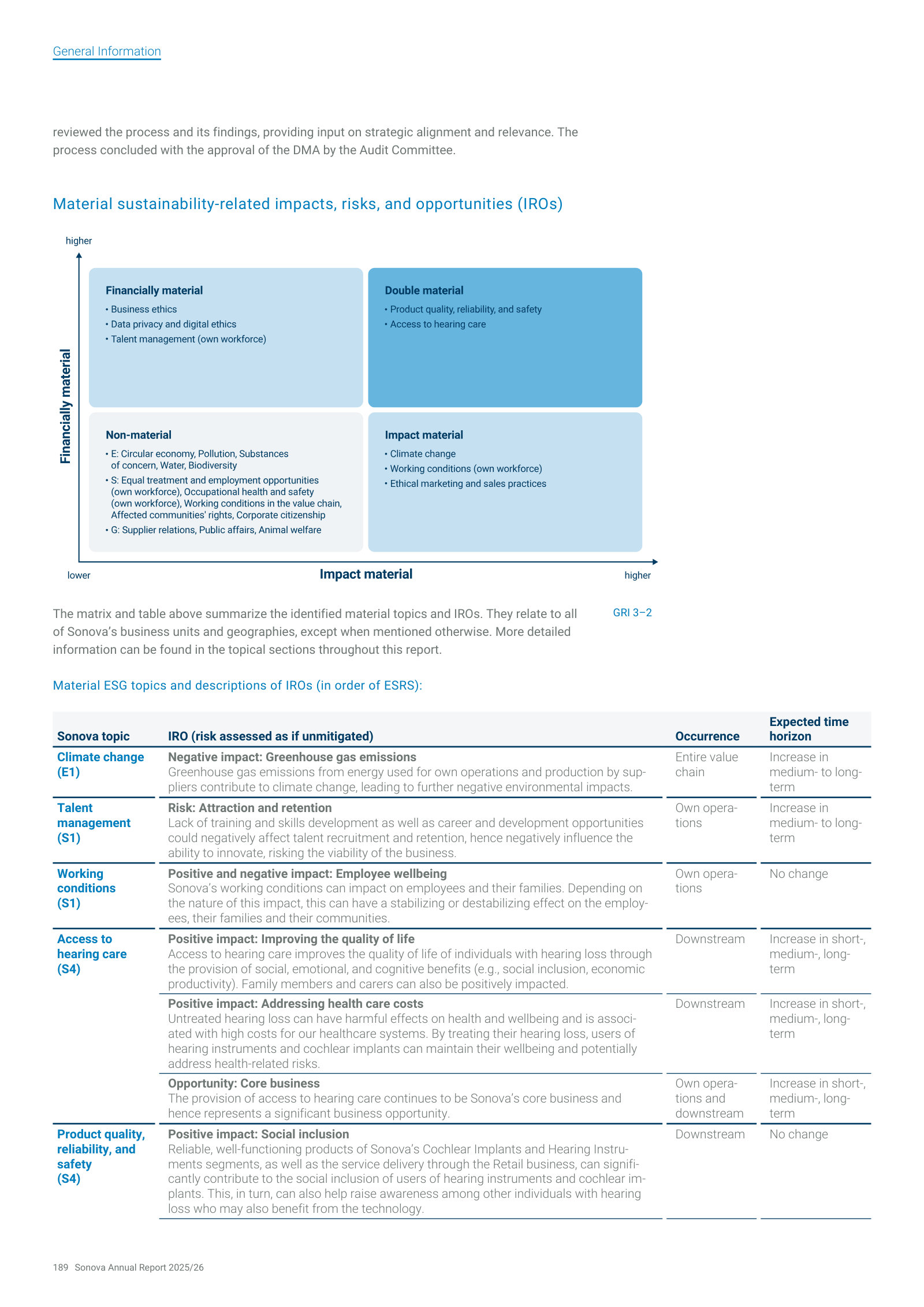
More annual reports
Sonova Holding AG — 2024/25 Annual Report (FY ended 31 March 2025) — FY2024/25 · 278 pages · The prior year under the old structure (Consumer Hearing still continuing) — the baseline the 2025/26 restatement revises. · Open →
Sonova Holding AG — 2023/24 Annual Report (FY ended 31 March 2024) — FY2023/24 · 288 pages · Where the Retail cost-efficiency program and the last full double materiality assessment were set in motion. · Open →
Sonova Holding AG — 2022/23 Annual Report (FY ended 31 March 2023) — FY2022/23 · 305 pages · Peak-margin year (normalized EBITA 22.1%) before the FX and Cochlear-Implants China headwinds set in. · Open →
Sonova Holding AG — 2021/22 Financial Report (FY ended 31 March 2022) — FY2021/22 · 287 pages · The post-pandemic recovery year, +29% sales — a useful low base for the current cycle. · Open →
Competitors describe Sonova Holding AG's market in their own filings and calls. These verified passages and visual pages show where their strategies meet, using source documents preserved in Sources.
Demant A/S (DEMANT)
The closest pure-play rival — the only competitor that mirrors Sonova across all three of hearing-aid manufacturing (Oticon, Bernafon, Philips), audiological retail and diagnostics. Demant fields its own AI-driven premium platform and is racing Sonova to consolidate hearing-care clinics.
Demant describes the KIND acquisition — its largest ever — taking it past 4,500 clinics globally and making it a leading hearing-aid retailer in Germany: the same vertical-integration-into-retail playbook Sonova runs with its AudioNova/GEERS arm.
Søren Nielsen, President and CEO: We proudly announced and finalised the acquisition of KIND, one of the world’s leading retailers of hearing aids. This – our largest-ever – expansion of our global network of hearing care clinics complements our long-term aspirations of helping more people with hearing loss through personalised care. […] The KIND acquisition makes Demant a leading retailer in Germany and will increase the Group’s revenue by almost 10%. Acquiring KIND is yet another strategic step for us to further consolidate and grow our Hearing Care business. […] Combined with Demant’s existing global clinic footprint, we now have more than 4,500 clinics globally.
p. 7 · Read in context →
Amplifon S.p.A. (AMP)
The world's largest hearing-care retailer, and both a channel Sonova sells through and a direct rival to Sonova's owned AudioNova retail arm. Amplifon's filings size the retail market Sonova's Audiological Care segment competes in and explicitly flag hearing-aid makers' vertical integration as a competitive threat.
Amplifon's stated retail footprint — over 10,100 locations, of which about 5,630 direct clinics, 1,210 franchised and 3,280 shop-in-shops — the distribution scale Sonova's owned-retail expansion competes against.
On December 31st, 2025, the Group operated over 10,100 locations organized under three regions – EMEA, Americas and APAC. […] Thanks to the capillarity of its distribution network, composed of around 5,630 direct clinics and 1,210 clinics in franchising, Amplifon is always close to those sufering from hearing loss, allowing everyone, even those with reduced mobility, to easily access quality audiological service. With around 3,280 shop-in-shops & corners located in third-party premises such as pharmacies, opticians and medical clinics, the Company is able to reach people with hearing loss also in rural areas or in areas that are not as densely populated
p. 22 · Read in context →
EssilorLuxottica (EL)
Entered hearing through Nuance Audio — hearing-enhancing glasses positioned as an OTC alternative to traditional hearing aids — backed by a retail network Sonova cannot match. It is a form-factor disruptor at the mild-loss, OTC end of the market. Exhibits are limited to its hearing/Nuance Audio material, not its core eyewear business.
EssilorLuxottica's CEO reports Nuance Audio hearing glasses reaching 15,000 stores across twelve markets in their first year — a distribution reach well beyond Sonova's audiology-clinic channel.
Francesco Milleri, Chairman and Chief Executive Officer: Smart eyewear is a powerful example of this convergence in action. Powered by iconic brands such as Ray-Ban and Oakley, AI-enabled glasses are creating a new paradigm that integrates vision care, connectivity and intelligent AI companions seamlessly into everyday life. […] We also launched Nuance Audio hearing-enhancing glasses, now available across 15,000 stores in twelve markets.
p. 5 · Read in context →
EssilorLuxottica describes Nuance Audio as the first FDA-cleared preset Software-as-a-Medical-Device hearing aid in the US, and says it is engaging 'traditional audiology practices' and optical customers — entering Sonova's regulated market and channels.
Paving the way for a disruptive new category in the med-tech space, Nuance Audio Hearing Aid Software is the first FDAcleared, preset Software as Medical Device (SaMD) in the US. […] leveraging its extensive retail network, while also engaging both traditional audiology practices and optical wholesale customers to make this technology accessible to consumers wherever possible.
p. 121 · Read in context →
Audientes A/S (AUDNTS)
A small Danish maker of self-fitting, low-cost OTC hearing aids and hearables aimed at underserved and emerging markets. It attacks the affordability and OTC flank that Sonova's premium Phonak/Unitron portfolio does not serve — a disruptor to watch rather than a scale competitor today.
Audientes' self-description as a maker of 'smart, self-fitting, and affordable' hearing aids with the hearing test built into the device — a low-cost, self-fitting model that bypasses the audiologist-fitted premium channel Sonova relies on.
Audientes A/S is a Danish hearing technology company dedicated to developing smart, self-fitting, and affordable hearing aids and advanced hearables. Our mission is to make high-quality solutions for hearing improvement and enhancement accessible to everyone who needs them globally. […] Ven is a self-fitting, binaural hearing aid designed for individuals with severe to profound hearing loss in one or both ears. Featuring an industry-standard hearing test built into the device and Bluetooth functionality, Ven delivers the audio quality of a high-end digital hearing aid combined with the versatility of a next-generation Bluetooth headset.
p. 3 · Read in context →
Audientes frames its opportunity as the affordability and access gap — targeting the '95% of unmet demand' in the MENA region and serving 'millions globally' across regulated and non-regulated (OTC) channels — the low end premium pricing leaves open.
Steen Thygesen, CEO: One of the key roles of our Indian subsidiary is to develop markets across the Middle East, Africa, and Asia, aligning with our mission to bring hearing solutions to underserved markets. […] They aim to focus on the 95% of unmet demand for hearing aids in the region, not only driving product distribution but also leading educational initiatives aimed at empowering individuals with hearing impairments - helping to close the hearing care gap. […] Today, Audientes have developed and had manufactured affordable, self-fitting hearing solutions for regulated and non-regulated markets, designed to improve the quality of life for millions globally.
p. 6 · Read in context →
More peer documents
DEMANT_annual_report_FY2024 — 208 pages · Prior-year annual report to trend Demant's market-size framing and strategy statements against the FY2025 exhibits used here. · Open →
EL_annual_report_FY2024 — 528 pages · First-year Nuance Audio disclosure to establish the launch timeline and how EL initially framed its move into hearing. · Open →
6758_annual_report_FY2025 — 230 pages · Sony's Form 20-F: the ET&S 'Sound' category (p.21, headphones and wireless speakers) and its ¥295.6bn/¥290.5bn/¥278.8bn segment sales (p.154) — the consumer-audio adjacency that underlies Sony's OTC/CRE hearing-aid push, though the report discloses no hearing-aid product itself. · Open →
AUDNTS_annual_report_FY2023 — 33 pages · Audientes' stated intent to move from a niche neckband product into the 'mainstream segment for hearing aids' and its India (1.4bn population) affordability thesis. · Open →
Source: S&P Capital IQ transcripts via Xpressfeed · latest indexed call 2026-05-18 · generated 2026-07-23.
Latest call digest
Sonova Holding AG, 2026 Earnings Call, May 18, 2026 · 2026-05-18T11:00:00
FY2025-26 results call, May 18, 2026. New CEO Eric Bernard and CFO Elodie Carr-Cingari framed a year that "fully met our guidance," with wholesale (Hearing Instruments) the clear engine: segment sales up 7.5% to CHF 3.4bn, wholesale up 9.5% and accelerating to double digits in H2 on the Infinio Ultra launch and Virto R, the group's first rechargeable in-the-ear device. Retail grew 5.1% (1.3pp from bolt-ons). The soft spot stayed Cochlear Implants: sales down 11% (down 3.8% ex-China) on China VBP, weaker upgrades and a competitor launch, though a new Phonak-powered sound processor is planned to lift H2 FY2026-27 subject to regulatory approval. Prepared remarks leaned on the March strategy refresh (CHF 6bn revenue ambition by FY2030-31, three pillars, CHF 90m of savings over four years) and the pending Consumer Hearing divestment, now discontinued operations. The headline change was financial framing: guidance moves to a new "core EBIT" metric, with FY2026-27 set at 5%-8% sales and 7%-10% core EBIT growth at constant FX. In Q&A the reality was more granular and, in places, guarded: management repeatedly declined to quantify Costco/large-account share, EasyGuard channel placement and specific APAC KPIs, and offered no crystal ball on the rechargeable-ITE addressable market. The tone on the market itself was cautiously improving — April described as "very positive" and recent months "getting closer to 4%" versus the 2%-4% FY assumption.
Participant coverage from the latest call.
| Group | Participants | Count |
|---|---|---|
| Management | Operator; Thomas Bernhardsgruetter — Former Senior Director of Investor Relations, Sonova Holding AG; Eric Bernard — Chief Executive Officer, Sonova Holding AG; Elodie Carr-Cingari — Chief Financial Officer, Sonova Holding AG | 4 |
| Analysts | Andjela Bozinovic — Research Analyst, BNP Paribas, Research Division; Veronika Dubajova — Head of EMEA MedTech & Healthcare Services, Citigroup Inc., Research Division; Marco Pires-Cox — Research Analyst, Barclays Bank PLC, Research Division; Aisyah Noor — Equity Analyst, Morgan Stanley, Research Division; Oliver Metzger — Research Analyst, ODDO BHF Corporate & Markets, Research Division; Susannah Ludwig — Research Analyst, Bernstein Institutional Services LLC, Research Division; Daniel Jelovcan — Research Analyst, Zürcher Kantonalbank, Research Division; David Adlington — Head of Medical Technology & Services Equity Research, JPMorgan Chase & Co, Research Division; Falko Friedrichs — Research Analyst, Deutsche Bank AG, Research Division; Martinien Rula — Equity Associate, Jefferies LLC, Research Division; Urs Kunz — Senior Analyst, Research Partners AG; Niels Granholm-Leth — Head of Equity Research, DNB Carnegie, Research Division; Richard Felton — Equity Analyst, Goldman Sachs Group, Inc., Research Division | 13 |
Curated latest-call exchanges; one row per analyst topic.
| Analyst | Firm | Topic | What changed in Q&A |
|---|---|---|---|
| Andjela Bozinovic | BNP Paribas | Guidance composition & Virto R/ITE share | Pressed on what sits at the top vs bottom of the sales guide and phasing; management pointed to Virto tailwind, US large-account share and the H2 platform launch, and said no competitor impact seen on Virto yet. |
| Veronika Dubajova | Citigroup | Market trajectory & H1/H2 EBIT phasing | Wanted evidence of the modest market acceleration and whether both halves sit in the 7%-10% core-EBIT range; CFO confirmed both halves in range, with CI weighting H2 stronger against a tough H2 comp. |
| Marco Pires-Cox | Barclays | Composition of share gains (Ultra vs Virto R) & cost inflation | Asked whether a structural shift to ITE is driving share and about cost assumptions; CEO said no real cannibalization of classic designs, CFO flagged operating leverage and no material supply-chain/EBIT impact. |
| Susannah Ludwig | Bernstein | Costco return & EasyGuard channel placement | Sought Costco H2 contribution and whether EasyGuard is in Costco/VA; management confirmed share was lifted in H2 to a "fair share" but declined to confirm channel-level details. |
| Oliver Metzger | ODDO BHF | Retail M&A multiples & rechargeable-ITE addressable market | Had to re-ask the ASP/ITE question; CEO said retail multiples are less stretched than a few years ago and Virto commands a good price, but gave no sizing — "I don't have a crystal ball." |
| David Adlington | JPMorgan | Path to top of 5%-8% & GN/Amplifon deal | Asked what gets them to 8% and the net effect of the GN Hearing/Amplifon transaction; management cited market, carryover momentum and H2 launches, and said exposure to that channel is limited with no significant near-term impact. |
| Niels Granholm-Leth | DNB Carnegie | Sam's Club channel conflict & Sennheiser brand rights | Probed whether expanding with Sam's Club conflicts with Costco and any risk to Sennheiser licensing; CEO reiterated the multi-channel/multi-brand line and said the Sennheiser license is a separate, secure agreement. |
Theme tracker
Themes are curator-classified across supplied calls.
| Theme | Status | Quarters mentioned | Read-through |
|---|---|---|---|
| AI hearing-aid platform (Sphere / Infinio / Ultra) driving share gains | persisted | May 2024, Nov 2024, May 2025, Nov 2025, May 2026 | The purpose-built AI-chip platform has anchored the wholesale growth story since the Aug 2024 launch; by May 2026 management called the H2 result the biggest share gain since Marvel and pre-announced another platform for H2 FY2026-27. |
| Cochlear Implants weakness — China VBP & aging upgrade cycle | persisted | May 2025, Nov 2025, May 2026 | Recurring drag: China volume-based procurement plus a stale processor (Marvel-era) depress upgrades; management ties the fix to a new sound processor now slated for H2 FY2026-27, subject to regulatory approval. |
| Virto R / rechargeable in-the-ear (ITE) category | emerged | Nov 2025, May 2026 | New entry into a segment where Sonova previously did not play; framed as incremental (a ~CHF 400m segment) and by May 2026 described as at a ~CHF 120m cruising altitude, a genuine ASP and share driver. |
| APAC / Asia expansion strategy | emerged | Nov 2025, May 2026 | A pillar of the refreshed strategy: dedicated regional leadership, a Singapore/EDB tie-up and a two-step plan to reach "natural" share; management flags Japan growth of 30%-45% but withholds specific KPIs. |
| Swiss franc / FX headwind | persisted | Nov 2022, May 2023, May 2025, Nov 2025, May 2026 | A standing pressure on reported (CHF) results while local-currency growth stays strong; now elevated to a structural fix — cutting the CHF cost base from ~15% toward below 10% over the midterm. |
| Consumer Hearing / Sennheiser as a growth narrative | dropped | Nov 2022, May 2023, May 2024, May 2025, Nov 2025 | A regular topic (MOMENTUM earbuds, HDB 630, market weakness) through Nov 2025; after the March 2026 divestment announcement it is discontinued operations and excluded from the FY2026 continuing-operations story. |
| Share buyback / capital return | dropped | Nov 2022, May 2023 | Active buyback (~CHF 304m in H1 2023, ~CHF 420m in FY2023) gave way to a pause on leverage/M&A priorities; management explicitly ruled out a buyback again in Nov 2025, and the May 2026 TSR framing centered on a 7% dividend increase rather than repurchases. |
Guidance ledger
Quotes, calls, and speakers are source-verified; outcomes are curator-classified.
| Verbatim guidance | Call | Speaker | Curator outcome | Outcome note |
|---|---|---|---|---|
| “we reiterate our outlook and continue to guide for sales growth of 5% to 9% and normalized EBITA growth of 14% to 18%, both at constant exchange rates.” | Sonova Holding AG, H1 2026 Earnings Call, Nov 14, 2025 · 2025-11-14T12:00:00 | Elodie Carr-Cingari | kept | On May 18, 2026 the CFO said pro-forma sales grew 5.5% and normalized EBITDA rose 14.5%, "well within the guidance," and management stated it fully met guidance. |
| “we expect consolidated sales to rise 5% to 8% and core EBIT to grow 7% to 10% at constant exchange rates.” | Sonova Holding AG, 2026 Earnings Call, May 18, 2026 · 2026-05-18T11:00:00 | Elodie Carr-Cingari | pending | FY2026-27 guidance on the new core-EBIT metric; no later call in the supplied history reports the outcome. |
| “So we do expect in H1 to be within the 7% to 10% range in terms of core EBIT growth in the first half.” | Sonova Holding AG, 2026 Earnings Call, May 18, 2026 · 2026-05-18T11:00:00 | Elodie Carr-Cingari | pending | Phasing commitment that both halves land in the 7%-10% core-EBIT range; not yet reportable. |
| “to excel in operations and driving CHF 90 million of savings in the next 4 years.” | Sonova Holding AG, 2026 Earnings Call, May 18, 2026 · 2026-05-18T11:00:00 | Elodie Carr-Cingari | pending | Multi-year cost-savings target tied to the March strategy refresh; too early to assess. |
| “If we reach our natural share of 25% to do the math, it could be an additional CHF 100 million of revenue over time.” | Sonova Holding AG, H1 2026 Earnings Call, Nov 14, 2025 · 2025-11-14T12:00:00 | Eric Bernard | pending | Virto R revenue ambition "over time"; the May 2026 call cited a ~CHF 120m cruising altitude, so tracking constructively but not confirmed against the 25%-share math. |
Q&A pressure map
Question counts and firms are curator tallies; analyst coverage shown above.
| Topic | Questions | Firms | Pressure / response |
|---|---|---|---|
| Guidance bridge & H1/H2 phasing (5%-8% sales, 7%-10% core EBIT) | 5 | BNP Paribas, Citigroup, Barclays, JPMorgan, Deutsche Bank | The single most-pressed area on the latest call — analysts repeatedly asked what drives the top vs bottom of the range and how growth phases across halves; management answered with drivers (carryover share, H2 launches, market) rather than hard splits. |
| Costco / VA and other large US accounts — share and channel placement | 3 | Bernstein, Zürcher Kantonalbank, DNB Carnegie | A recurring point of friction: management declined to confirm EasyGuard channel placement ("I will not share those details here") and would not quantify Costco's contribution, so several answers plainly did not address the specific channel questions asked. |
| Virto R / rechargeable-ITE addressable market & ASP durability | 3 | BNP Paribas, Barclays, ODDO BHF | Analysts sought a size and duration for the ITE opportunity; the CEO confirmed strong pricing and no meaningful cannibalization but gave no market-sizing answer — "I don't have a crystal ball." |
| APAC expansion KPIs and dilution risk | 2 | Morgan Stanley, Goldman Sachs | Pressed for benchmarks and current market share; management shared color (Japan 30%-45% growth, an index of 3-6 vs 10 in Europe/US) but explicitly withheld specific KPIs. |
Language shifts
Only language evidence verified against the referenced component is shown.
| Observation | Verbatim evidence | Call ID | Component |
|---|---|---|---|
| Guidance metric changed — management moved from "normalized EBITA" to a new "core EBIT" framework, a shift in how forward profitability is defined and compared. | “our move to core EBIT as the new guidance metric” | 1995362320 | 3 |
| Stepped-up confidence on wholesale share — the FY2025-26 result was framed as the strongest share gain in six years, a more emphatic claim than the earlier "about twice market growth" language. | “the highest year-on-year market share gain since the introduction of our Marvel platform 6 years ago” | 1995362320 | 2 |
| Unusually candid self-criticism on Cochlear Implants from the new CEO in Nov 2025, acknowledging an innovation gap rather than only citing external headwinds. | “So we are slow to innovate versus our competition.” | 1966020454 | 20 |
| New caution vocabulary around the CI recovery — the H2 processor-led rebound is repeatedly hedged on regulatory timing. | “the timing of the launch is subject to regulatory approvals” | 1995362320 | 14 |
The recent history reads as a management transition that has coincided with real execution: FY2025-26 guidance was fully met, wholesale share gains accelerated on Sphere Ultra and Virto R, and the debate now turns on whether the new 5%-8% sales / 7%-10% core-EBIT framework holds as the US large-account tailwinds mature and Cochlear Implants waits on a regulator-gated H2 processor launch.
Figures converted from Swiss francs at historical FX rates — see data/company.json.fx_rates for the rate table. Ratios, margins, percentages, and multiples are unitless and unchanged.
Web Research — What the Web and News Add to the Filings
Bottom line. The single biggest thing the public record reveals that the audited filings alone do not is a strategic U-turn in progress: on 23 March 2026 Sonova said it will sell the Sennheiser-branded Consumer Hearing business it bought only about four years ago, refocus on core hearing care, and — under a brand-new CEO poached from rival WS Audiology — chase a $7.6 billion revenue ambition by FY2030/31. As of mid-2026 there is still no buyer and no price for Sennheiser, and the sell-side is openly skeptical of the target (RBC: not achievable "without transformational M&A"). The important nuance the tape adds: after an initial 8% drop to a $207 low on the strategy day, the stock has fully round-tripped to ~$258, near its high — so the market has already digested the fear and the profit beat, but the actual sale terms remain unpriced because they are still unknown.
A note on sources. The automated web-research pipeline for this name failed entirely on a billing error (Parallel returned "insufficient credit" for every phase), so there is no external dossier and no pre-synthesized specialist research to lean on. This briefing is built from the corpus news/ section (30 indexed items), the specialist query files (which tell us exactly where the desk's uncertainty sits), targeted live web searches, and the primary record where a filing fact needs pinning. Where the web is silent, that silence is reported as a finding, not papered over.
Share price ($, 23 Jul 2026)
Strategy-day low ($, since retraced)
FY25/26 norm. EBITA ($m) — beat consensus $985m
Revenue ambition FY2030/31 ($bn)
Sources: share price and 52-week low from SIX price series, as reported; FY2025/26 normalized EBITA of CHF 811.2 million ($1,023m) [1]; $7.6 billion ambition [2].
The findings, ranked by what moves the thesis
1. Sennheiser is up for sale — announced, but no buyer and no price (the single dominant open question)
On 23 March 2026, following a strategic portfolio review, Sonova said it intends to divest its Consumer Hearing (Sennheiser-branded) business — headphones, earbuds, soundbars, hearables — the very unit it acquired from Sennheiser in 2022 for roughly €200 million. The business (about 6% of group sales) was immediately reclassified as discontinued operations, which drove a $134 million after-tax loss from discontinued operations in FY2025/26 — the operating result plus non-cash impairments tied to the planned sale [3]. As of late March and confirmed through mid-2026, Sonova has named no buyer and given no timetable (The Hearing Review; ecoustics; headphones.com).
So-what for the stock. This is the swing between a clean, value-accretive refocus and a value-destructive four-year round-trip on ~€200m of capital. The realized price determines (a) how much of the original outlay is written off, (b) whether proceeds refill the buyback tank or fund core M&A, and (c) whether management's capital-allocation credibility — already dented by the impairment — is restored or further damaged. Every single specialist (Warren, Quant, Sherlock, Historian, Forensic, Short-Interest) filed this as their top unresolved question. Priced in? The 8% strategy-day sell-off to $207 has fully retraced to ~$258, so the announcement is digested; the terms are not, because they don't exist yet. Until a deal prints, this is a live overhang with binary, unpriced outcomes. Red flag on process; neutral-to-positive on the eventual cleanup.
2. The $7.6bn-by-FY2030/31 ambition met open sell-side skepticism
The renewed strategy targets $7.6 billion in revenue by FY2030/31 (from ~$4.9bn), implying a 5–10% local-currency sales CAGR [4]. The sell-side did not take it at face value: RBC said it is "sceptical that the company will be able to deliver its CHF6bn revenue target in 2030/31 without transformational M&A, given that market growth has been well below the historical range of 4–6% in recent years with no clear signs of recovery"; Jefferies and Vontobel called the targets "ambitious"; J.P. Morgan expected investor skepticism, citing the market backdrop and the plan's emphasis on Asia (Investing.com).
So-what for the stock. The gap between a bold headline target and a sub-trend end-market means the ambition is treated as aspirational, not underwritten — which caps how much of a re-rating the market will pay ahead of proof. The RBC point is the sharpest: hitting the target likely requires M&A, which re-opens exactly the capital-allocation risk the Sennheiser round-trip just exposed. Priced in? This skepticism is consensus, not contrarian — the target is not in numbers anyone models. The edge is in tracking whether the first two years of local-currency wholesale growth validate or kill it. Neutral, leaning cautious.
3. FY2025/26: profit beat, sales at the low end, targets trimmed — yet the stock sits near its highs
FY2025/26 results (18 May 2026) delivered a 3.9% beat on normalized EBITA — $1,023 million vs $985 million consensus — on group sales of $4,549 million, in line and up 5.9% in local currencies [5] (Investing.com). The catch is the reported line: EPS including discontinued operations fell 20.3% to $9.12 (vs $11.38 continuing), dragged by the Sennheiser loss and a $279 million FX translation headwind [6]. Reaction was mixed: UBS lowered its price target on 21 May while staying neutral, and consensus fair value was trimmed from ~$298 to ~$287 (ad-hoc-news; Simply Wall St).
So-what for the stock. The reported-EPS decline is overwhelmingly FX and the discontinued-ops loss, not operational — normalized EBITA rose 17.3% in local currency. The bull case is precisely that local-currency earnings re-couple with reported EPS once the FX drag and divestment noise clear. Priced in? At $258 against a ~$287 consensus fair value, roughly 10–12% upside is on the table on consensus math — but the beat and the recovery from $207 are already in the price. The unresolved swing factor the market has not settled is whether wholesale organic growth holds high-single-digits into H1 FY2026/27 or fades as the Infinio launch tailwind rolls off. Neutral.
4. Consumer-tech and OTC disruption is accelerating — which validates the low-end exit but is a long-term funnel threat
Two entrants the filings treat abstractly are now concrete. Apple's AirPods Pro hearing-aid feature (AirPods Pro 2 and 3) has been live since December 2025 and is expanding country-by-country through 2026 (MacRumors). EssilorLuxottica's Nuance Audio hearing glasses sell OTC for ~$1,100 — about a quarter of the average prescription hearing-aid cost (Optometry Times; hearingtracker). Crucially, per MarkeTrak 2025, ~70% of OTC buyers are first-time users — evidence these products are, for now, expanding the market rather than cannibalizing prescription (Soundly).
So-what for the stock. Near term this is a tailwind: mainstream, stigma-reducing devices widen the funnel that eventually feeds professionally-fitted care. Structurally it is the threat to the mild-loss entry tier Sonova just deliberately exited — which is the strategic rationale for selling Consumer Hearing and doubling down on prescription and retail. It doesn't change FY2027 numbers, but it frames whether the "premium prescription compounder" thesis survives the decade. Priced in? Broadly known and debated; not a near-term earnings driver. Neutral.
5. Cochlear Implants is the one real operational sore — China VBP and an ageing processor — with the MED-EL patent war now settled
The Cochlear Implants (Advanced Bionics) segment is the clear margin drag: EBITA margin more than halved on China volume-based procurement (VBP) price cuts and developed-market share loss to "the largest competitor" (Cochlear Ltd). The offsetting positives: the long-running (since 2018) Advanced Bionics vs MED-EL patent litigation was globally settled, with dismissal filed 3 June 2025 and ~$36 million of H1 legal costs booked (JUVE Patent); and management guides a new sound processor launch in 2H FY2026/27 as the turnaround catalyst.
So-what for the stock. Small segment, outsized narrative weight because it is the one place the "market-share compounder" story visibly broke. The settlement removes a legal overhang and a recurring add-back; the new processor's timing and regulatory approval are the catalyst to watch. Priced in? The weakness is known; the recovery is a "show-me" that the market is not yet crediting. Neutral, with catalyst optionality.
6. Capital return: record $5.93 dividend approved, but the buyback is done and not yet renewed
The 2026 AGM (16 June) approved a record $5.93 dividend (~45% payout), and elected three new independent directors (Sonova). Separately, the $1.7 billion 2022–2025 buyback was completed in April 2025 (final tranche 1,532,910 shares for ~$463m, for cancellation), and buybacks were paused in FY2026 to de-lever (TipRanks).
So-what for the stock. The rising dividend signals board confidence, but the buyback is a latent, unpriced EPS lever tied to two variables the market can't yet size: the Sennheiser sale proceeds and the new CEO's still-undisclosed capital-allocation framework. A fresh authorization would be a confidence signal and a per-share tailwind. Priced in? Dividend yes; buyback resumption is optionality. Positive/neutral.
Governance and people signals — building on the People tab, not repeating it
The People tab already documents the C-suite churn in depth (new CEO, CFO, Chair all within ~18 months). The web adds three angles the filings soft-pedal:
- The CEO is a direct poach from a rival. Eric Bernard ran WS Audiology — one of Sonova's two largest hearing-instrument competitors — from 2019–2024 before becoming Sonova CEO on 15 September 2025 (Hearing Health and Technology Matters). Hiring the competitor's CEO is a capability coup, but Sherlock's open question — whether it triggered any non-compete dispute or litigation — is unresolved by the public record. A dedicated search surfaced no reporting of a non-compete action; the absence is mildly reassuring but not dispositive. So-what: transition/key-person risk is real (the people accountable for the $7.6bn plan have little Sonova mileage), but there is no public evidence of a legal cloud over the hire.
- Board renewal continued at the 2026 AGM with three new independent directors — Ingrid Cotoros, Malina Ngai, and Hooi Ling Tan — following the 2025 Chair transition to Gilbert Achermann (Sonova). So-what: orderly, deepening independence; no governance red flag.
- No public evidence of founder-family (Diethelm/Rihs) selling turned up — a question Sherlock raised on long-term-owner alignment. Switzerland does not require Form 4-style trade feeds, so silence here is expected rather than conclusive.
Watch item: management has changed its headline profitability metric three times in three years — adjusted EBITA, then normalized EBITA, now "Core EBIT" from FY2026/27. Forensic and Historian both flagged whether this quietly reclassifies recurring costs. No analyst has publicly called it out yet, but it deserves a close read of the first Core-EBIT reconciliation.
Positive signal: the goodwill overhang is disclosed and audited, not hidden. Goodwill of $2.88 billion equals 87% of total equity and was a Key Audit Matter, but the auditor's impairment-headroom work "did not lead to any reservations" [7]. The China VBP-driven Cochlear Implants weakness is the specific stress to monitor against that headroom.
Recent-news reference layer
The interpretive findings above are drawn from this indexed news set (corpus news/ plus live search). Recency orders the table; still-live items (the Sennheiser sale, the $7.6bn plan, the CI recovery) are included regardless of age.
Sources: corpus news/ indexed items (news.pdf, p.1–3) and the linked outlets above; the FY2025/26 normalized EBITA of CHF 811.2 million ($1,023m) is cross-checked to the Annual Report [8].
What every specialist asked — the answers not promoted above
The material specialist questions (Sennheiser terms, $7.6bn credibility, CI recovery, OTC threat, capital return, the CEO poach) are answered in the ranked findings. The remainder — mostly questions the failed web pipeline was meant to close — are collected here with the best synthesized answer the corpus and live search allow.
Sources: live web search (MarkeTrak 2025 via Soundly; Investing.com) and the corpus news/ section; peer scale per the Competition tab and Demant/Amplifon filings.
Where the real uncertainty still sits
Three threads the public record does not settle, and where the desk's remaining edge lies:
- The Sennheiser sale price and buyer. The largest binary. Terms determine value destroyed, buyback fuel, and management credibility. Nothing public yet.
- Whether wholesale local-currency growth holds into H1 FY2026/27 or fades as the Infinio launch tailwind rolls off — the single number that validates or kills the $7.6bn ambition.
- The Cochlear Implants processor timing and China VBP trajectory — the one operational recovery the market is not crediting.
On everything else, the web confirms the filing-based thesis rather than contradicting it: no regulator action, no accounting whistleblower, no insider-selling scandal, no litigation surprise (the one big case — MED-EL — was settled). For a name mid-transition, an uncontested public record is itself a useful, if unglamorous, finding.
Figures converted from Swiss francs at historical FX rates — see data/company.json.fx_rates. Ratios, margins, and multiples are unitless and unchanged.
Variant Perception — Where We Disagree With the Market
The one disagreement that matters. The market capitalizes the wrong earnings line. Sonova reports in Swiss francs but sells in dollars and euros, and for three straight years a relentlessly strong franc has erased genuine local-currency growth before it reaches the reported page — reported diluted EPS has fallen from an $11.61 peak (FY2023) to $9.11 (FY2026) even as the operating engine compounded. Consensus has responded by treating the franc as a permanent tax: FY2027 consensus EPS of roughly $13.1 is barely above the FY2026 normalized continuing figure of $13.15 — the Street is modelling another flat reported year — and the rating sits at Hold-tilting-Sell (12 of 28 analysts at sell or strong-sell), on a stock de-rated to ~20x from a 30x-plus history. Underneath that flat model, the business grew local-currency sales 5.9%, normalized EBITA 17.3%, and Wholesale hearing-aid sales 9.5% (double-digit in H2), per the Financials and Bull/Bear tabs. Our variant view: the reported-EPS line is skewed to surprise up, because consensus has priced a permanent-franc-headwind assumption into the one number the market actually capitalizes — while the operating evidence says the engine is compounding regardless. The observable that resolves it is one clean print: reported franc EPS inflecting positive with Wholesale local-currency growth intact, first testable at the H1 FY2026/27 results on 12 November 2026.
This page attacks consensus, not Stan's bull/bear tension. Stan weighs whether the business is a buy; we ask a narrower question — where is the market's stated assumption demonstrably at odds with the report's evidence, and how do we know if we are right? The honest answer has two sides, and we carry both: consensus is too pessimistic on the reported-EPS trajectory, and — in the opposite direction — slightly too generous on the headline "quality" it pays a market multiple for. Netting them is the edge.
The variant scorecard
Variant Strength (0-100)
Consensus Clarity (0-100)
Evidence Strength (0-100)
Months to Resolution (12 Nov print)
Source: analyst assessment synthesising the Financials, Forensics, Bull/Bear, Long-Term Thesis, Current Setup and Catalysts, Short Interest and Web Research tabs.
Why these scores. Consensus clarity is high (74): the belief is unusually observable — a countable sell-tilt, a de-rated multiple against the company's own history, a published guide the Street explicitly discounts, and a founder-anchored register with no short base. Evidence strength is high (76): the local-currency-versus-reported wedge is documented across a multi-year primary record and every specialist tab. Variant strength is only moderate (60) for one honest reason — the resolving variable, the Swiss franc, sits outside management's control, so the disagreement is real and monetizable but its timing is FX-contingent, not self-fulfilling. Time to resolution is short: the first clean read is the 12 November H1 print, roughly four months out.
Mapping consensus before we disagree
Every claimed market view below is nailed to a concrete consensus signal — a multiple versus history, a rating count, a guidance-versus-estimate gap, a price reaction, or a sell-side note — drawn from the Short Interest, Current Setup and Catalysts, Financials and Web Research tabs. The fourth column is the testable underwriting assumption embedded in each view, not the vibe.
Source: Short Interest tab (rating distribution, holder register), Current Setup and Catalysts tab (guidance-vs-consensus, price round-trip), Financials tab (multiples vs history), and Web Research tab (sell-side notes) — as reported.
Two of these are genuinely non-consensus targets for us (rows 1 and 2). Rows 3–5 we largely agree with the market on — and we say so plainly, because contrarianism for its own sake is not variant perception. The USD 7.4bn skepticism is itself the consensus (the Web Research tab is explicit that this view "is consensus, not contrarian"), so disagreeing with it would be manufacturing an edge that is not there.
The picture that frames the disagreement
The clearest way to see the mispricing is to line up the several "earnings" of a single year against what the Street then models forward. The number the market capitalizes — all-in reported EPS — sits far below the operating engine, and consensus extrapolates it flat.
Source: Financials and Bull/Bear tabs (FY2026 reported, continuing and normalized EPS); Current Setup and Catalysts tab (FY2027 consensus of ~$13.1 and the above-consensus variant of ~$13.9) — as reported.
The franc wedge is not new — it has bent the reported page for three years while the local-currency business kept growing. That persistence is exactly why consensus now treats it as permanent.
Source: Financials and Long-Term Thesis tabs — reported diluted EPS, FY2017–FY2026 (converted at historical FX rates); FY2026 is stated including the discontinued-operations loss (continuing basic EPS was $11.38).
The disagreement ledger
Two disagreements survived all five tests — a consensus analyst's likely read, the contradicting report evidence, materiality to valuation or risk, an observable resolution over the right horizon, and a stated way to be proven wrong. They point in opposite directions on the same stock, which is the point: consensus is offside on the reported-EPS trajectory and slightly over-crediting headline quality, and a PM who underwrites both nets to a clearer view than either the sell-tilt or the quality bulls hold.
Source: Financials, Bull/Bear, Current Setup and Catalysts and Forensics tabs — as reported.
Disagreement 1 — the currency lens (wrong denominator). What consensus would say: "Reported EPS has fallen three years running and management itself guides a further 3–4 points of franc drag into FY2027, so we model another flat year and hold." Why our evidence disagrees: the decline is almost entirely translation and the Consumer Hearing divestment, not operations — continuing-operations net income was roughly flat ($689m vs $713m per the Short Interest tab), and the engine grew mid-to-high single digits in local currency with Wholesale accelerating into double digits. What the market must concede if we are right: that it has been capitalizing a franc forecast, not an earnings forecast — and with the franc broadly flat since May 2026, a mid-single-digit reported Core-EBIT year lands the reported-EPS line near $13.9, roughly 5–7% above the flat consensus (Catalysts tab). The cleanest disconfirming signal: Wholesale local-currency growth decelerating toward low single digits, or the franc resuming its appreciation, at the 12 November print. Bucket: wrong denominator / currency lens — the market values the company on the wrong (franc-translated) earnings.
Disagreement 2 — the quality discount we apply (wrong quality of earnings). What consensus would say: "Sonova is a clean medtech compounder — 73.7% gross margin, 22.5% normalized EBITA margin, ~90% cash conversion — so a market multiple is fair." Why our evidence disagrees: the Forensics tab (verdict 34/100, "Watch") shows the normalized metric sits above reported EBITA in every one of the last five years on add-backs that recur annually, and that a measurable slice of the FY2025 cash-conversion strength was a deliberate supplier-payment stretch that is now unwinding — trade payables swung to a $66m use of cash and operating free cash flow fell 10.8%. What the market must concede if we are right: that the through-cycle FCF yield (~3.8%) is the honest anchor, not the normalized-margin headline, and that the imminent "core EBIT" redefinition deserves a two-year side-by-side before it is trusted. The cleanest disconfirming signal: DPO stabilising near 60 with FCF still converting above 85% and a complete, unchanged reported-to-core bridge — which would retire the caveat. Bucket: wrong quality of earnings — reported quality is a touch dirtier than the market treats it.
Note the asymmetry a PM should carry: Disagreement 1 is the larger, monetizable mispricing (it moves the multiple); Disagreement 2 is the discipline that bounds how far to chase the re-rating. They are not a hedge — they are the numerator and the denominator of the same underwriting.
The evidence a PM can audit fast
The items that actually move the probability of the variant view — not generic facts — with the consensus read, our read, why it matters, and what could make each misleading.
Source: Financials, Long-Term Thesis, Bull/Bear, Current Setup and Catalysts, Short Interest, Forensics and Web Research tabs — as reported.
How this gets resolved — observable signals only
Each signal is checkable in a specific filing, results release, or ad-hoc disclosure. None is "better execution" or "time will tell." The near-term prints matter only because they directly update the named long-term variable (Wholesale local-currency growth as the Infinio cycle ages), not because a single quarter is decisive.
Source: Current Setup and Catalysts, Forensics and Web Research tabs; hard date (12 November 2026 H1 results) per Sonova's financial calendar — as reported.
Red team — what would kill this view before the market does
The variant is not a conviction lay-up, and the case against it is not perfunctory. The decisive vulnerability is that our lead disagreement resolves on a variable no one in this report can forecast: the Swiss franc. The bear's strongest fact is not a rebuttal of the operating story — it is that the franc has erased local-currency growth for three consecutive years and management itself guides a further 3–4 points of drag into FY2027. If the franc resumes appreciating, reported EPS grinds sideways again, the "skewed up" thesis simply does not fire on the 12 November print, and a Hold-tilting-Sell book is vindicated. Three more ways to be wrong, each observable: (1) the moat is renting, not owning, share — the same silicon-cycle mechanism that handed Sonova VA share is already reversing in Cochlear Implants (segment sales −11.1% LC), so Wholesale could roll over the moment a rival ships better chips; (2) the quality caveat proves larger than "modest" — a renewed DPO stretch to prop up cash flow, or a "core EBIT" bridge that quietly reclassifies recurring costs, would confirm consensus is right to discount the headline and would cap the multiple further; (3) capital-allocation credibility fails again — a Sennheiser sale below carry, or the USD 7.4bn ambition chased through transformational M and A, repeats the four-year, $134m round-trip and hands the bear the "new team promising USD 7.4bn with a broken-deal record" framing. A fair reading is that Disagreement 1 is right on the business and uncertain on the timing, precisely because the trigger is a currency.
The single signal to watch first
Wholesale hearing-aid local-currency growth at the 12 November 2026 H1 print — read alongside the reported franc EPS line. It is the highest-margin engine, it drove the entire FY2026 acceleration, and it is the one number that simultaneously tests whether the moat still cuts as Infinio ages and whether the reported page can finally inflect. If Wholesale holds its double-digit exit rate while reported franc EPS turns positive, the variant is confirmed and the re-rating is live; if Wholesale fades toward low single digits, step aside — the franc will no longer be the excuse, and consensus will have been right all along.
Short Interest and Thesis — Sonova Holding AG (SOON)
Figures converted from Swiss francs at historical FX rates — see data/company.json.fx_rates for the rate table. Ratios, margins, multiples, share counts, and percentages are unitless and unchanged.
Bottom line. For this SIX-listed Swiss name, there is no decision-useful short-positioning data: no official/public reported short interest, no daily short-sale-volume feed, no public net-short (threshold) disclosures, no borrow/securities-lending indicators, and no peer short-interest comparison were staged, and no credible public short-seller report or activist campaign surfaced. The only positioning-adjacent signal is a cautious sell-side consensus (staged estimate data), and the only substantive "thesis risk" is disclosed in Sonova's own accounts: FY2025/26 net income fell to $554.3 million from $690.0 million, driven almost entirely by a $134.3 million loss on the Consumer Hearing business now classified as held-for-sale, cutting diluted EPS to $9.11 [1]. Crucially, that headline weakness is largely non-operational — continuing-operations sales still grew 5.9% in local currencies (down only 0.2% in Swiss francs on FX) [2] — so the bear case rests on a divestiture drag and FX, not a collapse in the underlying franchise. Short interest is not a driver of the SOON setup; read this page as thesis-risk, not positioning.
Evidence availability — what exists, what does not
The short-interest data step returned status: partial / reported short interest unavailable for SOON: zero reported-short-interest rows, zero short-sale-volume rows, zero public net-short disclosure rows, zero borrow rows, and zero peer rows. The staging note is explicit: "No deterministic official/public short-interest fetcher is configured for this market (SIX) in v1," and ADV-based days-to-cover therefore cannot be computed from a reported short position. Switzerland has no FINRA-style semi-monthly consolidated short-interest print, and no holder crossed a Swiss net-short threshold on file. This is a genuine data gap, stated up front rather than papered over with trading-flow volume.
No reported short interest, no short-sale volume, no borrow data, and no net-short disclosures are available for SOON. Nothing on this page should be read as a measured short position or days-to-cover. Daily trading flow is not a substitute for reported short interest, and Swiss threshold disclosures — none of which exist here — would in any case be holder-level, not complete aggregate short interest.
What a short thesis would have to lean on (grounded in disclosures)
With no positioning data, the only honest way to assess thesis risk is against Sonova's own primary record. The ledger below separates the bear argument, the company disclosure/response, and the unresolved risk — each anchored to the filing page.
Sources, all from Sonova's FY2025/26 report: divestiture and continuing-operations growth [3]; income statement [4]; OTC/regulatory scope [5]; buyback program [6].
The single most important framing point for a PM: the FY26 earnings decline is a reclassification-and-FX story, not an operating collapse. Net income from continuing operations was roughly flat at $688.8 million (FY25: $712.6 million); the entire step-down to $554.3 million is the $134.3 million discontinued-operations loss on Consumer Hearing [7]. A short leaning on the headline EPS drop of 20.3% [8] is largely selling the divestiture optics.
Source: FY2025/26 consolidated income statement — continuing income against the discontinued-operations loss [9].
Continuing profit is stable; the red bar is the whole story. That asymmetry matters for the setup: a clean disposal of Consumer Hearing removes the drag rather than confirming a bear thesis.
Crowding vs liquidity (proxy only — no short number to crowd)
Because no short position is reported, crowding cannot be measured — there is no shares-short, no percent-of-float, and no days-to-cover. What can be framed is the liquidity backdrop a hypothetical short would face. SOON trades roughly 168,000 shares a day (about $40 million of turnover) against a market capitalization near $15.4 billion, with net debt of about $780 million — an ample, liquid large-cap, not a thin borrow-constrained micro-cap.
Share Price ($)
Avg Daily Turnover ($M)
Market Cap ($B)
Net Debt ($M)
Sources: price and turnover derived from the staged daily price feed (as reported); net debt derived from the consolidated balance sheet — reported cash and equivalents against non-current financial liabilities [10].
Free float is the one structural nuance. Founder-linked anchors hold roughly 17% of the register — the Diethelm holding at 11.26% and the Rihs family at 6.18% — with BlackRock and UBS fund vehicles each above 5% [11]. That leaves an estimated ~82% free float: not tight enough to manufacture a squeeze, but a reminder that a fifth of the register is effectively strategic and not lending-motivated.
Source: FY2025/26 disclosed holders above 3% — Diethelm 11.26%, Rihs 6.18%, UBS 5.48%, BlackRock 5.10% [12].
On the supply side, the company itself held only 222,207 treasury shares at 31 March 2026 (up from 18,825) [13], and the $1.6 billion 2022–2025 buyback — historically a share-count reducer via capital cancellation, not a dilution source — ended on 18 April 2025 with no repurchases during FY2025/26 [14]. There is no dilution overhang for a short to press; if anything, the removed buyback bid is a mild negative for the long side, not a short catalyst.
Market setup — cautious sell-side is the only positioning proxy
With no measured short interest, the nearest read on "the market being offside" is analyst positioning, and it leans cautious. Staged consensus (source: staged estimate data, claude_web) shows a Hold that tilts to sell — one aggregator counts 9 sell plus 3 strong-sell against just 2 strong-buy and 3 buy out of 28 analysts, and TipRanks labels it "Moderate Sell." Yet the mean target (~$281–294) sits above the ~$258 share price, so the caution is on momentum, not on a crash. Next earnings land on 12 November 2026.
Source: staged estimate data (analyst ratings aggregated from public trackers); not a reported short position and not a PDF-citable filing.
This distribution is the closest thing SOON has to a "public short thesis": diffuse sell-side skepticism rather than a named, evidence-backed campaign. It affects the setup only mildly — a cautious book leaves room for positive surprise on a clean Consumer Hearing exit or a China CI stabilization, but there is no crowded short to squeeze and no forced-cover fuel.
Evidence quality
Source: short-interest data staging manifest (source classes as staged) and Sonova annual-report disclosures cited above.
Net assessment for the PM. Positioning tells you nothing actionable here — treat SOON as a name with no short signal rather than a lightly-shorted one. The real risk register is the disclosed one: a Consumer Hearing divestment being executed under a strategic review, a China Cochlear Implants headwind, and a cautious sell-side. None of these is a credible forensic short thesis; each is a well-telegraphed operating question with the underlying franchise still growing in local currencies. Size and risk controls should key off the divestiture and China catalysts, not off short interest.